Three measures to take good care of kiwifruit in summer management
What causes kiwifruit to start dropping fruit? A survey of the fruit drop phenomenon found that every dropped fruit has a hard patch, with a spongy texture forming beneath the hard patch, and in severe cases rot. The main cause of fruit drop is considered to be damage by stink bugs, followed by the spotted lanternfly. In response, the following introduces control methods for stink bugs. The species occurring on kiwifruit is called the pear...
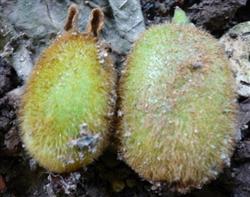 Strict fruit thinning. For kiwifruit, try to avoid using fruit-sizing hormones, and fruit thinning must be done well. In principle, keep a single fruit per inflorescence, and thin out the terminal fruit and tail fruit on the same branch. Generally, long branches keep 3 to 5 fruits, medium branches keep 2 to 3 fruits, and short branches keep 1 to 2 fruits. 15 days after pollination, spray foliar fertilizer, mainly urea and monopotassium phosphate, combined with micro-element fertilizers, etc., spraying once every 15 days for 5 consecutive sprays. After the young fruit stops growing for the first time, apply a fruit-sizing fertilizer once, mainly potassium and nitrogen fertilizers.
Branch and leaf management. Hongyang kiwifruit has thinner and larger leaves than other kiwifruit varieties, poorer stress resistance, and its shoots are slender and break easily. In strong wind weather, pay attention at all times to tying branches and training vines. If dry hot winds occur, where conditions permit, water can be sprayed on the leaves to prevent the dry hot wind from scorching the leaves.
Summer pruning. At the bud stage, first remove flowerless buds, overly dense buds, and weak buds in unsuitable positions. After pollination is finished, begin pinching. Pinching means removing the top shoot with 3 to 4 leaves from branches with 15 to 25 leaves, and removing the top shoot with 4 to 6 leaves from long branches with more than 35 leaves. After pinching, newly grown shoots should be removed promptly or pinched again. For vigorous shoots at the base of branches or in suitable positions, leave them to grow longer as appropriate, to train them into fruiting mother branches for the following year. According to the degree of vigor of the shoots, generally they should also be pinched at 80 cm in length to promote flowering.