Scientific Planting Techniques for Walnut Seedlings and Walnut Trees
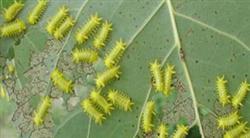
The yellow-spined slug moth mostly has 1 generation per year in the north, and 2 generations per year in the Yangtze River basin. After autumn, the mature larvae often spin silk and form hard cocoons on branch forks, twigs, leaf petioles, and even leaves to overwinter. The cocoon is oval, grayish-white, with several brown longitudinal bands, resembling a bird's egg. In early summer of the following year, the mature larvae pupate inside the cocoon, and after 1 month they emerge as adults and fly out,...
 For planting of walnut seedlings, walnut trees, grafted walnut seedlings, and grafted walnut trees, for information, consultation, inspection, and purchase, go to Chuansong Agriculture!
High-quality, high-yield, and productive cultivation techniques:
1. Land preparation: Choose open hilly and mountainous land and flat land with deep soil, a soil layer thickness of more than 100 cm, a slope of less than 25°, and a soil pH of 7-7.5 to establish the orchard. Dig planting trenches 1 m wide and 1 m deep. After the trenches are dug, apply 5000 kg of fully decomposed organic fertilizer per 667 sq m, or bury 6000 kg of straw. Mix the fertilizer thoroughly with the topsoil, then backfill the trenches from top to bottom.
2. Seedling selection: Choose 2-year-old high-quality grafted seedlings with well-healed graft unions, robust growth, complete and well-developed root systems, no pests, diseases, or mechanical damage, and a height of more than 1 m. Before planting, trim the roots, cutting off overly long roots, split roots, damaged roots, and rotten roots so that fresh cuts are exposed. Before planting, the seedlings must be soaked in water for more than 12 hours so they fully absorb water, which helps sprouting and rooting.
3. Planting time: Either spring planting or autumn planting is acceptable. For spring planting, do it from the Spring Equinox to Qingming (late March to early April). The planting depth should be based on the depth at which the seedlings were covered with soil in the nursery. For autumn planting, do it in mid-to-late October. Before the soil freezes, lay the autumn-planted trunks down and bank them with soil, with a soil thickness of no less than 20 cm from the trunk.
4. Planting density: Xiangling is a precocious walnut, generally planted at 56 trees per 667 sq m, that is, 3 m x 4 m. In the early years of the orchard (within 5 years), short-stature crops such as peanuts, beans, potatoes, shallow-rooted Chinese medicinal herbs, strawberries, or green manure can be intercropped. After 5 years, intercropping is generally not suitable. Regardless of what crop is intercropped, it must be more than 1.5 m away from the trunk.
5. Soil, fertilizer, and water management: 1) Cultivation and weeding. During the young tree stage, weeds must be removed in a timely manner to prevent them from competing with the trees for water, nutrients, and light, and this can also improve soil aeration and promote tree growth. In spring, summer, and autumn, carry out deep plowing to bury green manure or apply organic fertilizer. In spring, do this before sprouting; in summer and autumn, do it after rain, and bury the weeds into the soil while applying fertilizer. Carry out deep plowing outward year by year from the planting hole, with a suitable depth of 60-80 cm, and do not damage thick roots more than 1 cm in diameter. 2) Rational fertilization. Every autumn, combine base fertilizer application with deep turning to a depth of 30-50 cm. When applying base fertilizer, use 4000-5000 kg per 667 sq m and add a small amount of quick-acting nitrogen fertilizer and phosphate fertilizer. Apply topdressing 3 times each year: before sprouting, apply 30-40 kg of urea per 667 sq m; at the young fruit expansion stage and the hard shell stage, apply 40-50 kg of potassium sulfate or special fruit tree fertilizer respectively. To promote growth, foliar spraying should be carried out together with topdressing. The 1st spraying is in mid-to-late April after the leaves have formed, the 2nd is in mid-May, each with a 300-fold urea solution; the 3rd is with a 200-fold urea solution; the 4th is in early August with a 200-fold urea solution + a 300-fold monopotassium phosphate solution. 3) Timely watering. Generally, water 4 times a year: before sprouting, during fruit expansion, during the hard shell stage, and before freezing. Walnut is a deep-rooted tree species, drought-tolerant but not waterlogging-tolerant. In the rainy season, pay attention to timely drainage. Do not let water accumulate in the orchard for too long, otherwise it will cause root rot or tree death.
6. Flower and fruit management: 1) Thinning male flowers. Walnut produces a very large number of male flowers, and excessive male inflorescence growth consumes a large amount of tree nutrients. Therefore, 7-10 days before the male flower buds sprout, thin the flowers and remove 90%-95% of the male flowers, so that the ratio of male flowers to female flowers is 1:25 to 1:40. This can save a large amount of nutrients and water for female flower development and fruit growth, thereby achieving the goal of increasing yield. 2) Artificial supplementary pollination: Collect male inflorescences that are about to shed pollen and place them in a dry room to dry in the shade. At 20-25°C, they will shed pollen after 24-48 hours. Then collect the pollen for later use. When the stigma of the female flower splits and takes an inverted figure-eight shape, the stigma protrudes, secretes a large amount of mucus, and has a certain luster, this is the best pollination period. Mix pollen with flour at a ratio of 1:10, then pollinate with a sprayer, or prepare a 5000-fold solution and spray it. Pollination is best on a sunny day with no dew, generally from 9-11 a.m. and 3-5 p.m. Note that the amount of pollination must not be too large, because walnut female flowers are sensitive to large amounts of pollen.
7. Training and pruning: Since walnut enters the bleeding period as soon as it loses its leaves, pruning should be carried out after walnut harvest and before leaf fall begins. Xiangling belongs to the precocious walnut type, with strong branching ability, early fruiting, and easy production of secondary shoots, which causes the tree shape to become disordered. The open-center layered shape and natural open-center shape are often used. When pruning, in addition to paying attention to cultivating the main and lateral branches well, secondary shoots and water sprouts should also be controlled in a timely manner, overly dense branches should be removed, and downward-facing branches should be handled properly. For trees in the fruiting stage, pay attention to the renewal and rejuvenation of fruiting branch groups. Use the method of removing the weak and keeping the strong, and combining thinning with heading back to renew branch groups. At the same time, remove dead branches, pest- and disease-damaged branches, overlapping branches, and thin weak branches.
8. Pest and disease control: The main pests and diseases of Xiangling walnut include anthracnose, black spot, canker, cloud-banded longhorn beetle, slug moths, and clearwing moths. They should be controlled at the appropriate time.
9. Timely harvest: When the green husk of the walnut turns from green to yellow and splits, it can be harvested. This generally begins in late September. When more than 1/3 of the nuts on the tree have opened, knock them down from the inside outward with a bamboo pole and pick them up. The method for removing the green husk is: dip the green-husked walnuts in a 2000-fold ethephon solution for 0.5 minutes, remove them, pile them into a heap 50 cm thick, cover with plastic sheeting, and after 3-5 days the husks can be removed. During this period, turn them frequently to release heat. Immediately rinse the husked walnuts with clean water. When drying, do not expose them to direct sunlight, to avoid cracked shells and deterioration of the walnut kernels. After drying, package and store them promptly.