What to Do If a Walnut Tree Does Not Bear Fruit? Causes and Solutions
Grafting Types Grafted seedlings are new-variety walnut seedlings grafted onto rootstock seedlings (seedling rootstock). There are mainly two types: tongue grafting and bud grafting. 1. Tongue grafting is divided into bark-tongue grafting and double tongue grafting; 2. Bud grafting is divided into young-bud walnut seedling grafting and square bud grafting. Square bud grafting is currently the most commonly used method in walnut seedling grafting...
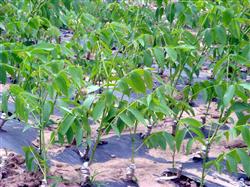 If a large walnut tree does not bear fruit, it can be solved by top grafting to change the variety, and this can produce good returns. The main techniques for high-level grafting of large walnut trees are:
Tree Age Selection
Grafting of large walnut trees generally selects 5-15 year old seedling trees that are low-trunked, small-crowned and vigorously growing. At the same time, large trees under 30 years old and young trees with a trunk diameter under 1.5 cm can also be top grafted. If the tree is weak, management should be strengthened and grafting carried out after the tree body has recovered its vigor.
Collecting and Cutting Scions
Scions should be taken from the middle or basal section of the developed branches of fruiting trees that are of excellent variety, grow vigorously and are free of pests and diseases, with a diameter of more than 1 cm, and with a small, smooth pith. The best time to collect scions is from after leaf fall to mid-February of the following year. Each scion should retain 3 plump buds and be sealed tightly with paraffin, tied in bundles of 50 or 100 by variety, buried in wet sand or wet sawdust at a thickness of 15-20 cm, and stored in a place with a temperature of about 10°C for later use.
Grafting at the Right Time The time for top grafting to change varieties of walnut should generally be when the tree buds swell or the leaves first unfold.
Bleeding Control Seven days before grafting, saw the graft points according to the subordinate relationship of the original crown, and the saw points should be 20-30 cm from the base. At the same time, at a point 20-30 cm from the ground on the trunk base, drill 2-3 holes in a spiral pattern, with a depth of one-fifth to one-seventh of the trunk diameter, to facilitate the outflow of bleeding sap. If there is too much bleeding, 1-2 more bleeding holes can be sawed at the base of the graft points.
Grafting Techniques
Bark grafting. This method is mainly used when the scion bark does not slip and the rootstock graft point diameter is 3-12 cm.
Bark-tongue grafting. This method is mainly used when the scion bark slips and the rootstock graft point diameter is 3-12 cm. When grafting, saw off the trunk layer of the rootstock, then shave off a long tongue-shaped strip of the outer bark of the rootstock, cut the scion into a 5-6 cm long tongue-shaped cut surface, and use the hand to pinch apart the bark and xylem of the tongue-shaped part, then insert the tongue-shaped part of the xylem between the bark and xylem on one side of the rootstock cross-section, so that the tongue-shaped outer bark of the scion lies on the tongue-shaped cut surface of the rootstock bark, and finally bind tightly with plastic tying strips.
Double tongue grafting. Used when the rootstock graft point diameter is under 3 cm.
Inlay-and-nail scion method. This grafting method is used when the rootstock is too thick and the phloem is too thick.
Wound Protection After the scion is fixed, the graft point should be treated to retain moisture. Generally, grafting tape, grafting wax or a plastic bag is used to cover the graft point and the entire scion. When covering, the plastic bag should extend 4-5 cm above the top of the scion, and the air should be expelled to facilitate scion sprouting and shoot growth. Wrap newspaper around the outside of the plastic bag and tie it tightly at the top and bottom to provide shade, retain moisture and keep warm, and promote wound healing.
Management After Grafting
Ventilation After grafting, when the scion begins to sprout, grow shoots and unfold leaves, observe once every 2-3 days. For those that have unfolded leaves, cut a small opening at the upper end of the plastic bag to let the tip of the tender shoot extend out. The ventilation opening at the upper end should go from small to large, and must not be opened all at once, still less should the plastic bag be removed too early.
Sucker Removal Remove the sprouting branches of the rootstock in time. If the graft point has not survived, 2-3 sprouting branches can be retained at an appropriate position for later supplementary grafting.
Breakage Prevention 25-30 days after grafting, the scions germinate one after another and grow rapidly. When the new shoots of the scion grow to about 30 cm, support stakes should be set up at the graft point in time, the new shoots should be lightly tied to the stakes, and the sprouts on the branches and trunk should be cut off at any time. As the new branches lengthen, they need to be tied 2-3 times.
Supplementary Grafting For scions that have not survived, 2-3 sprouts that occur on the rootstock stump should be selected and retained at suitable positions, and bud grafting should be carried out in July-August.
Loosening the Binding 2-3 months after grafting, the binding material at the graft point should be loosened once, but it must not be removed. After late August, it can be removed according to the situation.
Pruning Large walnut trees after top grafting tend to form clustered branches. When pruning, short cutting and thinning should be combined, the crown should be expanded as quickly as possible, and fertilizer and water management and pest and disease control should be strengthened so that they can be put into production and produce results as soon as possible.