What are the benefits of planting walnut trees in a scattered layout?
Cold-protection measures for walnut trees can be taken after leaf fall (generally from mid-November to early December). 1. Burying the tree in soil: for 1-2 year old young trees that cannot safely overwinter in the open, bend the entire tree body to one side and cover it with soil; this method is the most effective and reliable measure to prevent branch dieback. 2. Mounding soil for cold protection...
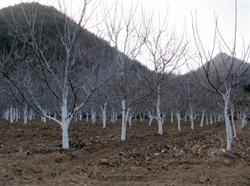 Planting walnut trees in a scattered layout has the following benefits:
Tall tree body. Walnut trees are long-lived; large trees over a hundred years old can still maintain relatively high yields. The tree body is tall, with thick branches and lush leaves. The canopy diameter of a single large walnut tree can reach more than 10 m, occupying an area of 100-200 sq m.
No competition with farmland. Planting walnut trees in a scattered layout can make full use of scattered open spaces such as field edges, land borders, ditch slopes, gaps, village sides and courtyards, without competing with farmland for land. At the same time, the environmental conditions of scattered planting are also conducive to the growth and development of walnut trees, so high yields can be obtained.
Ventilation and light penetration. Walnut trees are light-loving tree species; only under conditions of sufficient sunlight, good ventilation and a warm, cool climate can they bear large amounts of fruit and achieve high yields. If planted in a block plantation style, their canopies connect with one another, light inside the canopy is weak and ventilation is poor, the leaves inside the canopy are few, thin and small and tend to fall early, and fruiting inside the inner canopy is scarce or absent; the fruit is distributed only on the branch tips at the outer periphery of the canopy, and both the yield per plant and the yield per unit area are 20%-40% lower than under scattered planting.
Higher per-unit yield. Walnut trees planted in a scattered layout have high yield per plant and a wide suitable planting range, and the total planting area is large. When planting in a scattered layout, they can be planted on small plots unsuitable for crops, such as field edges, land borders, ditch slopes, gaps and vacant land beside villages, and can be planted by tucking them into every available space. The number of trees planted and the spacing between rows and plants are not restricted, but the spacing between two adjacent trees should be no less than 10 m.
Suppression of pests and diseases. Scattered planting has a certain inhibitory effect on the occurrence and spread of walnut pests and diseases, promoting high quality and high yield of walnuts.