Detailed Explanation of Control Methods for Walnut Bacterial Black Spot
Walnut bacterial black spot mainly damages walnut fruit, with a diseased fruit rate of 10%-40%, causing the fruit to turn black, rot, and drop early, and the walnut kernels to shrivel. In addition, it also damages leaves and tender shoots, with damage rates reaching 20%-40% in some plots. [Symptoms] On affected green young fruit, small brown oil-soaked spots initially appear on the rind...
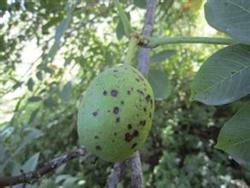
Walnut bacterial black spot mainly damages walnut fruit, with a diseased fruit rate of 10%-40%, causing the fruit to turn black, rot, and drop early, and the walnut kernels to shrivel. In addition, it also damages leaves and tender shoots, with damage rates reaching 20%-40% in some plots.
[Symptoms] On affected green young fruit, small brown oil-soaked spots initially appear on the rind, then expand into circular or irregular shapes without obvious margins, surrounded by a water-soaked halo. In severe cases, the lesions become sunken and extend into the inner pericarp (shell), and the entire rind turns black and rots, while the kernel shrivels and the fruit drops early. Leaf lesions are fewer, dark brown, nearly circular or polygonal, with a semi-transparent oil-soaked halo on the outer edge. In severe cases, the lesions merge, the leaves shrivel and scorch, and the petioles turn black and become slightly sunken.
[Control Methods] (1) Remove diseased and residual fruit, fallen leaves, and diseased and pest-infested branches to reduce sources of infection; (2) During the growing season, spray 1:0.5:200 Bordeaux mixture, or use 50% thiophanate-methyl wettable powder at 500-800 times dilution, spraying 1-3 times (once each before flowering, after flowering, and during the young fruit stage).