Detailed Explanation of Key Technical Points for Spring Management of Ma Walnut Trees
I. Planting of Ma Walnut Trees 1. The suitable time for planting is from March to mid-April, after the soil thaws and before the buds sprout. Early planting makes it easy to survive, with deep rooting. When choosing a site, the specific environmental requirements for walnut growth and development should be considered. The orchard site is best chosen on sunny flat land or gentle slopes, with sandy loam soil being ideal, and requires a soil layer of more than 1 m, with the groundwater level more than 2 m below the surface. The planting area should be leveled, aged, and measures taken to prevent alkalinity and waterlogging. For mountainous areas, fish-scale pits can be built first, then the tree discs gradually expanded. Before planting, large pits must be dug and sufficient base fertilizer applied. The correct method of digging pits is: dig pits 80-100 cm square, keep topsoil and subsoil separate, and apply one small cartload (50-100 kg) of barnyard manure organic fertilizer per tree. When backfilling the pit, first fill with topsoil mixed with base fertilizer, then fill with subsoil, tamping while filling, and water thoroughly before planting.
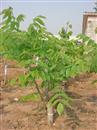
I. Planting of Ma Walnut Trees
1. The suitable time for planting is from March to mid-April, after the soil thaws and before the buds sprout. Early planting makes it easy to survive, with deep rooting. When choosing a site, the specific environmental requirements for walnut growth and development should be considered. The orchard site is best chosen on sunny flat land or gentle slopes, with sandy loam soil being ideal, and requires a soil layer of more than 1 m, with the groundwater level more than 2 m below the surface. The planting area should be leveled, aged, and measures taken to prevent alkalinity and waterlogging. For mountainous areas, fish-scale pits can be built first, then the tree discs gradually expanded. Before planting, large pits must be dug and sufficient base fertilizer applied. The correct method of digging pits is: dig pits 80-100 cm square, keep topsoil and subsoil separate, and apply one small cartload (50-100 kg) of barnyard manure organic fertilizer per tree. When backfilling the pit, first fill with topsoil mixed with base fertilizer, then fill with subsoil, tamping while filling, and water thoroughly before planting.
2. When planting finished seedlings, pure and excellent varieties should be selected. Currently, the best-performing ones are "White Lion's Head", "Nest-bottom Lion's Head", "Big Official Hat", etc. The planted seedlings should have well-developed main roots, complete lateral roots, no pests or diseases, many fibrous roots, strong branching ability, and be easy to form flower buds. If seedling trees are planted, they must be grafted in the same year, as the survival rate after grafting is high with no bleeding.
II. Grafting of Ma Walnut Trees
1. Selection of scions. Before selecting scions, a good mother tree for collecting scions should be chosen. The mother tree for collecting scions should be a robust, pest-free, excellent variety tree. The standard for qualified scion wood is 8 cm long, 1-2.5 cm thick developmental branches or pre-fruiting branches on the mother tree, with robust growth, full development, small pith, no pests or diseases, and mature plump buds. The time for collecting scions should be within 5 days before or after leaf fall, or before bud break in spring. After collection, the scions should be cut, wax-sealed, and stored in a sand pit no deeper than 60 cm.
2. Selection of rootstock. The selection of rootstock should be based on the ecological conditions of the planting area to determine the appropriate rootstock type. For example, in mountainous areas with patches of Manchurian walnut and large edible walnut trees, top grafting for variety change works well. The grafting site (rootstock stump) is mostly lateral branches or secondary lateral branches, with a cross-section of the stump under 8 cm. For trees with a trunk of more than 10 cm, it is best to choose 3-5 stumps for grafting to disperse bleeding, resulting in a relatively high survival rate. If grafting trees that remain in place, it is best to cut the roots to prevent excessive bleeding and affect the survival rate.
3. Grafting time. The grafting time of Ma walnut trees varies with the climate conditions of different regions. Each place should decide the specific grafting period based on local actual conditions. Generally, cleft grafting is carried out in March. From rootstock sprouting to leaf expansion (10 days after Qingming Festival), growth begins to accelerate, the rootstock and scion bark does not slip, and bleeding is minimal or absent, which is conducive to callus formation and survival, suitable for bark-lip grafting or bark grafting. For nursery grafting, it should be from early May to early June, with green-branch cleft grafting being appropriate.
4. Grafting methods.
Cleft grafting: Suitable for rootstocks that are older, with thicker seedling trunks (diameter over 4 cm), and for top grafting of large trees for variety change. The selected rootstock. Saw off leaving a stump 30 cm from the base, smooth the saw cut, use a knife to split vertically into the middle of the rootstock to a depth of about 5 cm. Cut a symmetrical slope on each side of the scion, 4-5 cm long, then quickly insert the cut surface of the scion into the cleft of the rootstock, so that the scion slope is exposed 3-7 cm, and the rootstock and scion cambium are closely aligned. If the scion is thinner than the rootstock, align the outer cambium layers, keep the bark on the inner side of the scion, then tie tightly with plastic strips to maintain moisture at the joint and facilitate healing. This grafting method is suitable for early grafting, when the rootstock and scion bark is not slipping.
Bark-lip grafting: This method is suitable for young trees 3-5 cm in diameter. After the bark easily slips, choose a white, smooth area, saw off, smooth the saw cut, and at the scion insertion point, cut away the old bark, 5-7 cm long, about 1 cm wide, exposing the bark layer. Cut the scion into a 6-8 cm long cut surface, with depth exceeding the pith, then make a slanting cut to ensure the entire slope goes from thick to thin. Use fingers to pinch open the bark on the back of the cut surface, separating it from the wood, then insert the xylem of the scion between the xylem and bark of the rootstock, so that the bark of the scion covers the cut surface of the rootstock bark, and finally tie the joint tightly with plastic strips. Note: do not water before grafting, or saw off the rootstock 10 days in advance to release water, to avoid excessive bleeding fluid reducing the survival rate.
Bark grafting: First saw off the rootstock, smooth the saw cut, and on a smooth part of the rootstock, make a vertical cut from top to bottom, reaching the xylem, about 2 cm long. Use the tip of the knife to pry open the bark on both sides along the cut. For the scion, first cut one side into a large cut surface, exceeding the central pith, with a slanting cut 6-8 cm long. Insert the scion between the bark and xylem of the rootstock, so that the bark layers of both connect, and wrap well with plastic strips. For the above grafting methods, to avoid excessive bleeding fluid, the trunk can be sawed to release water, or measures such as root cutting can be taken.
III. Spring Management of Fruiting Trees
1. Water and fertilizer. From March to April, Ma walnut trees begin to stir, sprouting and shooting branches. In almost one month, they need to complete the growth and development processes of sprouting, shooting branches, leaf expansion, and flowering. At this time, it is also the season of spring drought and little rain in the north, so fertilization should be combined with irrigation.
2. For trees entering the fruiting stage, before spring sprouting, some main branches and auxiliary branches can be bent and buds notched to promote flowering. The method of bud notching is to notch one bud in different directions every two buds on both sides of the branch.
IV. Prevention and Control of Pests and Diseases
1. In spring, mainly piercing-sucking pests cause damage. Before sprouting of hickory walnuts in March to April, spray 10% imidacloprid wettable powder at 2500-5000 times dilution. Scrape off the raised bark on the main trunk to expose the white-green bark, with two semicircles staggered, 5-10 cm wide, and apply 40% dimethoate emulsifiable concentrate at 5-10 times dilution.
2. Walnut rot disease has two peak periods of incidence in spring and autumn each year, with the most severe damage from mid-April to mid-May. Trees with weak vigor or severe frost damage are susceptible to this disease. It can be controlled by scraping off old bark and diseased spots and applying 100 times dilution of asomate solution.