How to control dodder (Cuscuta) on lychee and longan
Dodder has no roots and no leaves, but its stem bears serrated haustoria (or sucking roots), which it uses to penetrate deep into the bark to absorb nutrients, affecting the growth of the fruit seedlings; in severe cases it can cause the seedlings to wither and die. It is more commonly seen in mature lychee orchards in mountainous areas. Dodder can flower and set seed; the flowers are small and white, and the fruit drops to the ground on its own after ripening...
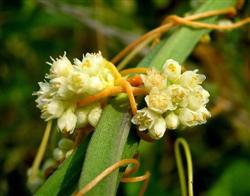
Dodder has no roots and no leaves, but its stem bears serrated haustoria (or sucking roots), which it uses to penetrate deep into the bark to absorb nutrients, affecting the growth of the fruit seedlings; in severe cases it can cause the seedlings to wither and die. It is more commonly seen in mature lychee orchards in mountainous areas
Dodder can flower and set seed; the flowers are small and white, and the fruit drops to the ground on its own after ripening. The following year the seed germinates, with one end forming a radicle that extends into the soil and the other end, the embryo tip, emerging from the soil surface to produce a thread-like young stem. The young stem grows very quickly; when it encounters a fruit seedling it twines around it, produces haustoria, and penetrates into the stem of the fruit seedling to absorb nutrients. The stem continues to produce haustoria and keeps branching, extending and causing damage. At this point the stem that extended into the soil gradually rots wet or withers and shrivels, separating from the soil.
Control methods:
(1) Once dodder is found, immediately cut it off together with the affected parts of the fruit seedling (because broken dodder stems have the ability to develop into new plants). Generally cut it off before the dodder flowers; be sure to cut thoroughly, and the cut stems should be gathered and burned.
(2) In nurseries or orchards, clear out climbing epiphytic plants such as weeds that serve as "bridge hosts". Dichlobenil at 0.5 kg per mu can also be used, or 2%-3% sodium pentachlorophenate and ammonium dinitrophenate for control.
(3) In severely affected orchards, deep plowing should be carried out every year to turn the dodder seeds that have fallen on the soil surface down to a depth of more than 3 cm, making it difficult for them to emerge and cause damage.
(4) Use biological control methods, such as spraying "Lubao No. 1" (a fungal preparation) on cloudy days after rain, using 1.5-2.5 kg per mu, which can artificially promote anthracnose in dodder and kill it. Breaking the dodder vines before spraying gives a better effect.
(5) Spraying herbicides such as glyphosate, laso, amiprophos and butralin can kill dodder; 1.5% sodium pentachlorophenate and 2% prometryn can also be sprayed. Or ammonium dinitro salt. Spray once every 25 days, 3 times in total.