Detailed Explanation of Key Points in Lychee Cultivation and Management Techniques
Lychee anthracnose is an important lychee disease. It damages young leaves, flower spikes and fruits. It causes a large number of rotten and fallen fruits during the lychee ripening period. [Symptoms] Leaf damage often starts at the leaf tip, initially producing round or irregular light brown small spots, which then rapidly expand into dark brown large spots with unclear edges. In...
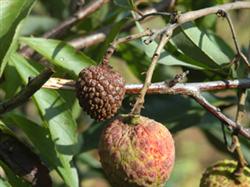 Lychee belongs to the soapberry family (Sapindaceae), genus Litchi, species lychee (Litchi chinensis). It is an evergreen tall tree with strong vigor, a tall trunk, deep roots and lush leaves. Its lifespan is very long. Due to changes in natural climate, the effects of human production and life, and the passage of time, people gradually domesticated, selected and cultivated part of the native lychees in nature into the sweet lychees widely eaten by humans today, while another part was preserved and continues to this day as sour lychees.
The main varieties of Hejiang lychee are divided into two major categories: sour lychee and sweet lychee. Sour lychee belongs to the seed type of native lychee, grown from seedlings to produce fruit, and both its tree vigor and fruit retain the characteristics of native lychee. Generally, the fruit matures and goes on the market at the end of June, more than 1 month earlier than sweet lychee. The varieties currently cultivated in our county mainly include "Hebao" lychee, "Baike", "Wupao" and others. Because sour lychee has poor quality and bears late, it is no longer suitable for production requirements and development.
Sweet lychee was introduced from Guangdong more than 500 years ago. The main varieties include Dahongpao, Feizixiao, Tadi, Dailü, Jiangshalan, Nanmuye, Guiwei, Lujiao, Nuomici, etc.; and the variety with the largest output and quantity is still "Dahongpao", accounting for 90% of the county's current 715,000 lychee trees, followed by Jiangshalan, Tadi, Feizixiao, Nanmuye, Guiwei, Nuomici, etc. According to the maturity and market period of lychee, we classify varieties whose fruit matures and goes on the market from the end of July to early August as late-maturing varieties, and those maturing in mid-to-late July as medium-maturing varieties, mainly including Dahongpao, Feizixiao, Jiangshalan, Nuomici, etc. Late-maturing varieties include Tadi, Dailü, Nanmuye and Guiwei; among the late-maturing varieties, Dailü and Tadi, and among the medium-maturing varieties, Feizixiao and Jiangshalan, all have great development potential in terms of appearance, color and internal quality.
1. Seedling planting
1. Selection of planting seedlings. First, choose large seedlings. Grafted seedlings should be required to grow vigorously, with dark green leaves, a stem diameter at the out-of-soil part of at least 1.5 cm, and a seedling height of at least 60 cm. Second, select excellent late-maturing varieties, preferably mixed planting of 2 or more varieties with relatively uniform maturity.
2. Soil selection: The planting site requires deep soil layers, fertile soil, and slightly acidic soil rich in organic matter. It is best to have convenient transportation and convenient water sources for irrigation and drainage. Purple shale soil and areas with an altitude above 600 m should not be chosen for planting.
3. Planting period and method: The best planting period is spring (early March to mid-April) or autumn (mid-September to late October). The general planting density is 18-20 plants per mu (spacing 7 x 7 m or 6 x 7 m). In the densest orchards, the number planted per mu should not exceed 40. Before planting, set out points, draw lines and dig holes: require holes 1 m deep and 1 m long and wide. Apply sufficient base fertilizer at the bottom of the hole: each hole with 100 jin of weeds, 200 jin of human and livestock manure, and 3-5 jin of superphosphate. Backfill soil and mound it into a steamed-bun shape. The seedling is planted in the middle of the hole basin about 10-20 cm above the soil surface. When planting, do not hammer or tread with feet. After planting, water thoroughly to settle the roots, with no less than 100 jin of water per plant.
2. Management after planting
After planting, fertilizer and water management and pest and disease control are required. After young seedlings are planted, the root system is injured and has not yet recovered, so fertilizer uptake is poor. Water should be irrigated in time to prevent drought. Generally, only after the seedlings survive for half a year may a small amount of diluted manure water be applied, mainly following the fertilization principle of "eat less but more often". At the same time, attention should also be paid to pest and disease control. After the seedlings survive for 2 years, the application amount of human and livestock manure and nitrogen fertilizer can be increased, generally applying four times a year. Each time, no less than 100 jin of human and livestock manure should be applied per plant. For every 100 jin of human and livestock manure, 3-4 liang of urea can be added, which helps promote the growth of branches and shoots and form a tree crown as early as possible.
3. Management of fruiting trees
1. Fertilization: After lychee enters production and fruiting, as the trunk, crown, tree age and fruit load increase, the various fertilizers applied to the soil should also be increased. The types of fertilizer should be mainly phosphorus and potassium fertilizers, supplemented by nitrogen fertilizer. It is best to use decomposed types, with weeds, human and livestock manure, and plant ash mixed with potassium sulfate or superphosphate for better results. Apply fertilizer four times a year: around the Beginning of Spring (about 10 days before), Beginning of Summer (10 days before), Beginning of Autumn (10 days before) and Beginning of Winter (10 days before), once each. Fertilization amount: generally should be determined according to the crown size of the fruiting tree and the amount of fruit set. The older the tree and the larger the crown, and the more fruit it bears, the more should be applied; otherwise, less can be applied accordingly. For 10-25 year old trees, each time apply 50-150 jin of human and livestock manure per plant, plus 2-5 jin of plant ash and 1-2 jin of phosphate fertilizer, diluted with 50-150 jin of water. For trees over 25 years old, each time apply no less than 150-250 jin of human and livestock manure per plant, plus 5-10 jin of plant ash and 3-5 jin of phosphate fertilizer, diluted with 150-500 jin of water.
Fertilization methods include ring trench application and ring pouring application. For trench application, the trench is 20-30 cm deep and 30 cm wide. For pouring application, turn the soil 10 cm deep under the drip line of the crown or 2-2.5 m from the trunk, and apply it in a 50 cm wide ring band around the crown.
2. Shoot control and pruning: (1) Shoot control: After lychee begins to enter production and fruiting, it is generally not easy to sprout shoots in summer. Shoot growth in spring and autumn is beneficial for crown expansion. Autumn shoots are the mother branches for flowering and fruiting the next year; they most easily form flower spikes. The mother branches that most easily flower and fruit are generally vigorous shoots formed from the Beginning of Autumn to End of Heat. Therefore, in shoot control work, part of the shoots sprouting in spring and the autumn shoots sprouting from the Beginning of Autumn to End of Heat should be retained, and shoots sprouting on the crown in other seasons should be removed in time.
(2) Pruning: Pruning should be carried out in summer, autumn and winter, especially autumn pruning. After fruit harvest, promptly cut off fruit stalks and dried branches damaged during harvest, dead branches, and late autumn shoots sprouting after End of Heat. Summer pruning is mainly to control excessive vegetative shoots sprouting in summer, reduce competition with fruit for nutrients, and prevent fruit drop. Winter pruning is mainly to cut off dried branches, diseased and pest-damaged branches and shaded branches, while also regulating the crown and tree shape.
(3) Pest and disease control: The common pests and diseases harming lychee mainly include gummosis and foot rot on the trunk, and downy blight harming the fruit. The main insect pests include the star longhorn beetle harming the trunk and the branch longhorn beetle harming shoots, tussock moths and leaf roller moths harming the leaf surface, and fruit borer and stink bugs harming the fruit. To control gummosis and foot rot, manually scrape off the diseased spots, then apply 800-1000 times dilution of thiophanate-methyl or carbendazim and paint the diseased part, for 2 consecutive times. To control downy blight: when the fruit is the size of a thumb or when 1/4-1/5 of the fruit surface turns red, use 1000-1500 times dilution of Ridomil or 800-1200 times dilution of Sandofan for control. To control the star longhorn beetle, use a wire to clear the insect hole, then use paper or a cotton ball dipped in undiluted dichlorvos and insert it into the hole. For branch longhorn beetles, manually cut off the damaged shoots and destroy them centrally. To control the fruit borer (also called fruit stalk borer): after flower drop and seed setting, when young fruit is the size of a "soybean", spray the crown with 1500-2000 times dilution of "Lesiben", or spray the crown with 1200-2000 times dilution of Chongmantongsha. Use the two alternately for 2-3 consecutive times, once every 5-7 days. If continuous rainy weather occurs, spray a few more times. For control of stink bugs (also called stink beetles), tussock moths, swallowtail butterflies and leaf roller moths: the young fruit stage (mid-June to early July) is when damage is most serious. In early June, insecticides such as Shachongshuang, Didiaosi, and Lesiben can be used alternately for spray control, 3-4 consecutive times, once every 7 days.
(4) Spraying method: Use a high-quality and efficient sprayer. When spraying, spray from inside to outside, from top to bottom, and also spray the ground inside the crown.