Spring management of greenhouse apricot trees to promote development
For apricot trees in a warm winter greenhouse, the fruit development period runs from mid-February to the end of April. This period is divided into three main development stages. The first stage is the first rapid growth period of the apricot tree and the new shoot growth period, lasting 28-34 days; the second stage is the pit-hardening period, lasting 8-12 days; the third stage is the second rapid growth period of the apricot fruit and the new shoot growth period, lasting...
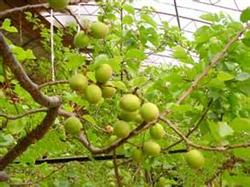
For apricot trees in a warm winter greenhouse, the fruit development period runs from mid-February to the end of April. This period is divided into three main development stages. The first stage is the first rapid growth period of the apricot tree and the new shoot growth period, lasting 28-34 days; the second stage is the pit-hardening period, lasting 8-12 days; the third stage is the second rapid growth period of the apricot fruit and the new shoot growth period, lasting 20-30 days.
Management work for the first stage: after flowering, apply 0.5 kg of nitrogen fertilizer and 1 kg of phosphate fertilizer per tree, and within two weeks after flowering spray 0.3% urea once every 7 days. After leaf expansion, spray Jing or Yashijing 3000-5000 times dilution. After flowering, promptly ring-girdle the vigorous branches of vigorous trees, 3-5 cuts per branch, with a spacing of 2-3 cm. Within two weeks after flowering, spray 3 times with fruit-setting agent, 0.1% boric acid, 25 ppm gibberellin plus 0.3% monopotassium phosphate, glucose and 300 times dilution anti-drop color-enhancing agent to increase the fruit-setting rate. Remove improperly positioned buds, and pinch the tips when new shoots grow to 25 cm, around late February to early March. Thin out small fruits at the base of fruiting branches, deformed fruits, twin fruits, and diseased or insect-damaged fruits. The maximum temperature inside the greenhouse should be 20°C-25°C, not lower than 7°C at night, with an optimum temperature of 15°C-18°C, relative humidity less than 6%, and the optimum soil temperature of 14°C-19°C. Try to increase the carbon dioxide concentration inside the greenhouse and prevent the greenhouse temperature from fluctuating sharply.
In the second stage, two key points must be handled well: 1. Fruit setting. Leave one fruit on a flower-bouquet fruiting branch, 1-2 fruits on a short fruiting branch, 2-3 fruits on a medium fruiting branch, and 4-6 fruits on a long fruiting branch. 2. Temperature and humidity control. The maximum temperature should not exceed 28°C, the daily average temperature should preferably be 18°C-22°C, and the soil temperature at a depth of 10 cm should be controlled at 20°C-24°C.
In the third stage, three points must be carried out well: 1. Fertilizer and water management. Spray 0.2%-0.3% urea plus 0.2%-0.3% monopotassium phosphate once every 7-10 days, for 2-3 consecutive sprays. 2. Summer pruning. Pinch the tips when new shoots exceed 20 cm, pull branches to open the angle when scaffold branches grow to about 50 cm, promptly thin out vigorous shoots on the upper side and densely growing branches, open up the light path, and carry out ring-girdling and shoot-twisting treatment on some new shoots to promote flower bud differentiation and fruit coloring. 3. Environmental regulation. Keep the daytime temperature at 26°C-28°C, not exceeding 30°C, and the nighttime temperature at 10°C-25°C, so as to increase the day-night temperature difference, with humidity at 50%--60%. Supplement carbon dioxide as much as possible, and pay attention to supplemental lighting. Under the premise of not exceeding the maximum temperature, raise the greenhouse temperature as much as possible.