A Detailed Explanation of the Growth and Fruiting Habits of Kernel Apricot and the Key Points of Pruning Techniques
I. Growth and fruiting habits of kernel apricot: 1. Weak branching ability: After planting, kernel apricot produces a few long branches, and once these long branches enter the fruiting stage, they rarely branch, often showing insufficient branch quantity under natural growth. 2. High germination rate: Whether the long branches of kernel apricot are left unpruned or cut back, the vast majority of buds can germinate, ...
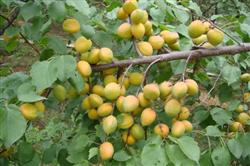
I. Growth and fruiting habits of kernel apricot:
1. Weak branching ability: After planting, kernel apricot produces a few long branches, and once these long branches enter the fruiting stage, they rarely branch, often showing insufficient branch quantity under natural growth.
2. High germination rate: Whether the long branches of kernel apricot are left unpruned or cut back, the vast majority of buds can germinate, with only a few buds at the base becoming latent buds. Long branches left unpruned easily form flower-bearing branch chains, and these flower-bearing branch chains bear fruit for consecutive years and extend outward, maintaining a balanced growth state.
3. Fruiting is mainly borne on flower-bouquet spurs and short fruit branches.
4. Fruit branches have a short lifespan and die easily, and the fruiting position readily shifts outward, causing fruiting to become superficial. Moreover, the flower buds of kernel apricot are pure flower buds, and after fruiting the bud position dies, making it impossible to renew by cutting back.
5. Strong trunk dominance, prone to the phenomenon of strong upper part and weak lower part.
6. Buds have precocity and can germinate multiple times within the annual growth cycle, readily producing secondary and tertiary branches; if not properly controlled, this easily leads to deterioration of light conditions.
7. The response of the bud at the pruning cut to sprouting long branches is irregular, and competitive branches easily appear.
II. Key points of training and pruning:
1. Training: Under natural growth, kernel apricot is mostly round-headed in form. In cultivation, the free spindle form should be mainly adopted, which helps overcome the deficiencies of a strong central leader and strong upper part with weak lower part, and maintains balanced growth and fruiting of the tree. When using the free spindle form for training, the trunk is generally headed at a height of 80-90 cm, with 12-15 main branches retained on the whole tree. No lateral branches are retained on the main branches; the main branches are evenly distributed on the trunk, with a spacing of about 20 cm between main branches.
A small-crown delayed open-center form may also be adopted, but during training it is necessary to prevent the occurrence of strong upper part and weak lower part.
2. Pruning:
Key points of pruning during the young tree stage:
(1) Make full use of bud precocity and use secondary branches to accelerate canopy formation. Kernel apricot grows vigorously during the young tree stage, and buds on new shoots can germinate in the same year, forming secondary and tertiary branches. When pruning, in addition to cutting back the extension leaders of scaffold branches, select thick and strong secondary branches in the middle and upper parts of the shoot and cut them back to increase branching, accelerate canopy formation, increase coverage, improve light energy utilization, increase accumulation of photosynthetic products, and facilitate early fruiting.
(2) Leave long branches unpruned to promote flower bud formation. After long branches of kernel apricot are left unpruned, they readily form short fruit branches of balanced vigor and form flower-bearing branch chains. Kernel apricot fruits mainly on short fruit branches, and flower-bearing branch chains are the main fruiting sites. Therefore, long branches not used for training should mostly be left unpruned, with less stimulation by cutting back, so as to promote flower bud formation and promote early production and an increase in early yield of kernel apricot.
(3) Pay attention to cultivating branch groups. When cultivating fruiting branch groups, the size of the space should be used as the basis, and corresponding branch groups should be cultivated according to the size of the space. Branch groups can be promoted by leaving long and vigorous branches unpruned, or thin and weak branches can be cut back to promote branch group formation.
(4) Control competitive branches to prevent disruption of tree form. During the young tree stage of kernel apricot, attention should be paid to controlling competitive branches. This can be controlled by combining bud removal during the growing season with branch thinning during winter pruning. Where there is space, competitive branches can be transformed into fruiting branch groups by twisting shoots and bending branches to change their direction.
Key points of pruning for trees in full fruiting stage
(1) Strengthen renewal of fruiting branch groups to maintain vigorous fruiting capacity. Each year, promote new branches amounting to 1/3 of the total branch quantity. Aged branches that have fruited for many years can be thinned out, maintaining fruiting on vigorous branches to keep yield stable.
(2) Strengthen renewal of flower-bearing branch chains. Although the flower-bearing branch chains of kernel apricot can bear fruit for many consecutive years, once the fruiting years become too long, the short branches weaken and the number of fruits decreases, which is unfavorable for improving quality. Therefore, after flower-bearing branch chains have fruited for 5 years, they should be cut back or thinned out in a timely manner to promote the formation of new fruiting units and improve fruiting capacity. When cutting back flower-bearing branch chains of kernel apricot, it is best to cut back to a rear branching point or to a latent bud at the base, so as to promote the formation of new branches.
(3) Strengthen the transformation and utilization of water sprouts. In the later growth stage of kernel apricot, dead branches increase, and water sprouts appearing in the inner canopy should be fully utilized. They can be changed into flower-bearing branch chains by methods such as leaving them unpruned and bending branches, promoting fruiting, prolonging the fruiting years of the tree, and improving overall production efficiency.