How to increase the fruit set rate of apricot trees? Master these technical measures
1. Choose superior varieties. Choosing varieties with a high percentage of perfect flowers, strong self-fruitfulness, frost resistance, a later blooming period, and early bearing and high yield as the main planted varieties is the key to increasing the fruit set rate. For example, Jintaiyang, Kate apricot, etc. In addition, varieties with early, mid, and late ripening can also be chosen in combination to reduce losses caused by early spring frost...
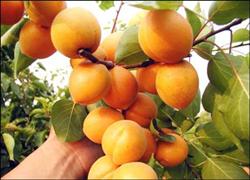
I. Choose superior varieties. Choosing varieties with a high percentage of perfect flowers, strong self-fruitfulness, frost resistance, a later blooming period, and early bearing and high yield as the main planted varieties is the key to increasing the fruit set rate. For example, Jintaiyang, Kate apricot, etc. In addition, varieties with early, mid, and late ripening can also be chosen in combination to reduce losses caused by early spring frost.
II. Arrange pollinizer trees. Varieties should not be too uniform. Some varieties are self-unfruitful and need 2-3 varieties arranged for pollination. The arrangement ratio of pollinizer trees to the main planted variety should preferably be 1:3-4.
III. Strengthen soil, fertilizer, and water management, enhance tree vigor, increase nutrient accumulation in the tree, and improve flower bud quality. These are effective measures to reduce flower organ abortion, increase the fruit set rate, and increase yield.
Base fertilizer is best applied in autumn, generally in September-October, applied as early as possible in combination with expanded holes and deep turning. During the young tree stage, the whole orchard should be deep turned once over a 3-4 year period. When deep turning, minimize root damage, especially to the skeletal roots. Base fertilizer is mainly barnyard manure, compost, and human excrement and urine. The application rate should be flexibly controlled according to tree age, tree vigor, fruit load, and fertilizer type.
On the basis of applying base fertilizer in autumn, timely topdressing is also needed: (1) Before bud break (late March to early April), apply 15 kg/mu of urea + 450 kg/mu of N, P, K compound fertilizer, by hole application or furrow application; (2) In mid-to-late May, during the rapid shoot growth stage and flower bud differentiation stage, this is the critical fertilizer demand period for apricot trees. For fruiting trees, apply 100-1205 kg/mu of urea as topdressing, by ring broadcasting or furrow application; (3) After fruit harvest, apply compound fertilizer mainly based on nitrogen fertilizer as topdressing. For fruiting trees, apply 0.5 kg/plant of N, P, K compound fertilizer.
To timely replenish nutrient consumption in the tree, foliar topdressing is needed for apricot. (1) Before flowering, spray branches with 0.5-1% urea solution. (2) At full bloom, spray 0.3% borax + 0.3% urea solution to increase the fruit set rate. (3) After petal fall, spray 0.3% urea + 0.3% potassium dihydrogen phosphate solution. (4) 40 days after petal fall, spray 10×10-4 B9, which can increase the proportion of first-class flowers and the fruit set rate. (5) Half a month before fruit ripening, spray 0.3-0.4% potassium dihydrogen phosphate to promote fruit coloring.
4. Place bees in the orchard during the flowering period and use artificial supplementary pollination. Apricot trees are entomophilous flowers, and honeybees and other insects can help with pollination. Placing bees in the apricot orchard can significantly increase the fruit set rate. Because the apricot flowering period is short, if adverse weather such as low temperature, cloudy days, rainfall, or strong wind occurs, insect activity is hindered, which affects pollination, so artificial pollination is needed for apricot trees. Artificial pollination uses pollen from wild apricot (large pollen quantity and strong pollen viability). After mixing pollen and starch at 1:2, use a writing brush or the rubber tip of a pencil to dip the pollen and dot it onto the stigma of the flowers.
5. Delay flowering and avoid frost. Because the apricot flowering period is susceptible to late frost damage, the fruit set rate is low. For this reason, we adopt: (1) Whitewash the trunk and spray 8% limewater within the canopy, or irrigate multiple times in early spring to lower soil temperature, delay germination, and irrigate heavily before full bloom to delay the flowering period. (2) Before frost arrives at full bloom, spray 350 times frost-prevention fruit-setting agent or spray water at flowering (water freezing releases heat), or use the smoke method to prevent frost. When frost weather is forecast, light smoldering piles at 2 a.m. so that the temperature in the apricot orchard does not drop below zero. (3) Heavy pruning. Some varieties (such as Honghebao) can be heavily pruned in summer to promote secondary shoots. After secondary shoots grow to 30 cm and are pinched, tertiary shoots, or even quaternary shoots, can be promoted. In this way, the flowering period of primary, secondary, tertiary, and quaternary shoots is extended by 5-7 days. Even if the first batch of fruit is frozen, the flowers on the secondary, tertiary, and quaternary shoots can avoid the late frost, greatly increasing the fruit set rate.
6. Girdling young trees. The suitable time for girdling is mid-May. The width of the trunk girdling cut should be 1/25-1/30 of the trunk diameter. Apply 25% carbendazim 100-fold solution to the wound for disinfection, and wrap it with plastic film (which can effectively reduce gummosis and promote wound healing). One week after girdling, begin spraying 0.3% urea solution 2 times, once a week, then spray 0.3% potassium dihydrogen phosphate solution 2 times, with an interval of one week between each spraying. Through girdling, young trees can effectively increase the flower quantity and fruit set rate the following year.