Winter Pruning Methods and Technical Key Points for Apricot Trees
Spring Management of Apricot Trees As the saying goes, "apricot trees fail nine years out of ten." Besides the low fruit-setting rate, the main reason is that apricot trees' ability to withstand low temperatures during bud break and blooming is greatly reduced. When temperatures fall below -3.9 at the bud stage, below -2.2 at the blooming stage, or below -0.6 at the young fruit stage, and the low temperature lasts more than 30 minutes, frost damage is likely to occur. Therefore...
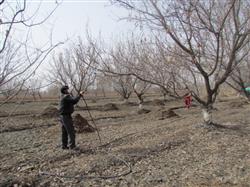 Apricot trees have the growth characteristic of secondary and tertiary branching. If left to grow freely, they will produce many useless branches, causing the canopy to become dense and reducing internal light penetration. This not only wastes tree nutrients but also causes a large number of flowers to develop poorly, seriously affecting apricot yield and quality. Winter pruning of apricot trees can concentrate tree nutrients, balance tree vigor, and increase yield.
I. Tree Shape
The tree shape commonly used in production at present is mainly the open-center layered main-branch form. The tree structure has no central leader, with 4-6 main branches. The main branches are headed back 3 times using back branches to increase the branch opening angle, so that the main branches grow slightly obliquely upward. Each main branch bears 5-6 lateral branches or large fruiting branch groups, divided into 2-3 layers, extending horizontally and obliquely outward. The canopy shape is large at the bottom and small at the top, with branch distribution sparse at the top and dense at the bottom, sparse on the outside and dense on the inside, and sparse large branches with dense small branches. The tree shape is characterized by thick and strong scaffold branches and vigorous growth.
II. Winter Pruning
(1) Young Trees and Trees in the Initial Fruiting Stage Young apricot trees and trees in the initial fruiting stage generally grow vigorously, with rapid canopy expansion, large new shoot growth, and often produce secondary and tertiary branches. Pruning at this stage should balance shaping and fruiting. The extension branches of main and lateral branches should be lightly pruned and left long, generally retaining 2/3 of the total branch length for heading back. Remove crowded branches, crossing branches, overlapping branches, and vigorous branches that disrupt the tree shape, and control competitive branches and upright vigorous branches. Apricot trees are light-loving; during the shaping stage, attention should be paid to thinning out dense upper branches and shoot tips to allow ventilation and light penetration in the inner canopy. For moderately growing, well-angled vegetative branches, leave them unpruned to encourage the emergence of medium and short branches, increasing the number of fruiting branches; after flower formation or fruiting, promptly cut back to cultivate fruiting branch groups. Medium and short branches with wide angles form flowers easily and should be retained as much as possible to promote early fruiting and high yield. For weaker young trees, it is advisable to retain more branches, make more heading cuts, thin out overly dense and weak branches, retain more healthy branches, and bend upright vigorous branches flat as auxiliary nurturing branches to promote medium and short fruiting branches.
(2) Trees in Full Fruiting Stage The shaping task for apricot trees in the full fruiting stage is basically complete. As tree age increases, yield rises and gradually stabilizes, growth vigor weakens, and tree vigor gradually moderates. The main task of pruning at this stage is to balance the relationship between rapid growth and fruiting, maintain tree vigor, and extend the fruiting years of the full fruiting stage. Pruning should be based on branch growth vigor and spatial conditions in various parts of the canopy, with appropriate thinning and weak-branch cutting to maintain stable fruiting positions and growth vigor. For extension branches at all levels, generally use medium heading back (cutting off 1/3 to 2/3 of the current year's growth) to encourage continued emergence of healthy new shoots. For weakened main branches, lateral branches, perennial auxiliary nurturing branches, fruiting branch groups, and drooping branches, cut back for renewal or raise the angle at positions with strong branches to restore growth vigor. For the lower part and inner canopy of the tree, during pruning ensure that the extension heads of lateral branches, secondary lateral branches, and branch groups are staggered in length to make full use of front and back spaces. For downward-slanting branches on the lower side of branches, appropriately head back to keep them healthy and gradually cultivate them into branch groups. For skirt branches below the canopy, cut back and raise the angle. For upward-growing branches on the lower side of branches, try to remove upright ones and keep slanting ones, change their direction; selected upward branch groups should be strong, kept short, and not excessive, with the principle of not affecting light penetration. For downward-growing branches, if there is space, remove weak ones and keep strong ones; if there is no space, thin them out. For medium and short branches in the middle and lower parts of the canopy, since they have many complete flowers and strong fruit-setting ability, appropriately retain more and pay attention to timely renewal and rejuvenation. Cut back or thin out overly dense and vigorous branches in the upper and outer parts of the canopy to improve inner canopy light. Where there is space, bend vigorous branches, upright branches, and auxiliary nurturing branches to transform them into moderate fruiting branches, increasing fruiting positions. Apricot trees have weak branching ability; as long as they are not overly dense, generally do not thin them out. You can head back to promote a small number of long branches and encourage medium and short branches in the middle and lower parts to bear fruit alternately.
(3) Senescent Trees In senescent apricot trees, extension branches become weak, new shoots are short, scaffold branches begin to droop, the inner canopy begins to become bare, and fruit is almost only produced on the outer surface of the canopy, with reduced yield and quality. The main task of pruning at this stage is to renew scaffold branches and branch groups, strengthen and restore tree vigor, and extend the economically productive fruiting years. Use upward-growing branches with small angles and healthy growth in the middle and lower parts for heading to renew the leader, or cut back on relatively upright branch sections to promote latent bud sprouting and renewal. For water sprouts in appropriate positions, use branch bending, heading back, summer pinching, and other methods to cultivate them into scaffold branches and fruiting branch groups. For fruiting branch groups and fruiting branches, following the principle of "remove weak and keep strong," select and retain strong branches and strong buds for renewal pruning. For trees with extremely weak vigor where renewal is difficult to achieve, on the premise of strengthening fertilizer and water management, carry out a whole-tree major renewal of main and lateral branches and large branch groups at the 10-15 year old positions, completed in one operation; a large number of new shoots can sprout in that same year. Through summer bud removal, pinching, and winter shaping and pruning, flowers and fruit can be produced in the second year, and a certain yield can be restored in the third year.