Detailed Explanation of Key Management Techniques for Chestnut Trees After Fruit Harvest
(1) Disease Control 1. Dieback Disease Dieback disease, also known as chestnut blight, chestnut trunk blight, or chestnut bark rot, is a fungal disease. The pathogen mostly invades through wounds, mainly damaging the trunk and branches. It is not easy to detect in the early stages. When lightly scraping the bark with a small knife, small reddish-brown spots can be seen. After the spots merge into patches, the bark surface becomes raised...
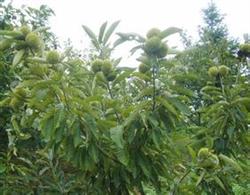 Early to mid-September to early October is the initial stage of flower bud differentiation, during which chestnut trees form the following year's yield. The quality of post-harvest management directly affects the following year's yield, so doing a good job of the four steps -- "eating well, drinking enough, dressing warmly, and staying healthy" -- is particularly important.
1. Reasonable Fertilization: Providing Enough to "Eat." Generally, every 100 kg of chestnuts developing to maturity requires the consumption of 4.5-5 kg each of pure nitrogen and potassium, and 1.5-2 kg of phosphorus. After harvest, fertilizer should be applied promptly as a supplement, with organic fertilizer as the main type. Generally, for 8-10 year old trees, apply 50-60 kg of barnyard manure, 0.5 kg of urea, and 1 kg of phosphate fertilizer per tree in furrows; for trees over 10 years old, increase the fertilizer amount according to the yield.
2. Irrigation and Drought Relief: Providing Enough to "Drink." After fruit harvest, the tree body loses a great deal of water. In addition, autumn and winter droughts are generally severe during the farming season, making chestnut trees prone to drought stress. Therefore, after harvest, chestnut orchards with irrigation conditions should promptly apply one thorough watering. If drought occurs afterward, timely irrigation is still needed.
3. Mounding Soil Around the Base: Providing Enough to "Wear." In mid to late November, depending on the size of each tree, use 2-4 carrying poles of decomposed garbage and pond mud, spread flat under the canopy with the trunk as the center, and then cover with a layer of fine soil. When temperatures rise the following spring, dig it open again to facilitate aeration and root growth, while also reducing weed growth.
4. Pest and Disease Prevention: Carrying Out "Health Care." After harvest, promptly clean the orchard, prune dead branches and pest- and disease-infested branches, remove fallen pest- and disease-infested branches and leaves from the ground, and burn or deeply bury them in a centralized manner. In autumn, pests and diseases of chestnut trees should be controlled with timely pesticide application. Pesticides can include double-strength Bordeaux mixture, 40% omethoate emulsifiable concentrate at 1500-2000 times dilution, 2.5% deltamethrin emulsifiable oil at 8000 times dilution, etc.