Technical points for supplementary application of micronutrient fertilizers after chestnut harvest
The main cause of low yields and high rates of empty burrs in chestnut orchards is the failure to apply or spray boron micronutrient fertilizer during management. When the soil available boron content is lower than 0.5 parts per million, it affects the normal fertilization process of chestnut, causing early embryo development to stall, thereby forming empty burrs. In production, one can seize the period after harvest...
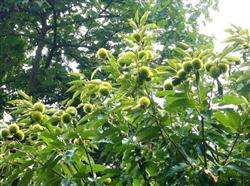
The main cause of low yields and high rates of empty burrs in chestnut orchards is the failure to apply or spray boron micronutrient fertilizer during management. When the soil available boron content is lower than 0.5 parts per million, it affects the normal fertilization process of chestnut, causing early embryo development to stall, thereby forming empty burrs.
In production, one can seize the favorable period from after fruit harvest to before leaf fall to increase spraying and supplementary application of boron micronutrient fertilizer, which can promote flower bud differentiation of chestnut trees, improve flower quality, and lay a solid foundation for large, heavy chestnut burrs the following year. Generally, the following two methods are used:
1. Foliar spraying. As a supplementary new measure to soil fertilization, it has the advantages of simple method, small fertilizer amount, quick effect, high utilization rate, and not being affected by nutrient redistribution in the tree. A mixture of 0.2% borax plus 0.2% zinc sulfate is often used for foliar spraying. The time should be chosen in the morning when dew has not dried or in the evening, and it is best to do it in moist and windless weather.
2. Root-zone broadcasting. After fruit harvest, at the drip line of the tree canopy, that is, the area where fibrous roots are most distributed, dig a trench one circle long, 0.4 m wide, and 0.6 m deep, apply boron micronutrient fertilizer, apply organic fertilizer together, and then cover with soil. The amount of boron applied is calculated according to the size of the tree canopy, with 10-20 grams of boron micronutrient fertilizer per sq m. For large fruiting trees, generally 100 grams of boron micronutrient fertilizer can be applied. A single soil application of boron micronutrient fertilizer has a special effect and shows obvious results within 5 years, and can change trees with an empty burr rate of about 50% so that the chestnuts become fully plump, improving economic benefits.