How to Grow Chestnuts for High Yield? A Comprehensive Guide to Cultivation Techniques
I. Close Planting. Reasonable close planting not only increases early yields and delivers economic returns as quickly as possible, but also facilitates intensive management of the orchard. Planting density: the spacing between plants and rows is generally 2m x 4m, 3m x 4m or 3m x 5m; the specific density should be determined by the characteristics of the rootstock, the characteristics of the scion, or the site conditions. The investment in establishing the orchard can be recovered within 6 years after planting...
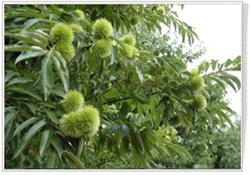
I. Close Planting
Reasonable close planting not only increases early yields and delivers economic returns as quickly as possible, but also facilitates intensive management of the orchard. Planting density: the spacing between plants and rows is generally 2m x 4m, 3m x 4m or 3m x 5m; the specific density should be determined by the characteristics of the rootstock, the characteristics of the scion, or the site conditions. The investment in establishing the orchard can be recovered within 6 years after planting. On hillsides, fish-scale pits or horizontal trenches can be dug along the contour lines as planting holes (trenches); on flat land, planting trenches are dug according to the row spacing, 1m deep and 1m wide, with the bottom filled with a mixture of topsoil and organic fertilizer, filling to about 70-80% full, leaving the remaining space to collect rain and snow; after weathering and decomposition, plant the grown seedlings in spring.
II. Soil, Fertilizer and Water Management
The chestnut (Castanea mollissima) is a deep-rooted plant with strong drought and poor-soil tolerance. Generally, water is applied only once at planting, filling the planting hole thoroughly; after the tree has established, no further watering is needed. On the basis of applying base fertilizer in autumn each year, chestnut trees are given 2-3 supplementary fertilizer applications during the growing season. The amount of autumn base fertilizer is 100 kg of organic fertilizer per tree, plus a small amount of chemical fertilizer. It can be broadcast over the whole orchard in combination with deep plowing (when fertilizer is plentiful), or applied in ring-shaped trenches or radially. Supplementary fertilizer can be applied before bud break, at flowering, and during the period of rapid fruit growth. It can be applied in trenches or holes, using 0.5-0.6 kg of urea or compound fertilizer per tree, or sprayed on the leaves as a 0.3% urea solution; at flowering, combined with a 0.1%-0.2% boron fertilizer solution, it can increase the fruit-setting rate by 8%-10%.
III. Training and Pruning
For young trees, the main goal is to develop the tree form. Follow the principle of "prefer light pruning over heavy pruning, thin out sparingly and do not cut back, with winter pruning as a supplement," to speed up the expansion of the canopy, increase the number of effective branches, and achieve early fruiting and early high yield. Generally, thin out overly dense branches in the inner canopy, water sprouts, and weak slender branches, while retaining strong branches to develop into scaffold branches, branch groups or fruiting mother branches, and adjust the angle and proportion of each type of branch above. Individual overly long shoots should also be appropriately cut back to facilitate shaping and encourage effective branching. The extension branches of the scaffold branches can be left unpruned for one year and cut back in the second year.
After entering the fruiting stage, the main focus should be on maintaining a vigorous tree condition and extending the number of years of the fruiting period (especially the full-bearing period), concentrating effective nutrients, maintaining a vigorous tree condition, and taking care to retain strong branches in the inner canopy and train them into fruiting mother branches, so as to achieve three-dimensional fruiting throughout the canopy and the goal of high and stable yields.
For excessively vigorous fruiting trees, more branches should be retained and fewer cut back, to disperse the tree's nutrients and moderate the growth vigor. Strong fruiting mother branches should be pruned lightly as appropriate, with less heading back and more leaving unpruned; each 2-year-old branch can retain 3-5 branches. Medium-vigor fruiting mother branches that produce fruiting shoots and bear fruit in the current year do not readily form new fruiting mother branches, so they should be appropriately thinned. For fruiting mother branches with very poor fruit-setting ability that have already shown signs of aging, they should be thinned or cut back in a timely manner to encourage new shoots and train them into fruiting mother branches. As for the treatment of fruiting branches, before the canopies close, about 13-15 fruiting branches can be retained per square meter of canopy projection area; after the canopies close, about 9-12 fruiting branches can be retained, with a branch spacing of about 30cm-40cm.
IV. Pest and Disease Control
1. Plowing the soil in early spring can eliminate many kinds of overwintering larvae in the soil, such as the chestnut weevil (Curculio dentipes) and the twig-pruning weevil.
2. Chemical control combined with scraping tree bark: applying a dichlorvos-kerosene solution (1-1.5 kg of kerosene plus 50 g of 80% dichlorvos), or a 10-fold dilution of 40% dimethoate emulsion, or a 20-fold dilution of 50% monocrotophos emulsion to the trunk, can eliminate overwintering pests on the trunk, such as the chestnut clearwing moth (Synanthedon castaneae) and the chestnut spider mite; wrapping the trunk with plastic film after application gives better results.
3. From late April to early May, promptly prune off the galls on the shoots, twigs and leaves and destroy them in a centralized manner; this can reduce the population density of the chestnut gall wasp (Dryocosmus kuriphilus) and effectively control its damage.
4. From late May to September, depending on the occurrence of pests, a 6000-fold dilution of 2.5% deltamethrin, or a 1000-2000-fold dilution of 75% phoxim, a 800-1000-fold dilution of 90% trichlorfon, or a 3000-fold dilution of 50% monocrotophos can be sprayed on the canopy 2-4 times, which can eliminate large numbers of adult pests of various kinds.