Detailed Explanation of Key Techniques for High-Yield Chestnut Planting
To achieve a high chestnut yield the following year, it is essential to break the practice of only harvesting chestnuts without any management, otherwise the yield and quality of chestnuts in the following year will be affected. Especially for chestnut trees in full bearing period, post-harvest management must be done well, with focus on the following four points. 1. Winter pruning: the winter pruning date for chestnut trees should be arranged in mid-December...
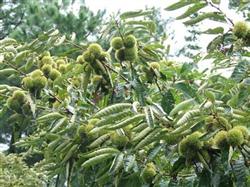 I. Fertilization In spring, before flowering, apply 300-400 g of urea and 200-300 g of ordinary calcium superphosphate per tree, and broadcast 6-7 g of borax per sq m of ground. In July, during the fruit burr enlargement stage, apply 0.7-1 kg of fruit-strengthening fertilizer and NPK compound fertilizer per tree. From June to October, drench the tree disc with a solution of 5 g borax and 5 g paclobutrazol per sq m. Apply once every 30 days, 3-4 times in total. After harvest, apply a heavy overwintering fertilizer: 40-50 kg of pig or cattle manure or farmyard manure per tree, plus 0.7-1.5 kg of calcium-magnesium phosphate fertilizer. In addition, during the flowering period, spray once every 10 days with a mixture of 0.2% borax solution, 0.3% urea and 0.2% monopotassium phosphate, spraying twice consecutively to improve fruit set. During the fruit growth period, spray once every 20 days with a mixture of 0.3% urea, 0.2% monopotassium phosphate and 800-fold mancozeb to promote the growth and development of branches, leaves and fruits. After harvest, spray once with 10 PPm2,4-D solution to promote flower bud differentiation and nutrient accumulation.
II. Pruning Chestnut trees are light-loving. Promptly thin out excessively vigorous extension shoots and dense, weak, slender branches to ensure ventilation and light penetration in the canopy. In spring, do a good job of shoot control and shoot removal to promote secondary shoots. Remove overly dense and weak male inflorescences as early as possible. Fruit-bearing branches with female flowers can be headed back or pinched at 3-4 nodes above the female inflorescence. For vigorous chestnut trees that have not flowered for years or produce only male flowers, wire girdling of the main branches with 1-2 loops can be used, or spiral scoring can be adopted to promote flower quantity and female flower formation. Wire girdling is carried out in August-September and removed before bud break the following year. Scoring or notching is carried out in September-October and must not damage the xylem.
III. Fruit Retention Chestnut is a fruit tree that is pollinated by cross-pollination on the same plant, so more than two pollinator cultivars should be planted in the orchard to facilitate pollination. When only a single cultivar is available, artificial pollination can be used to retain fruit. During full bloom, collect male flowers before 10 a.m. or after 3 p.m. on rainless days for artificial pollination. When there are many trees or the trees are tall, a gauze bag mixed with 3-4 times its volume of starch can be shaken within the canopy for pollination, once every 3-4 days, twice consecutively. When chestnut fruit set is heavy, thin the fruit promptly, keeping the leaf-to-fruit ratio at 20:1 to 25:1. On medium and short fruit-bearing branches, 1-2 fruit burrs can be retained; on flowering and fruiting branches, 2-3 fruit burrs can be retained. Keep the middle fruits on vigorous branches and the terminal fruits on short fruit branches. Thin out small, deformed, overly dense, pest-damaged and empty burrs.