Detailed Explanation of Key Points for Pollution-Free Chestnut Cultivation Techniques
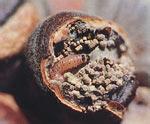
The larvae of the peach fruit borer in chestnuts bore into the nuts, filling the kernels with frass and making them unfit to eat, and also causing fruit drop, greatly affecting both yield and quality. Its hosts also include peach, plum, pear, sunflower, corn stalks, and others. Control methods: 1. Pick up fallen fruit, remove infested fruit, and destroy them. 2. Chemical control. Master the...
 1 Planting
Use grafted seedlings of superior varieties, with a spacing of 2 m x 3 m. Dig planting holes 1 m long, 1 m wide and 1 m deep. Before planting, soak the seedlings in 500-times Ougan water for 10-20 h. There are 2 planting methods:
1) Fill a discarded wine bottle or tin can with water, insert one lateral root (about 0.3 cm) of the seedling into the bottle, bury the seedling and bottle together in the planting hole, and water thoroughly. After the water seeps down, shape the tree basin into a funnel shape with a diameter of 1 m and 10-15 cm below ground level, low in the middle and high around the edges, then cover with plastic film to prevent water evaporation.
2) In spring, first plant the seedlings in nutrient bags in the yard for centralized management, to prevent spring drought and damage from early-spring underground pests, and after the rainy season arrives, transplant them with the bags to the orchard.
2 Fertilizer and Water Management
In orchards with irrigation conditions, before bud break apply 50 kg of ammonium bicarbonate and 0.5 kg of borax per 667 sq m; in the rainy season apply 50 kg of Sakefu three-element compound fertilizer per 667 sq m; in autumn apply 4000 kg of farmyard manure per 667 sq m. In orchards without irrigation conditions, focus on fertilizing in the rainy season, applying 100 kg of chestnut-specific fertilizer per 667 sq m, or 50 kg of Sakefu plus 50 kg of ammonium bicarbonate plus 0.5 kg of borax.
3 Training and Pruning
Chestnut is a light-loving tree species, and using an open-center tree shape helps achieve high, stable yields and good quality. For young trees and vigorously growing trees after grafting, use spring bud notching and branch bending techniques to ensure a good yield in the same year. For mature large trees, adopt fine pruning techniques that leave 8 fruiting mother branches per square meter of canopy.
4 Male Flower Thinning
There are two types: manual male flower thinning and chemical male flower thinning. For young trees, manual male flower thinning is done in late May, when the female inflorescences at the top of the branches have already appeared; manually remove 95% of the male inflorescences, keeping a small number of male inflorescences on the branches at the top of the canopy, which can increase yield by more than 40%. Chemical male flower thinning is carried out in mid-May, when the mixed inflorescences extend 1-2 cm; spray the tree with a 300-times aqueous solution of male flower thinning alcohol, and after 7-10 d, 60%-70% of the male inflorescences drop off, which can increase yield by more than 30%.
5 Control of Major Pests
5.1 Spider Mites
In winter, scrape off the coarse bark on the trunk and main branches and burn it centrally, and before bud break spray 5-degree lime sulfur mixture. Plant repellent crops for spider mites (gramineous crops) under the trees to reduce pest sources. In early to mid-May, spray 2000-times abamectin or 1000-times azadirachtin.
5.2 Peach Fruit Borer
Planting sunflowers around densely planted young chestnut orchards and under large trees, and in autumn removing and burning the sunflower heads and stalks from the chestnut orchard, is an effective method for controlling the peach fruit borer. In mid-July and early August, during the period when peach fruit borer larvae bore into the fruit, spray once each time with 1000-times cypermethrin + 2000-times diflubenzuron. In addition, installing 1 black light lamp per 2 hm2 can trap and kill many pests such as the peach fruit borer, leaf roller, inchworm, and black bean worm.
6 Grafting Techniques
1) Variety selection. Varieties such as Dabanhong, Beiyu No. 2, Yanshan Duanzhi, Yanshan Zaofeng, and 2399 can be selected.
2) Scion collection and storage. Before early March, cut healthy branches free of disease and insects from superior mother trees, bundle 20 per bundle, place them in plastic bags, and store them in a moist, low-temperature cellar, taking them out as needed.
3) Grafting period. Mid-April to the end of April is suitable. Grafting is prohibited after the first soaking rain in May.
4) Grafting method. Bark grafting or side bark grafting; this technique can greatly increase the survival rate and retention rate.
7 Timely Harvesting
In the early stage, use the natural picking-up method; after 60% has been picked up, knock down the chestnut burrs in a concentrated manner, pile them up, and then extract the kernels.