How to save water when growing chestnuts on hillsides? Four methods to teach you
1. Deep plowing to improve the soil and heavy application of organic fertilizer. Because hillside chestnut orchards are often left unmanaged, with severe soil erosion and extremely low soil fertility, measures should be taken to build up soil fertility. Immediately after harvesting the fruit that year, deep plow to improve the soil. 2. Foliar topdressing after fruit harvest. Timely foliar topdressing after fruit harvest can both ensure that the leaves drop at the right time, ...
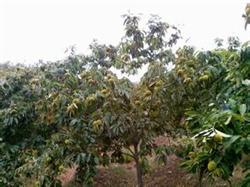 Mulching the tree disk with grass. Mulching the tree disk with grass is an economical, convenient, and labor-saving technical measure. It can make full use of the weeds growing on the hillside as well as the straw left after crop harvest. It can both store water and preserve moisture, and increase the soil's organic matter content, enhancing the soil's air and water permeability. The specific method is: spread weeds or harvested corn straw along the tree disk from the inside outward, with a thickness of 10-15 cm. After covering, sprinkle a small amount of soil on top to prevent it from being blown away by wind or catching fire. Add supplementary grass mulch once each year, and carry out deep plowing once every 3-4 years. After the mulch rots, it can increase soil nutrients.
Mulching the tree disk with plastic film. Covering the tree disk with plastic film can both raise soil temperature, which is good for root growth and promotes sprouting, and significantly reduce soil moisture evaporation. The mulched area varies with tree age, and at minimum it must not be smaller than the area of the tree disk. After mulching, compact the soil around the edges to prevent the film from being blown away by wind.
Digging holes under the tree canopy. Digging holes under the tree canopy is suitable for most chestnut forests on engineered-prepared land as well as chestnut forests established on relatively steep hillside land. The specific method is: with the trunk as the center, spread outward in a triangular radial pattern, and arrange the area under the tree disk into several small pits. The size and shape of the pits vary with the terrain. The depth and width of the pits are each about 30 cm. The number depends on the size of the tree canopy, and the coverage of the pits can extend 2-3 m beyond the outer edge of the canopy. Doing this can effectively control soil erosion and play a role in preserving water, soil, and fertilizer.
Water and fertilizer storage holes. Water and fertilizer storage holes are simple to operate and highly practical. The specific method is: before the tree buds, dig holes around the tree canopy. The holes are 30-40 cm in diameter and 40-50 cm deep. Place vertically into the holes grass bundles previously tied from wheat straw or weeds, and backfill around the grass bundles in the holes with evenly mixed fine soil plus a small amount of slow-release compound fertilizer. Tread firm and level the ground. Cover the top of the grass bundle with 2-3 cm of soil, water with 4-5 kg, cover the holes with plastic film, and press soil around the edges so that it forms a pot-bottom shape that is low in the middle and high around the edges. Open a small hole in the center. After mulching, watering and fertilizing are all done through the hole opening. At ordinary times, press it down with a clod of soil to prevent evaporation.