Key Technical Points for Pressing Green Manure under Chestnut Trees in the Rainy Season
Pressing green manure under chestnut trees can improve the soil and prevent water and soil erosion. It has many advantages such as low investment, low cost, and a high comprehensive utilization rate. The techniques for pressing green manure under chestnut trees in the rainy season are introduced as follows: 1. Sources of green manure for chestnut. First, artificially cultivated green manure, commonly including leguminous plants such as false indigo (Amorpha fruticosa) and mung bean; second, wild green manure,...
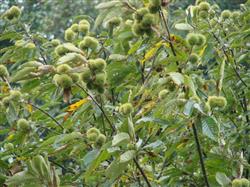
Pressing green manure under chestnut trees can improve the soil and prevent water and soil erosion. It has many advantages such as low investment, low cost, and a high comprehensive utilization rate. The techniques for pressing green manure under chestnut trees in the rainy season are introduced as follows:
1. Sources of green manure for chestnut. First, artificially cultivated green manure, commonly including leguminous plants such as false indigo (Amorpha fruticosa) and mung bean; second, wild green manure, such as weeds, leaves, fresh tender shrubs, etc.
2. Methods of applying green manure to chestnut.
(1) Harvesting or turning under at the right time. If green manure is turned under too early, the yield is low, the plants are excessively tender, and after turning under they decompose too quickly, giving a short fertilizer effect; if turned under too late, the green manure plants age, much of the nutrients have been transferred to the seeds, the nutrient content of the stems and leaves is relatively low, and the carbon-to-nitrogen ratio of the stems and leaves is high, making them difficult to decompose in the soil and reducing the fertilizer effect. Generally, the suitable time for turning under leguminous green manure plants is from full bloom to the end of flowering; grass-family green manure plants are best turned under at the heading stage; cruciferous green manure plants are best turned under at the stage of upper flowers and lower pods.
(2) Turning-under method. Dig a ring-shaped or strip-shaped trench around the outer edge of the tree canopy; both the trench width and depth are 30-40 cm. Sandy soil can be deeper, and clay soil can be shallower. The trench length is the same as one side of the tree canopy. The green manure and soil are pressed into the trench layer by layer alternately. When turning under, bury tightly and press firmly so that the green manure and soil fit closely with no gaps. Using fresh material to cover the tree disk or placing it between tree rows as fertilizer can provide a certain moisture-conserving effect for the soil under the trees.
(3) Application rate of green manure. It should be determined according to the type of green manure, climatic characteristics, soil fertility, and the crop's nutrient requirements. Generally, applying 1000-1500 kg of fresh seedlings per mu can basically meet the crop's needs. For every 100 kg of green manure, mix in 1-2 kg of superphosphate to regulate the relative balance of nitrogen, phosphorus, potassium, etc.
(4) Comprehensive utilization of green manure. The stems and leaves of leguminous green manure are good feed for livestock, and 1/4 of the nitrogen in them is absorbed and utilized by livestock, while the remaining 3/4 of the nitrogen is excreted through manure and urine, becoming excellent barnyard manure.
3. Common green manure crops suitable for artificial planting.
False indigo (Amorpha fruticosa). Intercropped in chestnut orchards, sown in spring, with a seeding rate of 1-2 kg per mu; spring layering can also be used. Plants over 2 years old are harvested 2-3 times each year, and 1000-2000 kg of fresh material can be harvested per mu. False indigo has strong adaptability and is drought-tolerant, waterlogging-tolerant, and salt-alkali-tolerant; it can be planted on hillsides, embankment land, and gullies. Plant once and harvest for many years; the branches and leaves are easy to rot and have a high fertilizer effect.
Mung bean. Sown in spring and summer, with a seeding rate of 2 kg per mu. After sowing, it grows for 60 days to full bloom and is then harvested, and 1000-1500 kg of fresh material can be harvested per mu. Sown in the same year and harvested in the same year; it grows quickly, has high yield, and rots easily. It likes high temperatures, is drought-tolerant, and tolerant of barren soil, but not waterlogging-tolerant. It can be planted in both acidic soil and saline-alkali soil.
Alfalfa. It can be sown in spring, autumn, and summer. It is harvested once in the same year, and after the second year it is harvested 3-4 times each year.