How to prevent flower and fruit drop in persimmon trees? Remember these seven key words
Peel: Girdling the trunk or main branches of vigorous trees not only promotes flower bud differentiation and earlier fruiting, but also reduces physiological fruit drop and advances fruit ripening. Girdling is generally carried out at the initial flowering stage and completed by full bloom, with an incision width of 0.3-0.5 mm. After girdling, wrap the incision with plastic (11395,70.00,0.62%) strips...
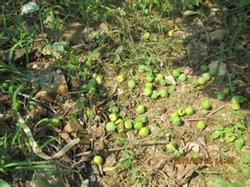
Peel: Girdling the trunk or main branches of vigorous trees not only promotes flower bud differentiation and earlier fruiting, but also reduces physiological fruit drop and advances fruit ripening. Girdling is generally carried out at the initial flowering stage and completed by full bloom, with an incision width of 0.3-0.5 mm. After girdling, wrap the incision with plastic (11395,70.00,0.62%) strips to maintain incision moisture and promote healing.
Prune: During the growing season, thin out overly dense branches and ineffective branches, leaving more branches on the windward side and fewer on the leeward side to promote ventilation and light penetration. Generally, after persimmon trees are pruned, latent buds will sprout abundantly. To reduce nutrient consumption, useless sprouts should be removed before they become woody. For long branches with growing space, especially vigorous water sprouts, pinch the tips when they reach 40 cm.
Thin: When 2-4 fruiting branches emerge from a fruiting mother branch, keep the 3 flower buds in the middle portion of the first 2 fruiting mother branches, and remove all flower buds on the other fruiting branches. If more than 5 fruiting branches emerge from a fruiting mother branch, keep the first 3 fruiting branches to bear fruit, leave 3 flowers in the middle of each fruiting mother branch, and remove all the rest.
Topdress: Applying fertilizer in May during the branch tip dormancy period and in July during the fruit expansion period has a clear promoting effect on improving fruit set rate, and can also increase the number of flower buds and improve flower bud quality for the next year.
Spray: Spray once each at full bloom and young fruit stage with 500 ppm gibberellin plus 1% urea, which can improve the nutritional status of flowers and fruits, prevent abscission layer formation between the persimmon calyx and fruit stalk, enhance the nutrient absorption function of flowers and young fruits, stimulate ovary expansion, and increase fruit set rate. During the rapid fruit expansion period, spraying the leaf surface with 0.3%-0.5% urea solution and trace element fertilizers such as ammonium molybdate can reduce flower and fruit drop.
Prevent: During the growing season, manually remove diseased and insect-infested fruits; in early June, spray 50% dichlorvos emulsifiable concentrate at 1000 times dilution to eliminate persimmon fruit borers; in mid-June, spray once with 1:5:400 Bordeaux mixture, or 65% zineb wettable powder at 500-600 times dilution, or spray once with 2.5% green kung fu at 1500 times dilution + 1.5% junlimei at 800 times dilution, which can control persimmon anthracnose, angular leaf spot, and circular leaf spot. In mid-to-late May and from late July to early August when larvae peak, spray 20% methomyl emulsifiable concentrate at 2500 times dilution, mainly spraying on the fruits, fruit stalks, and flower buds of persimmon trees, once every 10-15 days, for 2-3 consecutive sprays.