What are the key technical points for summer management of a persimmon orchard?
Summer management of a persimmon orchard should pay attention to the following matters: 1. Fruit thinning For astringent persimmons, from mid-May to early June, and for sweet persimmons, from early June to early July, after the physiological fruit drop ends, select and keep healthy young fruits free of pests and diseases at a ratio of 20 to 25 leaves per fruit. The ones to remove are deformed fruits, pest- and disease-damaged fruits, and fruits set on branches less than 15...
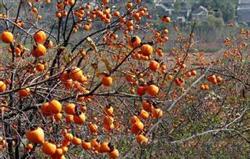
Summer management of a persimmon orchard should pay attention to the following matters:
1. Fruit thinning For astringent persimmons, from mid-May to early June, and for sweet persimmons, from early June to early July, after the physiological fruit drop ends, select and keep healthy young fruits free of pests and diseases at a ratio of 20 to 25 leaves per fruit. The ones to remove are deformed fruits, pest- and disease-damaged fruits, fruits set on branches less than 15 cm long or with fewer than 5 leaves, and fruits on the base and tips of bearing branches.
2. Girdling For mature bearing trees, carry out girdling once in mid to late May. The method is to use a sharp knife to make a ring cut around the trunk 2 to 3 mm wide, and gently make a vertical cut with the knife tip, but without damaging the xylem, then gently lift and peel off the narrow strip of bark with the knife tip. The purpose of girdling is to prevent the nutrients produced by persimmon leaves during photosynthesis - carbohydrates - from being transported to the roots, so as to help the fruits grow strong.
3. Cultivation and weeding and irrigation According to the growth of weeds, carry out cultivation and weeding 2 to 3 times, and consistently make shallow hoeing 7 to 10 cm under the tree canopy and deep hoeing 25 to 30 cm outside the canopy. During drought in July to August, irrigate promptly to resist drought. All persimmon orchards without intercropping should be fully covered with grass, which can preserve soil moisture and increase fertility, prevent weeds from growing rampant, and provide cold protection, sunscald protection, and soil improvement, but in dry weather pay attention to fire prevention.
4. Topdressing May to June is the peak growth season for persimmon trees, when root and shoot growth capacity is strong. For 1- to 2-year-old young trees, the fertilizer amount per plant is quick-acting fertilizer of 20 g pure nitrogen, 10 g superphosphate, and 20 g potassium chloride. For 3- to 5-year-old trees, the fertilizer amount per plant is 2 times that for 1- to 2-year-old trees. For mature bearing trees, the fertilizer amount per mu is 4 kg pure nitrogen (equivalent to 7.8 kg urea), 4 kg superphosphate, and 4 kg potassium chloride. Outside the vertical drip line of the tree canopy, at 5 to 10 cm for young trees and 15 to 20 cm for mature bearing trees, dig a ring-shaped ditch both 20 cm wide and 20 cm deep. Generally choose a cloudy day or a sunny day before 9 a.m. or after 5 p.m., apply the above 3 fertilizers, then fill with soil to cover.
5. Pest and disease control The main pests and diseases in persimmon orchards include circular leaf spot, angular leaf spot, anthracnose, and powdery mildew. For these diseases, you can choose 0.3 to 0.5 degree Baume lime sulfur mixture or 50% thiophanate-methyl powder 800 to 1500 times solution for spraying, or you can choose 1:2:100 Bordeaux mixture for spraying. The main insect pests include persimmon tussock moth, scarab beetles, persimmon fruit borer, blood-spotted small leafhopper, persimmon shoot noctuid, and so on. You can choose 40% omethoate 500 to 1000 times solution or 50% potassium ammonium phosphorus 1000 to 1500 times solution for spray control. Spraying with crystal trichlorfon 600 to 800 times solution can control nettle caterpillars.