Key Points of Standardized High-Yield Cultivation Techniques for Papaya
The papaya fruit is oval-shaped, with lignified flesh, and is resistant to storage, capable of being stored naturally for 5-6 months. The fruit skin is smooth and waxy, golden-yellow and shiny; clean and attractive, with a rich and unique fragrance. When placed indoors, the aroma fills the air and lingers for a long time. Because the seeds of Yizhou papaya have a layer of mucilage on the surface, the seedling emergence rate is low, currently...
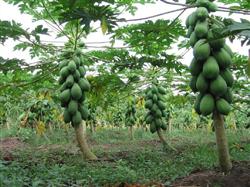
The papaya fruit is oval-shaped, with lignified flesh, and is resistant to storage, capable of being stored naturally for 5-6 months. The fruit skin is smooth and waxy, golden-yellow and shiny; clean and attractive, with a rich and unique fragrance. When placed indoors, the aroma fills the air and lingers for a long time.
Because the seeds of Yizhou papaya have a layer of mucilage on the surface, the seedling emergence rate is low. At present, the planting area is relatively small, and the yield per unit area is not high, making it difficult to meet market demand. For this reason, the author conducted standardized high-yield cultivation experiments on Yizhou papaya from 1998 to 2004 and achieved good results. The experimental results are summarized as follows.
1 Basic Information of the Experimental Site
The experimental site was located in the Science and Technology Demonstration Park of the College of Agriculture and Forestry, Linyi Normal University. The local average annual temperature is 13.2°C. The average January temperature is -2.6°C, the average July temperature is 27.6°C, the effective accumulated temperature is 4417°C, the average annual sunshine duration is 2417 hours, the frost-free period is 202 days, and the average annual precipitation is 869mm. The experimental site has sandy loam soil with deep soil layers, pH 6.9, soil organic matter content of 0.9%, and good drainage and irrigation conditions.
2 Seedling Cultivation
2.1 Seed Collection
Collect fully mature fruits from mother trees that grow vigorously and have strong stress resistance. Early-harvested fruits should first be piled in a cool place for after-ripening. In mid-to-late November, cut the fruits lengthwise with a knife and extract the seeds. Soak the seeds in 0.3% neutral laundry detergent solution for 2-3 hours, rubbing and washing continuously to wash off the mucilage on the surface of the seeds. Then soak in clean water for 3-4 hours, drain the water, and soak again in clean water for 3-4 hours to wash off the laundry detergent on the seed surface.
2.2 Seed Stratification Treatment
Mix the cleaned seeds with clean wet sand at a ratio of 1:5. The moisture of the sand should be such that it forms a ball when squeezed by hand without dripping water, and the sand ball cracks when the hand is released. The seeds can be placed in a 50cm deep trench for stratification, or placed in a large flower pot, and then the flower pot can be half-buried in a pit with the pot mouth slightly above the ground. If too wet, dry it promptly, and pay attention to preventing rodent damage. The stratification treatment time must not be less than 30 days.
2.3 Land Preparation and Sowing
2.3.1 Land Preparation The nursery land should preferably be sandy soil with irrigation conditions. Before sowing, apply 3-4 cubic meters of decomposed high-quality farmyard manure, 25kg of ternary compound fertilizer, 2-3kg of 3% phoxim granules, and 0.5-1kg of 40% carbendazim per mu (667 square meters, the same below). After spreading, deep plow 20-30cm and level the land. Make beds 1.2m wide and 30-40m long, and reserve drainage and irrigation channels.
2.3.2 Sowing Papaya can be sown in spring or autumn. Autumn sowing is carried out before the land freezes (mid-to-late November), which can reduce the time for sand storage and germination. Generally, the seed rate per mu is 1-1.5kg. Spring sowing is carried out after the early spring thaw (early March). First place the seeds in a warm place to promote germination. Sow when 1/3 of the seed radicles have emerged. The seed rate per mu is 1kg. Drilling is preferred for sowing, with 4 rows per bed, wide rows 40cm apart and narrow rows 20cm apart; open furrows 2cm deep, water along the furrows, and after the water seeps down, evenly scatter the seeds into the furrows, cover with about 2cm of soil, and lightly press and cover with plastic film the next day.
2.3.3 Arch Shed Nutrient Pot Seedling Cultivation In mid-to-late February, mix soil, sand, and farmyard manure at a ratio of 5:3:2. Add 1kg of diammonium phosphate, 100g of ferrous sulfate, 50g of zinc sulfate, 150g of 40% carbendazim, and 60g of 25% trichlorfon per cubic meter of soil. After adding a small amount of insecticide and fungicide, mix thoroughly and fill into seedling pots with a diameter of 8.8cm. Arrange them in seedbeds, water thoroughly, and sow the stratified and germinated seeds into the pots. Cover with fine sand or loose soil, and set up an arch shed over the bed surface. In the early stage, cover with 2cm thick straw curtains at night. In mid-to-late March, ventilate promptly when the temperature inside the shed exceeds 25°C. In early April, ventilate to harden the seedlings. In mid-April, remove the seedling pots and transplant with soil, watering promptly after transplanting. This method results in fast recovery from transplanting and vigorous growth, and seedlings grafted in the same year can become viable seedlings in the same year.
2.4 Nursery Land Management
After the seedlings emerge, inspect the nursery every evening and promptly break the film to release the seedlings. Water promptly during dry weather. When the seedlings are about 20cm tall, apply 10kg of urea per mu combined with watering. Apply foliar fertilizer once every 7-10 days, preferably alternating 0.3% urea with multi-element micro-fertilizer. When the seedlings are about 50cm tall and the ground diameter is above 0.5cm, grafting can be carried out.
2.5 Seedling Grafting
2.5.1 Scion Selection Cut peripheral new shoots or 1-year-old branches with plump buds from superior varieties free of pests and diseases as scions. When grafting during the growing season, remove the leaves from the new shoots immediately after cutting, retaining 0.3-0.5cm long petioles. It is best to use them immediately after cutting, or wrap them in a wet cloth and place them near the water surface in a well for temporary storage.
2.5.2 Grafting Methods ① "T"-shaped budding can be carried out from mid-May to the end of September. This method is simple, easy to master, fast, and has a high survival rate. The key point is not to cut into the xylem when making the horizontal cut on the rootstock, and the upper end of the bud piece should be flush with the horizontal cut. ② Cleft grafting is mostly used in spring, and can also be used on vigorously growing rootstocks in summer. The advantage of cleft grafting is that seedlings grafted in the same year can become viable seedlings in the same year. To improve the survival rate, the grafting principles of "flat, flush, tight, white exposed at the top, gap at the bottom" should be mastered. That is, the cut surface of the scion should be smooth, the phloem must not be split, the cambium of the rootstock must be aligned when inserting the scion, about 3mm of the top of the wedge-shaped cut surface of the scion should be exposed, there should be a slight gap at the lower part of the scion, and the cut and binding opening should be tightly bound without loosening.
3 High-Yield Cultivation Techniques
3.1 Orchard Establishment
In the autumn of the year before planting, level the land and dig 1m square planting holes according to the plant and row spacing, stacking topsoil and subsoil separately. In the following spring, mix 12kg of crop straw with subsoil in each hole and fill the bottom, then mix topsoil with farmyard manure (15-20kg per hole) and backfill, then irrigate to settle. Select 2-3-year-old Yizhou papaya root-sucker seedlings that are free of pests and diseases, with a plant height above 110cm and ground diameter above 0.7cm. When digging seedlings, retain as many fibrous roots as possible and cut off damaged parts of the root system. Soak the seedling roots in clean water for 12 hours before planting. Plant in north-south rows with a row spacing of 3×2m. The main cultivar is "Changjun" and the pollinator cultivar is "Hongxia", with a ratio of 4:1. When planting, dig a small hole 30cm square in the middle of the backfilled hole, apply 250g of potassium sulfate compound fertilizer mixed with soil, then plant the seedling and water after planting. In the first 1-2 years after planting, peanuts, soybeans, and other crops can be intercropped between rows, and the tree disk should be kept clean-cultivated.
3.2 Fertilizer and Water Management
Starting from late May of the planting year, apply topdressing 3-4 times consecutively combined with irrigation, applying 0.15kg of urea or 0.15kg of ammonium bicarbonate per plant each time. Starting from the second year after planting, apply base fertilizer every autumn. Dig a fertilizer trench 1m long, 0.4m wide and 0.4m deep below the tree canopy projection line, and apply 20-25kg of farmyard manure and 0.5kg of potassium sulfate per plant. Apply base fertilizer alternately between plants and between rows. Apply topdressing twice during the growing season: the first time during the vigorous growth period of spring shoots (when new shoots are 20cm long), apply 0.25kg of urea and 0.3kg of potassium sulfate per plant; the second time in mid-June when the fruit begins to expand, apply 0.5kg of urea and 0.4kg of potassium sulfate per plant. Irrigate once each before bud break, during the rapid growth period of new shoots, and before winter. Control water during the flowering period.
3.3 Training and Pruning
The tree form adopts a slender spindle shape. After formation, the tree height is 2.1-2.3m, the crown diameter is 1.2-1.5m, and the trunk height is 0.5-0.6m. The central leader has 10-12 alternately arranged main branches evenly distributed, with adjacent main branches spaced 20-25cm apart. Each main branch has 1-3 fruiting branch groups. In the planting year, head the tree at 80-100cm above the ground. During the growing season, select and retain the central leader and 4-5 main branches in the shaping zone (30-40cm below the cut), and remove all branches below the shaping zone. In the second winter, shorten the central leader by 50-70cm and select and retain 3-4 main branches at appropriate positions; in the third winter, select and retain 2-3 main branches, and develop medium and small fruiting branch groups on the main branches selected in the previous 2 years. After the fourth year, continue to develop a good fruiting framework. Leave main branches unpruned to promote medium and short branches, and remove overly dense branches, thin and weak branches, and pest- and disease-damaged branches.
3.4 Flower and Fruit Management
Artificial pollination should be carried out during the flowering period in cloudy and rainy weather. Use a brush to dip pollen and apply it to the stigma of fully opened flowers; or prepare a pollen solution with 10kg of water, 0.5kg of white sugar, 30g of urea, 20g of pollen, and 10g of borax and spray it. Use it immediately after preparation, spraying once each at the initial flowering stage and full flowering stage. Thin fruits promptly within 30 days after flowering. Large fruits should be spaced about 25cm apart, and small fruits about 20cm apart. Leave more on the upper part and periphery, and fewer on the lower part and inner canopy. The reasonable load for trees in full fruiting stage is a yield of 3500-4000kg per mu. Prop up main branches that droop after fruiting with wooden sticks or bamboo poles to prevent the fruit from breaking the main branches.
3.5 Pest and Disease Control
The main pests and diseases of local wrinkled papaya include papaya leaf spot, ring rot, dry rot, aphids, papaya fruit borer, and pear psylla. Control methods: In early March (before bud break), spray 3-5 degrees Baumé lime sulfur mixture to reduce overwintering pest and disease sources. In late April, when aphids cause damage, spray 10% imidacloprid emulsifiable concentrate at 3000 times dilution. In late May to early June and early July, spray once each a mixture of 30% taoxiaoling emulsifiable concentrate at 1500 times and 50% carbendazim wettable powder at 600-800 times to control papaya fruit borer and leaf spot, etc. From mid-July to before leaf fall, at intervals of 15-20 days, alternately spray 50% carbendazim wettable powder at 600-800 times, 1:1:200 Bordeaux mixture, and other fungicides, for a total of 2-3 sprays; at the same time, pay attention to controlling various caterpillars, pear psylla, and slug moths and other pests. After winter begins, clean up the orchard, sweep up fallen leaves, mummified fruits, and pest- and disease-damaged branches, and destroy them centrally to reduce overwintering pest and disease sources.