First-Time Melon Growing Experience Exchange: Growing Tips and Insights Shared
In 2009, the price of Elizabeth melons was surprisingly good. Greenhouse-grown melons that hit the market early sold for 5 yuan per jin; the first crop from arched sheds sold for close to 3 yuan per jin, and even the price of the second crop was similar to the first-crop price of previous years, at around 1.5 yuan per jin. As a result, many vegetable growers started planting Elizabeth melons this spring...
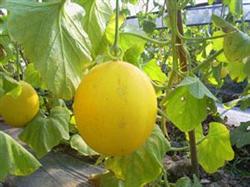
In 2009, the price of Elizabeth melons was surprisingly good. Greenhouse-grown melons that hit the market early sold for 5 yuan per jin; the first crop from arched sheds sold for close to 3 yuan per jin, and even the price of the second crop was similar to the first-crop price of previous years, at around 1.5 yuan per jin. As a result, many vegetable growers started planting Elizabeth melons this spring, and even some growers who had never grown in sheds before joined the ranks of melon growers. Master Han from Nanhan Village, Daotian Town, Shouguang City, was one of them.
While interviewing in Master Han's shed, the reporter saw that the greenhouse melons had already begun to be harvested. Growing melons for the first time certainly comes with plenty of reflections, and the reporter struck up a conversation with him.
"These melons are almost ready for market. I feel the worst thing I did this year was plant them too densely. I set out 2500 plants per mu. Although the number of plants was higher, the melons grew small and the quality was poor, so buyers were unwilling to purchase them. I've learned this lesson now, and next year I'll definitely pay attention no matter what," said Master Han.
Reflection: Blind dense planting leads to poor melon quality and difficulty selling
Generally speaking, if melons are not allowed to keep secondary vines and only the main vine is retained, planting 2000 plants per mu is already considered dense. But according to Master Han, he planted close to 2500 plants per mu. The reporter saw in his shed that the melons were rather small; while others' melons each weighed over 2 jin, in his shed even 1.5 jin was considered large. Observing the plant growth, the reporter saw that the melon leaves were large and thin, and the internodes were relatively long. This crop of melons was planted during the low-temperature winter period, so why did the plants show excessive vegetative growth? It was mainly caused by planting too densely.
When melons are planted too densely, the branches and leaves shade each other, and light is insufficient. In order to compete for light, the melons desperately grow upward. In addition, under the same conditions, the photosynthetic products produced by the plants are fixed. When more photosynthetic products are used for vegetative growth such as stems and leaves, naturally less nutrition is used for producing fruit, so it is not surprising that the fruit grows small. Add to that the mutual shading of branches and leaves, which reduces leaf function and the production of photosynthetic products, and it becomes difficult for the fruit to grow large.
Therefore, our newspaper has always advocated rational dense planting, but denser is not always better. Excessive dense planting cannot guarantee yield, and the quality will certainly be poor, so the overall benefit is not high. Moreover, planting too densely also increases investment costs and labor intensity. Under normal circumstances, planting 1800-2000 Elizabeth melon plants per mu is appropriate.
"This winter and spring, there were many consecutive cloudy days, and growing melons was very difficult. In particular, the small yellow spots that appeared on the fruit skin after consecutive cloudy days were very hard to treat. In order to control the disease, I increased the spray concentration and sprayed several times. I found that although the small yellow spots were controlled, phytotoxicity appeared in the melons in the shed, and I felt the melons' expansion rate had clearly slowed down," said Master Han.
Reflection Two: Using harsh chemicals to treat disease causes phytotoxicity and slow fruit expansion
In fact, no matter which vegetable is grown, consecutive cloudy days are the most feared. This year, there were many consecutive cloudy days around the Spring Festival, and many melons developed small yellow spots because of this. The small yellow spots appearing on the melon surface are actually caused by bacterial disease.
"Before I started growing melons, quite a few friends had told me about this small yellow spot disease in melons. If it is not controlled in time, it can very likely lead to reduced yield. So even before growing melons, I already had a fear of this disease, thinking, don't let me run into it. But the weather did not cooperate. This year, due to the weather, the melons in my shed developed small yellow spots. After I noticed it, I immediately sprayed chemicals to control it without thinking twice. I increased the spray concentration. Although the small yellow spots were controlled, the melons suffered phytotoxicity, and fruit expansion also slowed down," Master Han said with great regret.
No wonder Master Han's melons, which were planted at the same time as his neighbor's, had already all been sold while his had only just started to be sold. So that was what had happened.
When small yellow spots are mentioned, many vegetable growers, like Master Han, are very afraid, because once control is inadequate, it will lead to reduced yield. But any disease should still be prevented first. Preventing it well in advance not only saves a lot of money on buying chemicals, but also avoids harming the plants. It was precisely because Master Han did not recognize the importance of prevention that after the disease appeared, he increased the chemical concentration and sprayed heavily, causing phytotoxicity in the melons in his shed.
In fact, there is a physical method for preventing and controlling small yellow spots in melons, and that is bagging. It can both prevent small yellow spots and avoid affecting the melons' expansion.
From flower dipping until the young fruit grows to the size of a goose egg, there is no need to rush to bag the melon, because the melon surface has a dense layer of fine fuzz. If consecutive cloudy days bring high humidity in the shed, water droplets will only stick to the fuzz and will not stick to the melon skin surface. In this way, the melon is less likely to be infected by bacterial disease, and small yellow spots will not form. However, as the melon continues to expand, especially during the period when it grows from the size of a goose egg to about 1 jin, the fuzz on the melon skin gradually becomes sparse. If the humidity in the shed is high, water droplets easily stick to the melon skin surface, increasing the chance of infection by bacterial disease. During this period, if you learn that consecutive cloudy days are coming, you must bag the melons before the cloudy days. Doing so greatly reduces the humidity on the melon surface and avoids the occurrence of small yellow spots.
"This spring the melon yield was relatively low. I weighed them, and the largest melon was only 1.5 jin. Apart from the weather effects and planting too densely, another reason is that I did not keep secondary vines. When I first started growing them, some vegetable growers told me it was good to keep secondary vines, while others said there was no need, because keeping secondary vines would delay the melons' market date. Yesterday I heard a relative in Changle say his melons each weighed close to 3 jin. It seems I will have to keep secondary vines in the future," said Master Han.
Reflection Three: Not keeping secondary vines for early market results in relatively low melon yield
When the reporter went to the countryside for interviews, they learned that there were quite a few vegetable growers like Master Han who did not keep secondary vines. The reason they did so was to bring the melons to market three to five days earlier and sell at a high price, while also making management easier. But through the practical experience of vegetable growers, it was learned that keeping secondary vines still gives higher melon yield. This is because most vegetable growers now keep only one melon per plant, and the nutrition produced by one main vine is obviously different from that produced by two vines. Therefore, the reporter suggests: in order to ensure melon yield, it is still better to keep secondary vines.
Selecting and retaining melon secondary nourishing vines is itself a delicate task, because whether the selection of the melon secondary nourishing vine is successful determines whether the melon's growth is good. Therefore, when selecting secondary nourishing vines, one must be very careful and meticulous. So, exactly how should secondary nourishing vines be selected?
When selecting and retaining secondary nourishing vines, generally do not choose the first and second lateral branches growing from the very bottom of the plant, because although these two lateral branches grow early, their leaves are dense and small, they are unwilling to elongate their internodes, and they are slow to grow. Their growth vigor is weak, and the nutrition they produce is not enough to meet the needs of fruit growth. In addition, do not choose the fourth, fifth, or higher lateral branches either. These lateral branches emerge late, and when the main vine reaches 14-15 leaves for flower dipping, these lateral branches have not yet grown long enough. The nutrition they produce likewise cannot meet the needs of fruit growth, which will inevitably affect fruit expansion and delay the market date. Therefore, when selecting and retaining secondary nourishing vines, it is best to choose the third lateral branch as the secondary nourishing vine, because this lateral branch grows quickly. By the time the melon is dipped, it can already accumulate sufficient nutrition to supply fruit growth, promoting the melon to grow large, grow quickly, and have good market quality.
"Through this season's growing, although there were unsatisfactory aspects, when I think it over carefully, I also learned quite a lot. Of course, this was all learned from the friends around me. Using it in production this year felt pretty good. These experiences were all summarized by them themselves," said Master Han.
Reflection Four: Solving uneven melons must start with flower dipping
Uneven melons are often seen, meaning one side of the melon is large and the other side is small. Such melons can only be sold as junk at a lower price. So how can the problem of uneven melons be solved? Master Han told the reporter that it must be solved starting with flower dipping.
Generally speaking, uneven melons show up within 7-10 days after flower dipping. Analyzing the causes, aside from flower bud differentiation, plant growth vigor, and environmental factors, the main cause of uneven melons is uneven distribution of the chemical solution during flower dipping.
When dipping the melon, because the female flower mostly leans to one side, after dipping, the chemical solution easily gathers on the lower side of the female flower. The concentration there is high, causing one side of the melon to expand noticeably faster while the other side expands more slowly, thus creating an uneven melon.
So how can uneven melons be solved during flower dipping? Master Han's method is to gently flick the chemical solution with a finger after dipping the melon. This can flick away the excess chemical solution gathered on the female flower, so uneven distribution of the solution will not occur, thereby avoiding uneven melons.
Master Han reminded that if uneven melons still appear in the shed after using the above flicking method, then after the uneven melons appear, a growth regulator can be used to adjust the newly uneven melons, speeding up expansion on the slower-growing side so that they become normal melons. The specific operation is as follows: on the second day after the uneven melon appears, use one 5 ml bag of fruit-setting agent mixed with 6 jin of water, then use a small spray bottle to lightly spray the middle of the slower-growing side, as long as the melon body is evenly coated with a layer of the solution. After 4-5 days in this way, the uneven melon can be adjusted into a normal melon. However, the solution must not be sprayed too much. Once too much is used, it will also cause the slower-growing side to expand too quickly, and may still form an uneven melon or even cause lumps on the melon body. Therefore, when spraying, be sure to pay attention to the solution concentration and the amount used.