Detailed Explanation of Key Cultivation Techniques for Spring Greenhouse Melons
Melon production is developing very rapidly. Whether in greenhouses or spring greenhouse production, the economic benefits are quite significant, with returns per mu around 10,000 yuan. Based on the characteristics of spring greenhouse production - low investment, easy management, high yield, good quality, short production cycle, and quick market capture - to promote production development, the management techniques are now organized as follows for...
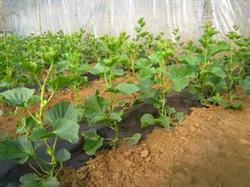
Melon production is developing very rapidly. Whether in greenhouses or spring greenhouse production, the economic benefits are quite significant, with returns per mu around 10,000 yuan. Based on the characteristics of spring greenhouse production - low investment, easy management, high yield, good quality, short production cycle, and quick market capture - to promote production development, the management techniques are now organized as follows for reference.
I. Land Selection, Fertilization, and Ridge Making Melons are crops that prefer warmth and fear cold, prefer light and fear shade, and prefer dryness and fear waterlogging. Therefore, sloped land or sandy loam soil should be selected, with sunny slopes and virgin soil being best. Conditions with water sources for irrigation and convenient transportation are even better. Yellow clay soil and sticky clay soil are not very suitable. The greenhouse site should be 6-8 m wide (using 8-10 m plastic film), with length determined by the land. The greenhouse should run north-south, mostly using bamboo and wood structures, though steel frame greenhouses can also be used. Before the ground freezes, the melon field should be fertilized, rotary tilled, and ridged. Generally, apply 3000-4000 kg of high-quality farmyard manure per mu, 10 kg of diammonium phosphate, and 15 kg of potassium sulfate. After rotary tilling, ridges can be made, with ridge width (including walking furrow) of 0.9 m.
II. Variety Selection Generally use Qitian No. 1, Yumeiren, etc., with sugar content of 14-15% and growth period of 120 days.
III. Seedling Raising The time is chosen in early to mid-February. Methods used: There are two types of seed treatment. One is warm water soaking - soak seeds in 55°C warm water for 10-15 minutes, stirring while pouring the seeds into the water. The second is soaking in 500-700 times diluted Topsin or Carbendazim solution for about 4 hours, placed at 25-30°C, sprouting in 1-2 days. Sow after sprouting. Use nutrient pots with a diameter of 8 cm and height of 10 cm. The nutrient soil uses 50% decomposed high-quality manure and 50% soil from onion-garlic fields or corn fields. The nutrient soil must be disinfected by soaking in 500 times diluted 30% peroxyacetic acid. Sow seven days later, covering with 0.5 cm of soil. Grafting seedlings are best used, with Shengzhen No. 4 as rootstock, using the top-insertion cross grafting method, with a survival rate of 98%. The main advantages are disease resistance allowing continuous cropping without rotation, high yield, tolerance to low temperature and high humidity, and fertilizer savings. The seedling age is about one month, but note that rootstock seeds should be germinated 3-4 days earlier than scion seeds. When grafting, the rootstock should have one true leaf and one heart leaf, and the scion should be at the one-heart stage.
IV. Transplanting The time is in mid-to-late March, when melon seedlings have 3 leaves and 1 heart leaf. Cover the greenhouse 15-30 days before transplanting to raise soil temperature. On the afternoon or evening before planting, water the seedling pots thoroughly to facilitate transplanting with the root ball. After hilling, the pit surface should be slightly concave. Planting density of 90X50 cm with double plants, or 90X33 cm with single plants is appropriate. Since melon roots have strong regeneration ability, try not to damage roots during cultivation.
V. Pruning and Pinching 1. Four-vine pruning method using secondary vines: Pinch the main vine when it has four leaves, simultaneously remove the secondary vines between leaves one and two, keep the secondary vines between leaves three and four. When secondary vines grow to four leaves and one heart leaf, pinch them. Each tertiary vine keeps 2 melons, and each plant can keep 6-8 melons. 2. Four-vine pruning method using secondary vines: When the main vine grows to six leaves, pinch it, remove the secondary vines between leaves one and two, keep secondary vines between leaves 3-6. Each secondary vine keeps 1-2 melons.
VI. Top Dressing The principle is light fertilization during the seedling stage and heavy fertilization during the fruiting stage. When melons grow to the size of an egg, apply fruiting fertilizer: 7.5-10 kg of diammonium phosphate per mu and 12.5-15 kg of potassium fertilizer. Note that potassium fertilizer must be potassium sulfate, not potassium chloride, to prevent bitter melons.
VII. Irrigation During the melon expansion period, appropriate irrigation can increase yield and improve quality. When the number of melons reaches its peak, if melon leaves are found wilting during the day, irrigation can be applied using the furrow irrigation method. After irrigation, pesticides can be sprayed, generally using 500 times diluted peroxyacetic acid (one liang to two kettles of water).
VIII. Pay Attention to Pest and Disease Control (Sun Hongxu, Liaoning Province Famous, Special and Excellent Agricultural Products Development Service Center) Edited by: Tianjin Agricultural Science and Technology Information Network To make watermelons sweet, fertilization is key 1. Increase phosphorus and potassium fertilizer: Phosphorus and potassium elements promote the formation, transport, and storage of carbohydrates. Therefore, increasing phosphorus and potassium fertilizer can improve watermelon sugar content, while applying only nitrogen fertilizer will reduce sugar content. Experiments have proven that applying 3000-4000 kg of farmyard manure per mu to watermelons, followed by top dressing with phosphorus and potassium fertilizer, has an obvious sweetening effect. Generally, after watermelons set fruit, applying 10 kg of potassium sulfate per mu can increase watermelon sweetness by 1-2 degrees; spraying 0.2% potassium dihydrogen phosphate solution at the initial stage, or applying 5 kg of phosphate fertilizer per mu in holes during the early vine extension stage. 2. Spray sweetening liquid: In the middle and late stages of watermelon growth, spray sweetening liquid on watermelon leaves. The sweetening liquid formula is: 30 g borax, 1000 g sucrose, 5 g calcium hydride, mixed with 50 kg water. Spray 25-30 kg per mu, increasing watermelon sweetness by 1-2 degrees. 3. Stevia bean fertilizer: Take 0.5 kg of stevia, mix with 25 kg of water, then add 10 kg of soybeans. Soak in a pot, and after the soybeans expand, boil until the liquid is completely evaporated. When watermelons set fruit, apply near the roots and cover with 3-5 cm of soil. 4. Saccharin soybean cake fertilizer: Dissolve 300-500 g of saccharin in 15-25 kg of water. After the water boils, add 5 kg of soybean cake, and simmer over low heat until dry. Then mix the soybean cake with rice bran and spread around the watermelon roots, covering with 3-5 cm of soil. After this treatment, watermelon sweetness is equivalent to about 70% of white sugar sweetness.