Analysis of Why Melons Fail to Set Fruit and Effective Measures to Overcome It
1. Promoting flowers and preserving fruit: At the early flowering stage, young fruit stage and fruit swelling stage, spray the Zhuangguadi Ling solution once each time. This can thicken the fruit stalk, strengthen the targeted nutrient supply, promote rapid fruit development, produce attractive fruit shape with abundant juice and good flavor; during the growth cycle there will be no flower drop, no fruit drop, no split fruit, and no deformed fruit. At the same time, strengthen field fertilization and irrigation...
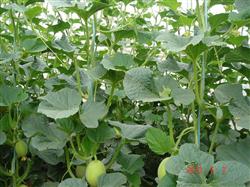 Germination stage
From seed swelling to cotyledon unfolding is the germination stage. The length of the germination stage is mainly related to temperature. Under normal conditions this stage lasts 5-10 days, varying with variety and season. When soil temperature is 28°C and moisture is sufficient, seedlings can emerge in 3-4 days; when soil temperature is 20°C, emergence takes 7-10 days. The optimum temperature for melon germination is 28-32°C, and most varieties cannot germinate below 15°C. The optimum soil moisture content for seed germination is about 10%; below 8%, water absorption is insufficient and the germination rate decreases; above 18% also affects germination. In addition, seeds are photophobic, meaning seeds prefer to germinate under dark conditions. During the germination stage, seedlings mainly rely on the nutrients stored in the two cotyledons of the seed for growth. Growth during this period is relatively small, and photosynthesis can begin once the cotyledons unfold. During this time, the seedbed should maintain suitable temperature and humidity to prevent seedling legginess. When the seedling breaks through and the true leaf appears, the germination stage ends.
Seedling stage
From cotyledon flattening and true leaf emergence to three leaves and one heart is the seedling stage, which normally takes 20-25 days. During this period the root system begins vigorous growth, the main root can reach about 35 cm in length, and lateral roots develop abundantly and are distributed in the top 20-30 cm of soil. This period is also the flower bud differentiation period. At the end of the seedling stage, about 20 nodes have differentiated at the stem apex. Under conditions of 30°C during the day, 18-20°C at night, and 12 hours of sunlight, flower bud differentiation is early and the node position of female flowers is lower. Under high temperature and long-day conditions, the node position of female flowers is higher and flower quality is poor. The quality of seedling stage management directly affects the timing of flowering and fruit setting and the level of yield. For melons cultivated in winter and spring, the seedling stage occurs during a period unsuitable for melon growth, so conditions should be created to allow seedlings to grow in a suitable environment. The key management points are raising soil temperature, loosening the soil, etc., so that seedlings grow robustly and compactly.
Vine elongation stage
From the unfolding of the fourth true leaf to the opening of the first female flower is the vine elongation stage, which takes 25-30 days. During this period the aboveground and underground parts of the plant grow rapidly at the same time. The plant changes from the upright growth state of the seedling stage to prostrate growth, vegetative and reproductive organs on the main vine continue to differentiate at each node, and the plant enters a stage of vigorous growth. In the cultivation management during the vine elongation stage, promotion and control must be combined: it is necessary both to ensure rapid growth of stems and leaves so that the plant develops a larger vegetative mass, and to prevent excessive stem and leaf growth. Good stem and leaf growth can lay a good foundation for flowering and fruiting. During this period, appropriate topdressing and watering can be done, and through technical measures such as pruning, the growth of stems and leaves can be properly controlled to regulate plant vigor.
Fruiting stage
From female flower opening to fruit maturity is the fruiting stage. The length of the fruiting stage is related to variety characteristics. Generally, the fruiting stage of early-maturing varieties is 30-40 days, while late-maturing varieties can reach 60-80 days. According to the characteristics of fruit growth and development, the fruiting stage can be divided into the early fruiting stage (young fruit stage), middle fruiting stage (fruit swelling stage) and late fruiting stage (maturity stage).
(1) Early fruiting stage
From flower opening to the beginning of rapid swelling of the young fruit is the early fruiting stage, which takes 5-7 days. During this period the plant gradually shifts from mainly stem and leaf growth to mainly fruit growth. Before and after flowering, ovary cells divide rapidly. The key management point in this period is to promote fruit setting. Timely pruning before fruiting and measures such as artificial supplementary pollination can promote melon fruit setting and prevent flower and fruit drop.
(2) Middle fruiting stage
After 5-7 days from flowering, the fruit begins to swell rapidly. From then until the fruit stops swelling is the middle fruiting stage, which is the period of fastest fruit growth, while stem and leaf growth slows significantly. During this period, nutrients produced by leaves through photosynthesis are continuously transported to the fruit, causing the fruit to swell rapidly. This is the most critical period for fruit yield formation. The key management point is to strengthen fertilization and water management, maintain vigorous leaf photosynthesis, and ensure sufficient water and nutrient supply to the fruit.
(3) Late fruiting stage
From the fruit stopping swelling to approaching maturity is the late fruiting stage. During this period, root, stem and leaf growth gradually stagnates, and the fruit basically takes shape. In this period, besides the fruit continuing to accumulate nutrients, the main characteristics are: the sugar content of the fruit continuously increases, chlorophyll gradually disappears, the fruit displays the color, netting, aroma, flavor and quality specific to each variety, and firmness begins to decline. To ensure normal fruit ripening, management should be strengthened in cultivation to protect leaves and promote roots, and prevent early senescence or disease of stems and leaves. Because root absorption capacity weakens during this period, foliar fertilizer spraying should be used to supplement nutrients, and diseases should be controlled in a timely manner. During the fruit maturity period, watering should be controlled, with no watering or little watering, to improve fruit flavor and quality.
For the vast majority of melon varieties, the above three stages clearly exist during the fruiting stage, but for a small number of varieties the above stages are not obvious, and melon growth occurs in an almost linear pattern rather than the usual "s" curve.
During the fruiting stage, melons have strict temperature requirements: 27-30°C during the day, 15-18°C at night, a day-night temperature difference above 13°C, and sufficient light.
Harvest stage
When the fruit reaches physiological maturity, or begins to reach the degree of harvest, it enters the harvest stage. For thin-skinned melons and thick-skinned melons that retain fruit in layers multiple times, the fruiting stage and harvest stage overlap. Fruit maturity is mainly judged from peel color, pattern, flesh texture, etc. During this period the sugar content of the flesh reaches its highest value and emits fragrance.
Harvesting too early affects melon quality; harvesting too late affects economic income, so harvesting must be done at the right time.
Relationship between melon growth and fruit setting
1. Mutual relationship between vegetative growth and fruit setting
Whether melon stems and leaves grow vigorously directly affects the number of fruits set. Vigorous stem and leaf growth can increase the number of female flowers, and when the number of female flowers increases to a certain extent, it can raise the fruit-setting rate. Leaves are the organs through which the plant carries out photosynthesis. Within a certain range, as leaf area increases, yield and sugar content also increase correspondingly.
2. Effect of pruning on growth and fruit setting
Pruning controls the growth of leaves and vines to a certain extent. Experiments show that whether single-vine or double-vine pruning is used, the fresh weight of leaves and vines is lower than that of unrestricted growth, and that of double-vine pruning is lower than that of single-vine pruning. From the perspective of fruit growth, single-vine pruning is faster than unrestricted growth and double-vine pruning, indicating that the number of leaves and vines retained by single-vine pruning is more suitable for fruit growth than unrestricted growth and double-vine pruning, and the coordination between vegetative growth and reproductive growth is more reasonable, so it can promote fruit growth.
Pruned plants have a higher fruit-setting rate and higher yield than unpruned plants allowed to grow freely, and single-vine pruning also gives higher yield than double-vine pruning. This shows that pruning controls leaf and vine growth and promotes fruit setting. Therefore, pruning is a technical measure that cannot be ignored in melon cultivation, and growers must be able to master it skillfully and flexibly.
Reasons why melons fail to set fruit and measures to overcome them
Although melons have many female flowers, fruit setting affects subsequent growth and fruit setting. Fruit setting occurs precisely during the vigorous period of leaf and vine growth, and the growing points of branches and vines compete with young fruits for nutrients, causing a contradiction between vegetative growth and reproductive growth, which can lead to flower drop, fruit drop, stunted buds and stunted fruits, reducing the number of fruits set. Second, there is no pollination at flowering or no conditions for pollination; or adverse environmental factors such as high temperature and drought may cause buds, flowers and fruits to become stunted. Methods to increase the fruit-setting rate include:
(1) Carefully carry out pruning and pinching, properly regulate the relationship between vegetative growth and reproductive growth, and improve ventilation and light conditions between plants, thereby increasing pollination and fruit-setting rates;
(2) On the basis of applying base fertilizer according to local conditions, carry out timely topdressing so that promoting seedlings, stabilizing vines and forcing fruit are continuously effective;
(3) Carry out artificial supplementary pollination, especially in protected cultivation where it must not be ignored;
(4) Water at the right time and to the right degree, especially ensuring moderate water supply during the fruit-setting period, which can increase the fruit-setting rate; excessive water is also unfavorable for fruit setting;
(5) For plants showing excessive vegetative growth, spray growth regulators such as daminozide (B9), mepiquat chloride, Zenggualing, etc., to control excessive leaf and vine growth and promote reproductive growth.
In summary, to solve the problem of melon growth and fruit setting, it is necessary, according to the respective growth and development rules of thick-skinned melons and thin-skinned melons, to scientifically apply measures such as fertilization, irrigation, pruning, vine training and pinching, so that fruit setting occurs at the proper position. Then, through timely topdressing to meet the needs of fruit development and prevent excessive leaf and vine growth, the goal of setting more fruit and setting large fruit can be achieved.