What are the fertilizer requirements for melon cultivation?
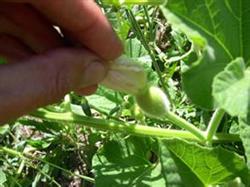
Based on the fruiting habits of melons, there is no pollen on the tip of the female flower, and pollen is only found around the corolla. It is necessary to manually remove the corolla and shake out the pollen, then use a brush to pick up a little of the shaken-out pollen and apply it to the stigma of the female flower. However, note that manual pollination must be done on a sunny day with no dew, and the brush must be kept clean, otherwise pollination will not suc...
 According to experiments, the optimal amount of nitrogen required per melon plant is 6-12 grams, phosphorus 12-18 grams, and potassium 20 grams. Taking into account factors such as fertilizer loss and the actual fertilizer utilization rate of melons, the fertilizer application rate per plant is approximately 12 grams of nitrogen, 25 grams of phosphorus, and 20 grams of potassium. In other words, for every 1000 kg of melons produced, approximately 2.5-3.5 kg of pure nitrogen, 1.3-1.7 kg of phosphorus pentoxide, and 4.4-6.8 kg of potassium oxide need to be absorbed from the soil, with the largest absorption occurring during the fruiting stage.
The soil fertility of each melon field varies. How much fertilizer should be supplemented on top of the original soil fertility must be determined through soil fertility testing. This is not easy to do in actual production. In addition, the farmyard manure mainly composed of barnyard manure used in production varies greatly in fertility, making it difficult to formulate an accurate fertilizer application rate. Therefore, in production, it is usually applied at 4000-5000 kg of farmyard manure per 667 sq m, and this application rate is basically feasible. When applying chemical fertilizers, attention should be paid to the comprehensive application and reasonable combination of the three elements: nitrogen, phosphorus, and potassium. The soils in areas such as ** and Gansu, where specialty Hami melons and Bailan melons and other high-quality thick-skinned melons are produced, are mostly sandy and mildly salinized secondary saline-alkali soils. These mildly salinized sandy loam soils are particularly rich in potassium, which is beneficial for improving melon quality.
In addition to the three elements of nitrogen, phosphorus, and potassium, melons are relatively sensitive to elements such as calcium, magnesium, and boron. Therefore, soil rich in calcium can enhance the sweetness of the fruit. A certain salt content in the soil promotes growth, advances maturity, and increases sugar content. Melons are chlorine-sensitive crops, so chlorine-containing fertilizers such as ammonium chloride and potassium chloride should not be applied. Melons also have relatively high salt tolerance, and can grow normally as long as the salt content in the soil does not exceed 1.14%.