Detailed Explanation of Key Points for Irrigation and Fertilization Techniques for Mango Trees
For every 1000 kg of fresh mangoes produced, N: 1.74 kg, P2O5: 0.23 kg, K2O: 2.0 kg are required. The greatest demand is for potassium, followed by nitrogen and phosphorus. In production, nitrogen, phosphorus, and potassium fertilizers are generally applied at a ratio of N:P2O5:K2O = 1:0.5:0.5 to 1, but for mangoes of different tree ages, in different regions, and at different yield levels...
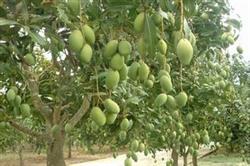 There are mainly two irrigation periods for fruiting mango trees: the first period is after fruit harvest and pruning, when the weather is dry. Irrigation should be combined with post-harvest fertilization to promote autumn shoot growth and cultivate robust fruiting mother branches for the coming year; the second period is during fruit development. During this period, fruit development, cell division, and fruit enlargement all require large amounts of water. Irrigation at this time can fully meet the needs of fruit growth and development and increase yield. Irrigation should be carried out 2-3 times per month depending on weather conditions.
For fruiting trees, the key fertilization work should focus on the following four applications
First, apply post-harvest fertilizer (early June to July): post-harvest fertilizer is the most important fertilization of the year, accounting for 70-80% of the annual fertilizer application. Its main purpose is to promote autumn shoot growth, restore tree vigor, and lay a good foundation for the next year's fruiting. It is mainly based on quick-acting nitrogen fertilizer and organic fertilizer. Apply 30-50 kg of organic fertilizer, 1-1.5 kg of urea, and 0.5 kg of compound fertilizer per tree after fruit harvest and pruning.
Second, apply flower-inducing fertilizer (September to October): normal flower bud differentiation of mango generally occurs in November to December, and flower bud differentiation induced by chemical agents can be advanced to October. Therefore, flower-inducing fertilizer should be applied before the end of the rainy season that year, mainly potassium fertilizer, with 1-1.5 kg of potassium nitrate applied per tree.
Third, apply post-bloom fertilizer: mango flowering causes a large consumption of nutrients, so a quick-acting nitrogen fertilizer should be applied once at flower drop, with 0.5-1 kg of urea or potassium nitrate applied per tree. Urea or potassium nitrate can be dissolved in water to make a 0.5-1% fertilizer solution and sprayed on the leaves for foliar feeding to supplement nutrients.
Fourth, apply fruit-sizing fertilizer: when mangoes are about 30 days after flower drop, during the rapid growth period of young fruit, in order to reduce fruit drop, apply 0.5-1 kg each of urea and potassium nitrate per tree, or other foliar fertilizers.