Five scientific measures for spring cultivation of mini watermelons
Cultivating mini watermelons in early spring has become a planting project favored by many melon growers, but due to climate and other reasons, the cultivation of mini watermelons still requires very scientific methods. Below, we explain 5 measures for scientifically cultivating mini watermelons: 1. Temperature management. Because the natural temperature in early spring is low, after transplanting the focus should be on keeping warm, keeping the greenhouse film tightly closed...
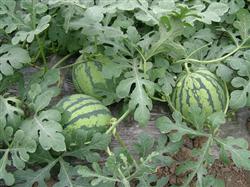
Cultivating mini watermelons in early spring has become a planting project favored by many melon growers, but due to climate and other reasons, the cultivation of mini watermelons still requires very scientific methods. Below, we explain the 5 measures for scientifically cultivating mini watermelons:
1. Temperature management. Because the natural temperature in early spring is low, after transplanting the focus should be on keeping warm, keeping the greenhouse film tightly closed, and covering with double or even multiple layers of film at night so that the greenhouse temperature is not lower than 15°C. When the daytime temperature is high, the small arched frame film can be uncovered for ventilation to reduce temperature and humidity. In the early growth stage, the greenhouse temperature should preferably be 20°C-25°C, during fruit setting 25°C-28°C, and during the fruit enlargement stage, after spraying an enlargement agent, the temperature should be controlled at 28°C-35°C.
2. Pruning and fruit thinning. Mini watermelons have weak early growth and small fruit, and are suitable for retaining multiple vines and setting multiple fruits, so the principle is light pruning. When 5-6 true leaves have grown, retain 5 true leaves and pinch off the growing tip; generally two-vine pruning is used. When the secondary vines grow to 40-50 cm, select and retain two robust and uniform secondary vines, and remove all the rest. After fruit setting, retain 10-15 leaves above the fruit-setting node and remove the growing tip. For trellis cultivation, after two-vine pruning, do not pinch off the tips of the two secondary vines until the vines fill the trellis. After the watermelon enlarges, for the tertiary vines that grow out again at the top, decide whether to keep or remove them on the principle of not blocking light. For ground crawling cultivation, the secondary vines must be coiled, that is, when the secondary vines grow to 80-100 cm, first guide the two secondary vines respectively toward the diagonal rear of the plant's root zone, then coil them into a semicircle, and let the stem tips of the secondary vines turn back to face forward. The distance between coiled vines should preferably be kept at 15-20 cm. Generally, ground crawling cultivation mostly uses multi-vine pruning; when the seedlings reach the 6-leaf stage, pinch off the growing tip, and after the secondary vines form, retain 3-5 vines of similar growth vigor and remove the other secondary vines. In this way, several secondary vines can set fruit at the same time, making the fruit shape uniform. Mini watermelons have small fruit and set fruit easily, especially under multi-vine cultivation they can set fruit successively and set a relatively large number of fruits. Therefore, during the young fruit stage, fruit can be thinned appropriately according to the fruit-setting node, the strength of the vine and the shape of the young fruit, to improve the commercial grade of the fruit. As for the number of fruits retained per plant, it varies with the pruning method: two-vine pruning can retain 3-4 fruits, and 3-, 4-, and 5-vine pruning can retain 5-7 fruits.
3. Artificial pollination. For protected cultivation in early spring, the temperature is low, light is weak, and there are few insects. To promote fruit setting and increase the fruit-setting rate, artificial supplementary pollination should be carried out. This is generally done from 8-11 a.m. If there is continuous rainy weather and the amount of pollen is small, flowers can be dipped with an appropriate concentration of fruit-setting hormone to promote fruit setting, so as to facilitate fruit enlargement, and an enlargement agent can be sprayed. However, the concentration should not be too high, so as to avoid forming deformed fruits, cracked fruits, and the like.
4. Fertilizer and water management. In early spring cultivation, the temperature is low and growth is slow. The first topdressing is at the 3-true-leaf stage, applying 3 kg of ammonium sulfate per mu, irrigated along with water; at the 6-leaf stage apply 6 kg of ammonium sulfate; at the vine extension stage apply 10 kg of ammonium sulfate plus 6 kg of superphosphate; at the early fruit enlargement stage apply 10 kg of ammonium sulfate plus 6 kg of potassium chloride, opened in shallow holes and applied 30 cm from the roots, then watered after application. During the flowering and ripening stage, water less to avoid affecting the fruit-setting rate and causing fruit cracking, and appropriately spray foliar fertilizer to supplement the nutrients needed during growth.
5. Timely harvesting. From sowing to harvest, about 100 days are needed. Fruits set early mature 35-38 days after pollination, fruits set in the middle period mature 32-35 days after pollination, and fruits set late mature in 28-30 days. They can be harvested when the peel color turns from dark to light, the peel stripes are slightly uneven, and the small leaves outside the fruit stalk turn yellow and withered. When harvesting watermelons, a fruit stalk 6-8 cm long needs to be retained, which makes harvesting convenient after the morning dew has dried or in the evening. Mini watermelons have thin rinds and are best in quality when eaten immediately after harvest; if transport is needed, they should be packed in boxes with foam protective netting for market, to ensure the quality of the watermelons.