How can spring open-field watermelons be grown for high yields?
Currently it is the season for sowing and raising seedlings of open-field watermelons. In order to do a good job of watermelon cultivation and increase farmers' income, the key points of spring open-field watermelon cultivation techniques are introduced as follows: 1. Choosing varieties. Varieties should be selected according to market demand, choosing varieties with good quality, high yield and strong disease resistance, such as Qinghongbao...
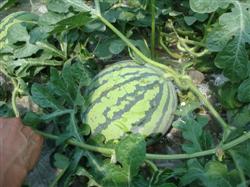
Currently it is the season for sowing and raising seedlings of open-field watermelons. In order to do a good job of watermelon cultivation and increase farmers' income, the key points of spring open-field watermelon cultivation techniques are introduced as follows:
1. Choosing varieties
Varieties should be selected according to market demand, choosing varieties with good quality, high yield and strong disease resistance, such as Qinghongbao, Heifeng Bawang, Jingfengbao, etc.
2. Choosing the planting site
For the watermelon planting plot, choose a sheltered, sunny, level field. Do not plant continuously on the same land. It is advisable to choose a plot with convenient drainage and irrigation, deep soil layers and rich organic matter for planting.
After deep plowing and sun-drying the soil for half a month, break up the soil and make beds, forming a slanted bed 2.5 m wide including the ditch, with one side of the bed 40 cm high and the other side 20 cm high; on the side next to the high bed, dig a planting furrow 25 cm deep and 40 cm wide, and in the furrow apply per mu 1000-1500 kg of decomposed farmyard manure, 25 kg of ternary compound fertilizer, 1.5-2 kg of borax, and 4 kg of magnesium sulfate. When applying in the furrow, the fertilizer should be mixed evenly with the backfilled soil.
3. Seed soaking
Select plump watermelon seeds and soak them in warm water at 55 degrees C, stirring constantly. When the water temperature drops to 30 degrees C, continue soaking for 5 hours, wash off the mucus on the seed coat, drain off the water and sow promptly.
4. Sowing at the right time
For early spring open-field watermelon fields using plastic film mulching, the sowing time is preferably in late April. The sowing method is dibbling in the middle of the plastic film, 2-3 seeds per hole, with a sowing depth of 2 cm. After dibbling, cover flat with fine soil and press firmly. Generally, the seed rate is 200 g per mu.
5. Seedling management and seedling retention density
After emergence, pay attention to ventilating the seedlings in time to prevent them from being scorched to death. Watermelon seedlings can be transplanted when they have 3-4 leaves. The planting density per mu is 600-700 plants for large watermelons and 700-800 plants for small watermelons.
6. Field management
1. Fertilizer and water management. When fertilizing, be careful with the seedling-promoting fertilizer, apply the vine-extending fertilizer skillfully, and apply the fruit-swelling fertilizer heavily. The seedling-promoting fertilizer is applied 5-7 days after transplanting, after the seedlings have recovered. Generally, urea and compound fertilizer are mixed in a 1:2 ratio to make a 0.3% solution and applied once. The vine-extending fertilizer is generally applied about 20 days after the seedling-promoting fertilizer, using 10-15 g of urea and 15 g of potassium fertilizer per plant. Open strip furrows 25 cm deep on both sides 35 cm away from the transplanting point, apply the fertilizer in the furrows and cover with soil. The fruit-swelling fertilizer is applied when the young fruit is the size of an egg, using 30-40 g of urea, 15 g of superphosphate and 30-40 g of potassium fertilizer per plant, at 50 cm away from the transplanting point. The application method is the same as for the vine-extending fertilizer, but the furrow position should be perpendicular to the vine-extending fertilizer furrow.
For spring-planted watermelons, drainage after rain must be done in time, so that the furrows dry after the rain stops. If high temperature and drought occur during the fruit-setting period, furrow irrigation can be used at night, but the bed surface must be kept slightly dry and then drained.
2. Intertillage and weeding. Intertillage and weeding should be carried out when the watermelon vines are 40-50 cm long. If the vines are too long when intertilling, not only is the operation inconvenient, but the vines and leaves are easily damaged, allowing disease to invade, and the loosened soil easily splashes mud onto the leaves, flowers and young fruits after rain.
3. Pruning and vine training. Common pruning methods include the two-vine type and the three-vine type. The two-vine type means keeping the main vine and one robust side vine at the base of the main vine, and removing the other side vines early. This method is suitable for dense planting and has a high fruit-setting rate, and is more often used in early-maturing cultivation or in plots with relatively poor soil. The three-vine type means keeping the main vine and selecting 2 robust side vines from the third to fifth nodes at the base of the main vine, removing the other side vines. This method is more commonly used for mid- and late-maturing varieties. From when the main vine emerges until the first female flower opens, arrange the watermelon seedlings once every 3-4 days so that the main vine extends forward in an orderly manner. After flowering, no more vine training is carried out.
4. Artificial pollination. Spring-planted watermelons are prone to continuous rainy weather, which affects insect activity. Artificial pollination can be adopted to increase the fruit-setting rate.
5. Promoting fruit setting. It is ideal to select and keep the second and third female flowers on the main vine for fruit setting. Fruits set from female flowers very far from the main root are also relatively small and are generally not suitable to keep.
6. Fruit management. In the process of multi-vine pruning and cultivation, sometimes several fruits are set on one plant or the fruit-setting nodes are not ideal. At this time, fruit removal measures should be taken, removing young fruits at low nodes or with irregular shape, disease or injury, so as to retain and ensure the development of normal fruits at normal nodes.
7. Pest and disease control
For watermelon pest and disease control, comprehensive control measures should be adopted.
1. Agricultural control. First, clear the weeds in the ditches and roadsides near the watermelon field to reduce the hosts available to pests in the early stage; second, pay attention to removing diseased watermelon plants. Diseased plants should be pulled out and buried deeply in a centralized place or burned, and should not be casually discarded in ditches or on roadsides.
2. Chemical control. To control fusarium wilt, use 50% carbendazim wettable powder at 500 times dilution or 70% thiophanate-methyl at 1000 times dilution for root irrigation once, with 250 ml of the liquid per hole. Viral disease is mainly transmitted by aphids, so the focus should be on controlling aphids to prevent the disease. Before the aphid peak, spray 20% imidacloprid at 1500 times dilution for control. When virus-diseased plants are found, spray 20% virus A at 600 times dilution, once every 7 days, for 2-3 consecutive times. In the early stage of anthracnose, spray 80% carbendazim-ziram at 800 times dilution or 70% thiophanate-methyl wettable powder at 500 times dilution.
8. Harvesting
They can mature and be harvested for market 30-35 days after pollination. When harvesting, keep the fruit stalk and a section of vine, which not only prevents pathogen invasion but also has a certain fresh-keeping effect.