Detailed Explanation of Key Techniques for High-Yield Spring Watermelon Cultivation
1. Select disease-resistant, high-yield, high-quality improved varieties: For medium-to-large fruit watermelons, you can choose Xinong No. 8, Japanese Jubao Wang, Qingbao Wang, Heiju Guan, Gannong No. 8; for small watermelons, you can choose Heimeiren small watermelon; for seedless watermelons, Heimi No. 1 and No. 2. 2. Choose a good planting site: It is advisable to choose a site with a certain slope, convenient drainage and irrigation...
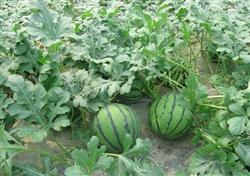
1. Select disease-resistant, high-yield, high-quality improved varieties: For medium-to-large fruit watermelons, you can choose Xinong No. 8, Japanese Jubao Wang, Qingbao Wang, Heiju Guan, Gannong No. 8; for small watermelons, you can choose Heimeiren small watermelon; for seedless watermelons, Heimi No. 1 and No. 2.
2. Choose a good planting site: It is advisable to choose light loam or medium loam with a certain slope, convenient drainage and irrigation, deep soil layer, and rich organic matter for planting. Watermelon is a crop that cannot be continuously cropped, and it requires paddy fields that have not grown cucurbit crops for 3 years or dry land for more than 5 years.
3. Sow at the appropriate time and cultivate strong seedlings: For early spring watermelon planting using double-film mulching, the sowing period can be in mid-January. At the same time, use heated hotbeds or nutrient pots plus small arched sheds for seedling cultivation. For nutrient pots, plastic nutrient pots with a specification of 8×10 cm can be used.
4. Finely prepare the soil and apply sufficient base fertilizer: Deeply plow the soil and expose it to the sun for half a month. Apply 50-75 kg of quicklime per mu by broadcasting, then break up the soil and prepare the beds. Make connected beds with ditches at 2.5 m, with one side of the bed 40 cm high and the other side 20 cm high, forming a sloped bed; on the side near the high bed, dig a planting ditch 25 cm deep and 40 cm wide. In the ditch, apply 1000-1500 kg of decomposed farmyard manure per mu, 25 kg of ternary compound fertilizer, 1.5-2 kg of borax, and 4 kg of magnesium sulfate. When applying in the ditch, the fertilizer should be mixed evenly with the backfilled soil.
5. Transplanting: Watermelon seedlings can be transplanted when they have 3-4 leaves. The planting density per mu is 400-500 plants for large watermelons and 600-700 plants for small watermelons. The planting holes should be 10-15 cm in diameter and 10 cm deep.
6. Double-film mulching: Plastic film plus arched film. Before covering the film, spray 100 ml of butachlor emulsifiable concentrate mixed with 60 kg of water per mu over the entire area. When covering the film, pull it tight and press the edges firmly. Cut a "+"-shaped opening in the plastic film at the planting holes, move the seedlings in, fix them with soil, water each plant to settle the roots, then seal the film opening with soil. Finally, insert the arched frames and cover with the arched film.
7. Field management:
① Fertilizer and water management: The principle for topdressing is to apply seedling-promoting fertilizer cautiously, apply vine-extending fertilizer skillfully, and apply fruit-swelling fertilizer heavily. The seedling-promoting fertilizer is applied 5-7 days after transplanting once the seedlings have recovered. Generally, urea and compound fertilizer at a 1:2 ratio made into a 0.3% solution is applied once. The vine-extending fertilizer is generally applied about 20 days after the seedling-promoting fertilizer. Use 10-15 g of urea and 15 g of potassium fertilizer per plant. Open 25 cm deep furrows on both sides 35 cm from the transplanting point, apply the fertilizer in the furrows, and cover with soil. The fruit-swelling fertilizer is applied when the young fruit is the size of an egg. Use 30-40 g of urea, 15 g of calcium superphosphate, and 30-40 g of potassium fertilizer per plant at 50 cm from the transplanting point. The application method is the same as for the vine-extending fertilizer, but the furrow position should be perpendicular to the vine-extending fertilizer furrow.
Water management: For spring-planted watermelon, drainage after rain must be done promptly, ensuring the ditches are dry once the rain stops. If high temperature and drought occur during the fruit-setting period, furrow irrigation can be used at night, but the bed surface must be kept slightly dry and then drained.
② Cultivation, weeding, and earthing up: Cultivation, weeding, and earthing up should be carried out when watermelon vines are 40-50 cm long. If the vines are too long when cultivating, not only is the operation inconvenient, but it is also easy to damage the vines and leaves and allow disease to enter. Moreover, the loosened soil may splash onto leaves, flowers, and young fruits after rain.
③ Pruning and vine guiding: Vine guiding and pruning should be done on sunny days after the dew on the leaves and vines has dried. Guide the vines toward the lower side of the bed. When guiding the vines, do not turn them at will and do not twist the vines. Use the two-vine pruning method, that is, in addition to the main vine, select and keep one strong lateral vine at the base. For lower densities, use the three-vine pruning method.
④ Artificial pollination: Spring-planted watermelon often encounters continuous rainy weather, which affects insect activity. Artificial pollination can be used to increase the fruit-setting rate.
8. Pest and disease control: Integrated control measures should be adopted for watermelon pest and disease control.
⑴ Soil and seed disinfection: The cultivation site must undergo paddy-upland rotation, with a rotation period of more than 3 years. For soil disinfection, 2-3 kg of 40% quintozene per mu can be used, mixed with 50 kg of poisoned soil and broadcast over the entire field, or 0.1% quintozene solution can be applied to the holes. For seed disinfection, soak seeds in warm water at 50°C for 20 minutes, then soak in cold water for 8-12 hours, then germinate; or soak seeds in 800 times 25% metalaxyl for 30 minutes, then soak in clean water for 8-12 hours, then germinate.
⑵ Cultivate disease-free strong seedlings: Strengthen field management during the seedling stage to improve plant disease resistance. During the seedling stage, spray 800 times 80% metalaxyl to control damping-off.
⑶ Clean the garden and maintain garden hygiene.
⑷ Promote cultivation methods with deep ditches and high beds.
⑸ Advocate the use of organic fertilizer, stop partial application of nitrogen fertilizer, and apply more phosphorus and potassium fertilizer.
⑹ Chemical control: ① Phytophthora blight and downy mildew: Use 800 times 50% carbendazim or 800 times 75% chlorothalonil or 500 times 25% metalaxyl, and spray again after 7 days, for 2-3 consecutive times. ② Anthracnose: The main disease control uses 500 times 50% carbendazim or 700 times 75% chlorothalonil or 800 times 80% anthracnose thiram by spraying, once every 5 days, for 2-3 consecutive times. ③ Southern blight: Spray 500 times 50% carbendazim or 1200 times 20% triadimefon or 1000 times 50% quintozene. ④ Gummy stem blight: Use 600 times 75% chlorothalonil or 800 times 50% thiophanate-methyl by spraying. ⑤ Fusarium wilt: Adopt disease-resistant varieties, paddy-upland rotation, seed disinfection, spray 1000 times potassium permanganate solution in the evening, drench roots with 500 times 50% carbendazim solution, drench roots with 1500 times 20% triadimefon. The best method for controlling Fusarium wilt is to use pumpkin or bottle gourd as rootstock for grafting. ⑥ Viral disease: The main virus types are tobacco mosaic virus and cucumber mosaic virus. Adopt seed disinfection, spray 500 times 20% Virus A solution. Yunda 120 and brassinolide have the best control effect on viral disease. Spray at the 4-5 leaf stage during the seedling stage. ⑦ Aphids: Whitefly occurs commonly and severely. Use Dagongchen and imidacloprid for control. ⑧ Leafminer: Use 5000 times abamectin and insect mite control solution. ⑨ Aulacophora femoralis: Spray 800 times Tuojialing. ⑩ Melon fly: Spray 2000 times deltamethrin and 5000 times avermectin.
9. Harvesting: After pollination, it matures and can be harvested for market in 30-35 days.