What are the control methods for watermelon fruit hardening in spring
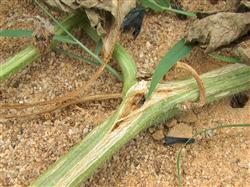
In recent years, protected cultivation of watermelon has developed rapidly in the Jiangsu area. Due to the many rainy days during the growing period, favorable conditions have been provided for the occurrence of watermelon gummy stem blight, and the disease has worsened year by year. Watermelon gummy stem blight mainly damages the stems and vines, and also damages leaves and fruits. When the vines are affected, the disease mostly occurs at the stem nodes near the ground, first appearing as dark green...
 At present, it is exactly the growing period of spring Festival watermelon. Due to poor management, watermelon fruit hardening is easily caused. The causes of fruit hardening are the following types:
1. Excessive vine growth: the nutrients produced are mostly consumed by stem and leaf growth, which cannot meet the needs of fruit enlargement, resulting in a rampant growth state. Strong seedlings should be cultivated to lay a good foundation for normal fruit development. Before and after fruit setting, the amount and timing of fruit-swelling fertilizer application should be adjusted according to the size of new leaves, the thickness of the vines, the length of internodes, and the length from the top of the vine to the node of the opened female flower. If the length from the top of the vine to the node of the opened female flower exceeds 67 cm, it indicates that the vine growth is excessive and its growth should be suppressed; if its length is less than 50 cm, it indicates that the vine growth is weak and topdressing should be applied immediately to promote its growth; if its length is within the range of 50-67 cm, it indicates that the vine growth is normal.
2. Dry soil and insufficient fertilizer and water: if fertilizer and water are insufficient during the fruit enlargement period, hardened fruit is easily formed. Therefore, the watermelon field should be irrigated, with the amount of water increasing from small to large, and the water should not cover the bed surface. The retention time of water in the field should not be too long. Irrigation should be done in the evening or at night to avoid burning the roots at high temperatures. In developing watermelon in hilly areas, water storage should be increased before winter, and the method of raising seedlings and transplanting should be adopted to strive for early fruit setting and reduce the impact of drought on fruit enlargement. When the young fruit grows to the size of an egg, apply fruit-swelling fertilizer in time.
Insufficient functional leaves: generally speaking, fruits with more leaves grow larger and have better quality. Therefore, a considerable number of functional leaves should be present in cultivation to carry out photosynthesis and meet the needs of fruit enlargement.
4. During pollination, the amount of pollen from male flowers applied to the stigma of female flowers is insufficient. The number of seeds has an important impact on fruit development. Under the same conditions, fruits with more seeds grow larger. Therefore, the best timing should be selected to apply as much pollen with strong viability as possible to the stigma, so as to increase the number of seeds and achieve the goal of high yield.
5. Female flowers that are slender, weak, and have sparse hairs are not easy to set fruit after pollination, and even if fruit is set, it is difficult for it to grow large. Therefore, female flowers with well-developed buds, large size, and vigorous growth should be selected for pollination. The main characteristics of high-quality female flowers are a thick fruit stalk, a large ovary, normal shape, tender green and glossy color, and densely grown hairs.
6. Leaves seriously harmed by pests and diseases cannot carry out photosynthesis normally, affecting fruit development.
7. Fruit setting is too close or too far, and fruit enlargement is affected by many aspects and becomes hardened.