What are the control methods for navel orange fruit cracking?
I. Causes 1. Climate: high temperature and drought in summer damage the peel tissue and cells; excessive rainfall after a long drought causes water uptake, creating excessive turgor pressure that damages the peel; 2. Peel factors: the peel tends toward maturity, the peel becomes thinner, and the flesh becomes softer; sugars in the juice continuously accumulate, accelerating water uptake and increasing turgor pressure; 3. Cultivation...
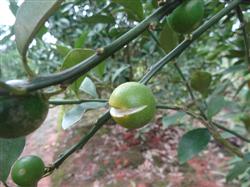
I. Causes
1. Climate: high temperature and drought in summer damage the peel tissue and cells; excessive rainfall after a long drought causes water uptake, creating excessive turgor pressure that damages the peel;
2. Peel factors: the peel tends toward maturity, the peel becomes thinner, and the flesh becomes softer; sugars in the juice continuously accumulate, accelerating water uptake and increasing turgor pressure;
3. Cultivation factors: excessive P application; drastic changes between drought and wetness in soil moisture; overly weak tree vigor; overly shallow root system;
4. Biological causes (1) Flowers -- leafless flowers and leafy single flowers have a higher proportion of fruit cracking. Leafy single flowers produce the largest fruit, the most lopsided fruit, the most segments, and are the most prone to cracking. Among inflorescence branches, the 2nd-3rd fruit from the top cracks the least. When temperatures are high before and after flowering, longitudinal growth of young fruit is promoted, making cracking less likely; (2) Fruit -- flat-shaped fruit cracks easily, long-shaped fruit does not crack easily. Fruit with a thin peel at the apex cracks easily. Fruit with more segments cracks easily; (3) Navel -- fruit with a large navel cracks easily. Order of navel shape and severity of cracking: sunken navel > flat navel > closed navel > protruding navel. The more segments and the larger the volume of the secondary fruit, the more prone to cracking
II. Control measures
1. Select varieties and strains with good quality and low susceptibility to fruit cracking;
2. Increase application of organic fertilizer, cultivate a deep and well-developed root system, and strengthen tree vigor;
3. Increase application of N fertilizer and K fertilizer to enhance peel vitality and thickness;
4. Regulate water well in summer and autumn, and drain and irrigate in a timely manner;
5. Thin fruit according to flower type, first removing leafless flowers and fruit, leafy single flowers and fruit, and flat-shaped fruit. By thinning fruit well, the fruit cracking rate can be controlled below 5%;
6. Cultivate high-quality flower types, promote the development of inflorescence branches and make them full, with each inflorescence branch bearing 3-4 flowers and 4-6 leaves;
7. Strengthen tree vigor so that the tree body stores sufficient nutrients. Shorten inflorescence branches to suppress flower number, and manage fertilizer and water reasonably in autumn and winter;
8. Preventive treatment measures for fruit cracking ① If water and nutrients are insufficient from spring bud break to around flowering, this indicates that severe fruit cracking will occur in summer, so foliar nitrogen spraying and corresponding irrigation are advisable; ② Drastic changes in soil moisture in summer and autumn are the direct trigger of fruit cracking, so on the premise of not affecting quality, irrigate to prevent the soil from becoming too dry; ③ In early summer, apply 5-10 ppm GA3 solution to the fruit apex.