How to cultivate dragon fruit for high yield? Proper cultivation is key
1. Site selection. Dragon fruit is drought-tolerant but not moisture-tolerant, and fears low temperatures; it can be planted in areas with an annual average temperature above 20°C. When establishing an orchard, choose sloping hillside land with good drainage, fertile and loose soil, good aggregate structure, and loam, sandy loam, or clay loam that has not become sandy. Soil moisture must not be too high and aeration must be good, otherwise root and seedling rot easily occurs...
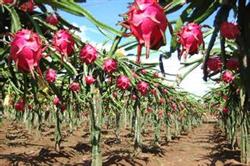
1. Site selection. Dragon fruit is drought-tolerant but not moisture-tolerant, and fears low temperatures; it can be planted in areas with an annual average temperature above 20°C. When establishing an orchard, choose sloping hillside land with good drainage, fertile and loose soil, good aggregate structure, and loam, sandy loam, or clay loam that has not become sandy. Soil moisture must not be too high and aeration must be good, otherwise root and seedling rot easily occurs.
2. Erecting supports. Dragon fruit needs a support to climb up; after the branches reach the top they naturally droop, and only the drooping branches easily become fruiting branches. The support must be sturdy and durable. There are various ways to plant dragon fruit; some grow it against walls, some grow it under trellises, but column-type cultivation is the most common, as it has low production cost, is convenient to manage, and has high land utilization. Generally, dragon fruit growers mainly use cement column supports. With a plant-to-row spacing of 2.5 x 2.5 m, erect cement columns, 110 columns per mu; the cement columns (specification 8 x 8 x 210 cm) are buried 50 cm into the ground, with 160 cm above ground, and a ring about 60 cm like a motorcycle tire is fixed at the top of the cement column for the branches and vines to grow. After the cement columns are erected, plant 4 dragon fruit plants around each column, 440 plants per mu.
3. Raising seedlings and planting.
① Raising seedlings. Dragon fruit seedlings are a type of grafted seedling; the rootstock is night-blooming cereus (also called night-blooming cereus, queen of the night), and then the dragon fruit scion is used. First insert and plant 30 cm-long night-blooming cereus pseudostems; after the pseudostems sprout, carry out grafting, and only after half a year can they be transplanted and planted.
② Planting. On gentle slopes, build terraces for planting. After the planting points are determined, prepare the beds; within the 3 m row spacing, leave an inner 1 m as a walking path, and use the 2 m width at the foot of the support frame and cement column as the planting bed, with a bed height of 40 cm. Apply some farmyard manure, granular organic fertilizer, etc. in the bed and mix evenly with the soil. The planting density of dragon fruit is a hole-to-row spacing of 2.5 x 2.5 m, with 2 plants per hole; the planting depth is 5-7.5 cm. After planting the seedlings, cover with topsoil and press the seedlings slightly firm; never plant the seedlings upside down. After planting, water once to settle the roots; at first, water once every 2-3 days, and afterward just keep the soil moist. You can also spread some straw, rice husks, etc. on the surface to suppress weed growth and retain moisture.
4. Fertilizer and water management. Dig pits around the climbing column with length, width, and depth of 0.3 x 0.3 x 0.1 m. In the pits apply 25 kg of pig manure or chicken manure, 1 kg of phosphate fertilizer, 0.5 kg of compound fertilizer, and 1 kg of lime, mix evenly with soil and apply, and the effect is even better if supplemented with microbial compound fertilizer. After the dragon fruit plants begin normal growth, apply light fertilizer or organic fertilizer, 1-2 times per month. During the growth stage, nitrogen, phosphorus, and potassium must be balanced, and do not emphasize nitrogen fertilizer too much; after flowering and fruiting, phosphorus and potassium fertilizers should be the main focus. In addition, a 300-fold solution of potassium dihydrogen phosphate can be sprayed on the leaves throughout the year. Dragon fruit has high yield, and the fruiting period lasts as long as 6 months, ripening in several batches, which can thus satisfy the nutrients needed for the growth and development of dragon fruit.
5. Pollination, flower thinning, and harvesting. Dragon fruit has red-fleshed and white-fleshed types. The white-fleshed varieties have a fruit-setting rate of up to 98%, while red-fleshed varieties have poorer self-compatibility. During the peak flowering and fruiting period, there are quite a lot of flower buds; sometimes a single branch has nearly 30 flower buds, so within 8 days after the flower buds appear, the excess buds must be thinned, leaving only 1-2 per branch. Pollination is best done from 10 p.m. to 1 a.m. the next day; take the pollen from the male flowers and apply it with a brush to the stigma of the female flowers. On the 26th-27th day after the flowers fade, the fruit skin begins to turn red; after another 7-10 days, when the fruit surface is swollen and round and appears glossy, it can be harvested. When harvesting, cut off part of the stem flesh from the fruit stalk area, and retain the fruit stalk as much as possible; fruits with the stalk are more resistant to storage.
6. Pest and disease control. At the seedling stage, the main control targets are snails, slugs, and caterpillars; lime, plant ash, or poison bait can be spread at the base of the plants to trap and kill them. When caterpillars are severe, insecticides can be used. Generally, spraying starts when new shoots emerge about 3 cm; the agents include 90% trichlorfon or 80% dichlorvos plus 50% dimethoate at 1000-fold solution each; 20% fenvalerate or 2.5% deltamethrin at 2000-3000-fold solution; 50% phenthoate at 1000-fold solution. Apply once every 7-10 days, spraying 2-3 times in succession. In the middle stage of fruit development, bagging can be done to prevent fruit flies from eating the flesh.
7. Pruning and propagation. After the production season ends, all old branches that have fruited and been pulled by the fruit to hang vertically toward the ground should be cut off. For dragon fruit entering the peak production period, excess vegetative branches can be cut off during the flowering period to reduce shading and nutrient consumption.
The cut branches can be used for cutting propagation. When cutting, cut the branches into about 30 cm lengths, place them in a cool, ventilated place until the wounds dry, then insert them in sand or directly insert them under the support frame and beside the cement column. Except during frost periods, this can be done at any time. After cutting, do not water; the soil should be dry, and watering begins only 10 days after planting.
8. Replanting and pruning. For individual planting holes with weaker growth, replant new seedlings to increase next year's yield. Cut off old branches that have already fruited and branches with weaker growth vigor, so as to avoid consuming nutrients and affecting yield.