Detailed Explanation of Key Techniques for Greenhouse Cultivation of Hami Melon
In recent years, ** Hami melons have been successfully introduced, demonstrated, and promoted in the Jiading area, and a number of Hami melon varieties suitable for cultivation in the eastern region have been selected, among which Xuelihong has become the leading Hami melon variety in this district. At the same time, through the "base + farmers" model, Hami melons have been promoted to a large number of farmers, and a...
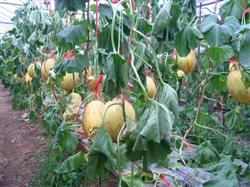
In recent years, ** Hami melons have been successfully introduced, demonstrated, and promoted in the Jiading area, and a number of Hami melon varieties suitable for cultivation in the eastern region have been selected, among which Xuelihong has become the leading Hami melon variety in this district. At the same time, through the "base + farmers" model, Hami melons have been promoted to a large number of farmers, and a relatively mature set of greenhouse cultivation techniques for Hami melon has been formed. The greenhouse cultivation techniques are introduced as follows:
I. Variety Characteristics
Xuelihong, a thick-skinned melon bred by the ** Hami Melon Research Center, is an early-to-mid-maturing variety. The fruit development period is about 40 days. The fruit is elliptical, with white skin and occasional sparse netting, turning white with a pink blush when ripe; the flesh is light red, tender in texture, crisp and refreshing, melting in the mouth, with a taste similar to fragrant pear. The central refractometer sugar content is above 15%, and the single fruit weight is about 2.5 kg.
II. Determination of Sowing Time
The best sowing period for spring greenhouse cultivation of Hami melon in the Shanghai area: late January to early February.
III. Raising Strong Seedlings
1. Seed Treatment
Dry treatment may be used: bake dry seeds in a constant-temperature drying oven at 60-69°C for about 3 days, which gives a good disinfection and sterilization effect. If this condition is unavailable, sun the seeds under strong sunlight for 2 days.
2. Sowing
When sowing, first, the pot surface should be flat and the seedling pots should be arranged tightly together; second, the seedbed should be watered thoroughly, and sowing should be done after the water has seeped down; third, one seed per pot, with the seed placed flat; third, the covering soil should be uniform in depth, preferably about 1 cm thick, and gently compacted after sowing.
3. Seedbed Management
Spring seedling raising emphasizes heat preservation and disease prevention. The seedbed uses multi-layer film covering, and electric heating wires are laid on the ground.
Temperature management: adopt the "two high and two low" variable temperature management method. That is, before emergence, the seedbed temperature should be maintained at 30-32°C during the day and 18-20°C at night to promote uniform emergence; before the first true leaf unfolds, the bed temperature should be appropriately lowered, maintained between 25-28°C during the day and 15-16°C at night to prevent leggy seedlings; until the third true leaf appears, the bed temperature should be appropriately raised, maintained between 30-32°C during the day and 18-20°C at night to promote early true leaf emergence; one week before planting, carry out low-temperature hardening to gradually adapt the seedlings to field environmental conditions.