Detailed Explanation of Key Techniques for High-Yield Hami Melon Cultivation
I. Sowing at the Right Time and Raising Strong Seedlings
Sow and raise seedlings from the end of December to early January of the following year, with a seedling age of 30 days. Before sowing, disinfect the seeds, soak them, and sprout them. For the nutrient soil, use soil that has never grown cucurbit crops or paddy field soil, and apply 2000 kg of decomposed manure and 10 kg of superphosphate per 667 sq m as base fertilizer. ...
I. Sowing at the Right Time and Raising Strong Seedlings
Sow and raise seedlings from the end of December to early January of the following year, with a seedling age of 30 days. Before sowing, disinfect the seeds, soak them, and sprout them. For the nutrient soil, use soil that has never grown cucurbit crops or paddy field soil, and apply 2000 kg of decomposed manure and 10 kg of superphosphate per 667 sq m as base fertilizer. To prevent disease, apply 3 kg of 50% carbendazim per 667 sq m to disinfect the soil.
II. Transplanting at the Right Time and Reasonable Close Planting
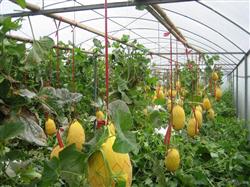
For planting Hami melons, a greenhouse should be built 15 days before transplanting, preferably 4-5 m wide, with raised beds 2 m wide and 15 cm high made inside, covered with plastic film, and the middle of the bed serving as the transplanting row. Transplant when the seedlings have 2 true leaves and 1 heart leaf, planting 600 plants per 667 sq m. Note that the soil temperature should be above 15°C when transplanting.
III. Fertilizer and Water Management
Apply sufficient base fertilizer: 50 kg of nitrogen-phosphorus-potassium compound fertilizer per 667 sq m, or 4000 kg of decomposed manure. Two-thirds of the base fertilizer should be deeply applied 15 days before transplanting, and the remaining one-third applied in a furrow 10 cm from the transplanting row, then covered with soil and film. Do not fertilize before fruit set; apply fruit-swelling fertilizer when the melons reach the size of a duck egg. Hami melons are very sensitive to water; the soil should be kept dry rather than wet, but not excessively dry.
IV. Temperature Management
From transplanting to establishment, keep the temperature above 18°C at night and 25-30°C during the day; from establishment to flowering, above 15°C at night and 30°C during the day. The main measure for temperature control is timely ventilation: ventilate little when the seedlings are small and more when they are large, especially around noon on sunny days. During fruit set, keep the temperature at 25-28°C during the day and 15-18°C at night. After fruit set, maintain the greenhouse temperature at 30-35°C during the day and 15-18°C at night.
V. Pruning and Pinching
Generally, the two-vine pruning method on secondary vines is used: when the seedlings have 2-3 true leaves, remove the growing point with a bamboo stick to promote the development of secondary vines from the two nodes below; tertiary vines grow from the secondary vines. Remove tertiary vines below the 5th-6th node of the secondary vines, and use the middle tertiary vines above the 5th-6th node for fruit set. Tertiary vines usually produce female flowers at the 1st node; tertiary vines that produce female flowers late tend to grow excessively and should be removed, and tertiary vines above the 12th node should also be removed, keeping tertiary vines at nodes 7-12 for fruit set. After a tertiary vine sets fruit, pinch it off leaving 1 leaf before the fruit. Tertiary vines that do not set fruit should be pinched off leaving 2 leaves. Pinch off secondary vines at 20 leaves. Pruning must be done promptly, preferably on sunny days, to help wounds heal.
VI. Artificial Pollination
The best time is before 10 a.m. or after 3 p.m., or use bees for insect pollination, or use efficient fruit-setting agent to assist fruit set.
VII. Pest and Disease Control
The main pests are aphids and red spider mites, which can be controlled with deltamethrin. The main diseases are powdery mildew, anthracnose, gummy stem blight, downy mildew, and bacterial angular leaf spot, which can be controlled with triadimefon, chlorothalonil, metalaxyl mancozeb, agricultural streptomycin, and others respectively.