Symptoms and Control Methods of Root-Knot Nematode Disease in Hami Melon
Root-knot nematode disease is an important disease of Hami melon, occurring and distributed in some areas. It can develop both in protected cultivation and in open fields, with more severe incidence in autumn. Infection at the seedling stage has a great impact on production, and after onset the diseased plant rate often reaches more than 60%, significantly affecting Hami melon production. The symptoms mainly damage the root system, producing on the main root and lateral roots...
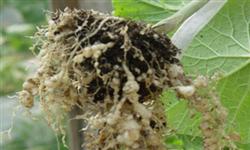
Root-knot nematode disease is an important disease of Hami melon, occurring and distributed in some areas. It can develop both in protected cultivation and in open fields, with more severe incidence in autumn. Infection at the seedling stage has a great impact on production, and after onset the diseased plant rate often reaches more than 60%, significantly affecting Hami melon production.
The symptoms mainly damage the root system, producing many milky-white root knots of varying sizes on the main root and lateral roots. When the root knots are cut open, white semi-transparent pear-shaped nematodes can be seen. In the late stage of the disease, the diseased roots darken in color and finally rot. The aboveground parts of the plant or seedling fade in leaf color as the disease progresses, gradually wilting from bottom to top until all die.
The pathogen Meloidogyne incognita Chitwood is called the southern root-knot nematode. The pathogenic nematode is sexually dimorphic, with larvae being slender and worm-like. The male adult is linear, slightly rounded at the tail end, colorless and transparent, measuring 1.0-1.5mm x 0.03-0.04mm. The female adult is pear-shaped, and each female nematode can lay 300-800 eggs, embedded in the host tissue, measuring 0.44-1.59mm x 0.26-0.81mm.
Disease characteristics: The southern root-knot nematode can overwinter by damaging and reproducing on various vegetables in winter. In northern vegetable-growing areas, the nematode mainly overwinters as female adults in egg sac masses expelled within root knots, together with diseased plant residues in protected cultivation soil. When the temperature rises, overwintering eggs hatch into larvae, or some overwintering larvae continue to develop and become active in the surface soil layer. Upon encountering a host, they invade from the young roots, stimulating host cell division and proliferation to form giant cells, and excessive division forms tumor-like root knots. The larvae develop into adults within the root knots and begin mating and laying eggs. The eggs hatch within the root knots; first-instar larvae remain inside the eggs, while second-instar larvae bore out of the host to cause secondary infection. They are mainly spread through diseased soil, diseased seedlings, irrigation water and farm tools. Under conditions of soil temperature 20-30°C and humidity 40%-70%, the nematode reproduces very quickly and easily accumulates in large numbers in the soil. Generally, plots or greenhouses with high and dry terrain, loose soil texture, and lack of water and fertilizer have more severe incidence. Usually greenhouses are more severely affected than plastic tunnels, and plastic tunnels more than open fields. In addition, continuous cropping of the same crop leads to more severe incidence.
Control Methods
(1) Agricultural control.
Raise seedlings in disease-free soil. In areas where the disease frequently occurs, use nematode-free soil or field soil for raising seedlings, and apply organic fertilizer that does not contain diseased plant residues or is fully decomposed. Substrate can also be used for raising seedlings, and attention should be paid to preventing human-mediated spread.
After harvest in severely affected plots, the diseased roots and residues should be thoroughly removed, and the soil should be deep-plowed 30-50cm. In late spring and early summer, solar high-temperature disinfection should be carried out to kill pests. That is, after the previous crop is pulled up, apply quicklime and chopped rice straw at 4.5-7.5t/hm2 respectively, plow and mix evenly, then dig trenches and form ridges or make beds, fill with water, cover with plastic film and press it down firmly, then seal the greenhouse for 10-15 days, which can kill all nematodes, pathogens, weeds, etc. in the soil. After treatment, note to increase the application of biological bacterial fertilizer.
(2) Chemical control.
Before sowing or transplanting, carry out soil treatment according to the nature of the pesticide. You can choose 1.8% abamectin EC at 10-15L/hm2, dilute with water and apply evenly to the seedbed, or apply to the transplanting furrow or transplanting hole before sowing or transplanting. You can also use 98%-100% dazomet microgranules at 75-120kg/hm2, evenly broadcast or applied in furrows within the top 20cm of soil. After application, immediately cover with soil, sprinkle water to seal or cover with film for 7-12 days, then loosen the soil and aerate for 3-10 days, then sow or transplant. You can also use 3% miler granules at 22.5-30kg/hm2 evenly applied into the transplanting furrows or holes.