How to treat bacterial leaf spot in Hami melon? Detailed guide to chemical control methods
Bacterial leaf spot is a major disease of Hami melon. It can occur in both protected and open-field cultivation. In severely affected fields or greenhouses, the diseased plant rate can reach over 80%, and severely diseased plants die from the disease, significantly affecting production. The symptoms mainly affect the leaves, and in severe cases also infect the stems, vines and fruit. When leaves are infected, initially dark green oil-soaked small spots appear, with...
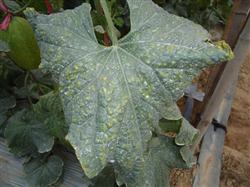 Symptoms: The disease can occur throughout the entire growth period of melon. It mainly affects the leaves, and can also affect the fruit and stems and vines. Leaf infection: On the cotyledons, round to irregular light yellowish-brown, translucent dot-like lesions can be seen. When true leaves are infected, water-soaked small spots appear on the leaves, and the lesions gradually expand, restricted by the leaf veins, taking on a polygonal to irregular shape. Sometimes yellow-white bacterial ooze exudes on the underside of the leaves. In the later stage, the diseased leaves dry up and turn yellowish-brown, and the lesions tend to crack and fall off. Stem and fruit infection: Initially water-soaked, sunken spots appear, carrying large amounts of bacterial slime. The lesion area on the fruit surface tends to rot and split open, and after spreading inward it extends all the way to the seeds, causing the seeds to carry the bacteria.
Pathogen: Pseudomonas syringae pv. lachrymans, a bacterium.
Control methods:
(1) Select disease-tolerant varieties.
(2) Select and keep seeds from disease-free melons. Melon seeds can be subjected to dry heat sterilization at a constant 70°C for 72 hours, or soaked in warm water at 50°C for 20 minutes, removed and air-dried, then germinated and sown; they can also be soaked in 300-fold calcium hypochlorite solution for 30-60 minutes, or in 150-fold 40% formalin solution for 1.5 hours, or in 500-fold 1 million unit streptomycin sulfate solution for 2 hours, then rinsed clean and germinated and sown.
(3) Raise seedlings in disease-free soil, implement crop rotation with non-cucurbit crops for more than 2 years, strengthen field management, remove diseased leaves during the growing period and after harvest, and bury them deeply in a timely manner.
(4) Promote rain-shelter cultivation in open fields, and carry out preventive chemical control. At the early stage of disease onset or the beginning of spread, spray 300-fold 14% copper ammoniacal complex aqueous solution, or 600-fold 50% methoxyethyl mercury copper wettable powder, 500-fold 50% DT (dodecyl benzene sulfonate copper) wettable powder, 500-fold 60% DTM wettable powder, 400-fold 77% Kocide wettable micro-particle powder, using 60-75 liters of prepared spray solution per mu, for 3-4 consecutive applications. DT also has some simultaneous control effect on powdery mildew and downy mildew. In addition, streptomycin sulfate or 4000-fold 72% agricultural streptomycin soluble powder can also be used; or 1:4:600 copper soap solution or 1:2:300-400 Bordeaux mixture. 400,000 unit penicillin potassium salt diluted with water to 5000-fold is also effective.