How to Achieve Full Stands and Strong Seedlings When Growing Hami Melons
Before each crop of Hami melons is planted, the soil must be disinfected to kill pathogens, insect eggs, insect bodies and harmful substances secreted by the plants themselves that remain in the soil after the previous crop. Common soil disinfection methods include gas disinfection, chemical disinfection, high-temperature disinfection and irrigation disinfection. Through practice, Hami melon planting land...
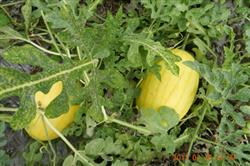 Hami melons in Altay City are sown in May, when the temperature is unstable. Through years of exploration and practice, we have summarized a complete set of techniques for achieving full stands and strong seedlings, which are introduced below.
I. Land preparation
For Hami melon fields, deep autumn plowing is recommended, to a depth of more than 30 cm. In early April of the following year, trenches are opened and fertilizer is applied; a north-south direction is best for the trenches. The fertilization method is: open a 30 cm deep fertilizer trench 60-65 cm on each side of the center of the melon trench, then scatter in organic fertilizer and mixed chemical fertilizer, applying 10 kg of urea, 15 kg of diammonium phosphate and 10 kg of potassium sulfate per 667 sq m. Use machinery to open the melon trenches and hand labor to tidy them; the finished trench should be 80-100 cm wide at the top, 15-20 cm wide at the bottom and more than 40 cm deep.
II. Seed treatment
One day before sowing, soak the seeds for 2 hours in a 200-fold dilution of 40% formaldehyde solution, rinse them clean with clear water, drain them, then spray with a 100-fold dilution of phoxim. Wrap the seeds to be sown in gauze or cloth and place them in a cool, shaded place.
III. Pre-sowing irrigation
The melon trench should be no longer than 40 m; if it is longer, a small distribution channel should be built in the middle. Within a 40 m melon trench, the difference between the water level and the top of the trench should not exceed 10 cm; if it does, a check dam should be built in the middle of the melon trench to control the water level. Irrigate twice before sowing: the first irrigation should be shallower, and the second deeper, so that the water level comes as close to the top of the trench as possible.
IV. Sowing
The "seed first, then lay the film" method is suitable for melon fields where the temperature is relatively low at sowing time, or where sowing needs to be appropriately advanced for an earlier market date. In May 2005, Altay City experienced 20 consecutive days of cloudy, rainy and low-temperature weather, yet all fields sown by this method had uniform, strong seedlings. The main technique is: after the pre-sowing water has naturally receded, level the soil along the water line with a rake, then use a willow-leaf hoe to open a small hole 7-9 cm deep and about 10 cm in diameter 5 cm from the edge of the trench; place 2-3 seeds in each hole, cover with 1 cm of moist soil, then press lightly with a half-clenched fist so that the seeds make full contact with the soil, which helps the seeds absorb water and germinate; then lay the film and tie belts. Five to seven days after sowing, the seeds will germinate and emerge. Because the seedlings grow in a small-greenhouse environment, this is very favorable for their growth and development. The "film first, then seed" method is suitable for Hami melons sown when the temperature is relatively high or when the sowing date is later. After the pre-sowing water has naturally receded, level the soil along the water line with a rake, then lay the film; when laying the film, be sure to tie a belt every 5 m. After the film is laid, place the seeds in moist soil 5-8 cm from the edge of the trench and 2 cm deep, press the moist soil lightly with the hand so that the seeds make full contact with the soil, and scatter 1-2 cm of dry soil on top.
V. Seedling-stage management
For strip fields sown by the "seed first, then lay the film" method, take care to prevent high temperatures from scalding the seedlings. After emergence, as the temperature rises, use a wooden stick 1.5 cm in diameter with one end sharpened to poke a small hole at the side of the seedling; as the seedlings grow and the temperature rises, gradually enlarge the hole, following the principle of not scalding the seedlings. If the film is laid first and the seeds are sown afterward, take care to prevent soil crusting and strong winds. If rain falls after sowing, break up the crust to help the seedlings emerge; after emergence, place a large clod of soil or a stone on the windward side of the seedling, or pile up soil to block the wind.
VI. Timely thinning
Thinning is carried out when the seedlings have 4-5 true leaves. For strip fields sown by the "seed first, then lay the film" method, choose an afternoon with relatively low temperature or a cloudy day, and release and thin the seedlings in one operation: release 1 robust seedling and press the remaining seedlings together with weeds under the plastic film, then seal with soil. For strip fields sown by the "film first, then seed" method, select 1 robust seedling, pull out the others with their roots and then seal with soil.