Technical Guidance for Autumn Cultivation of Hami Melon
1. Field preparation: For autumn Hami melon, the site should be chosen far from greenhouse melon fields and vegetable fields, and field cleaning, deep plowing with fertilizer application, and ditching and ridging should be completed. 2. Timely sowing and seedling raising: It is necessary to consider both avoiding disastrous weather such as high temperatures, typhoons, and rainstorms, and paying attention to the temperature requirements of Hami melon in the late stage of growth and development. Suitable...
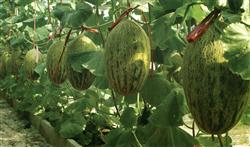
1. Field preparation: For autumn Hami melon, the site should be chosen far from greenhouse melon fields and vegetable fields, and field cleaning, deep plowing with fertilizer application, and ditching and ridging should be completed.
2. Timely sowing and seedling raising: It is necessary to consider both avoiding disastrous weather such as high temperatures, typhoons, and rainstorms, and paying attention to the temperature requirements of Hami melon in the late stage of growth and development. The suitable sowing period for seedling raising is around August 10.
3. Raising small strong seedlings: Raise seedlings in nutrient pots, with a seedling age of about 7-10 days; transplant when the leaf age reaches the 1-leaf-1-heart stage, and prevent leggy seedlings and high-temperature seedling scorching.
4. Planting, pruning, and fruit setting: Planting density of about 9000 plants/hm2; adopt two-vine pruning; the fruit-setting node is around the 10th node, leave 1 fruit per vine, and set 2 fruits per plant.
5. Appropriate fertilizer and water application: Apply about 300 kg/hm2 of compound fertilizer extract as base fertilizer. 5-6 d after the first batch of fruits set, apply 150 kg/hm2 of compound fertilizer, and apply it with water as a fruit-swelling fertilizer.
6. Control greenhouse temperature: Before fruit setting, pay attention to ventilation and cooling; after fruit setting, emphasize heat preservation and warming, especially in mid-to-late September, to prevent low nighttime temperatures.
7. Pest and disease control: Give priority to prevention and adopt integrated control. Use high-ridge cultivation, cover the entire greenhouse floor with plastic film, and take other measures to control greenhouse humidity and reduce disease occurrence. At the same time, inspect frequently, strengthen management, and when pests and diseases are found, promptly use biological pesticides and high-efficiency, low-toxicity, low-residue pesticides for control. During the growth and development of Hami melon in spring cultivation, special attention should be paid to the occurrence and control of pests and diseases. During the growth and development of Hami melon in autumn cultivation, attention should be paid to the control of diseases and pests such as gummy stem blight, fungal leaf blight, bacterial angular leaf spot, downy mildew, powdery mildew, aphids, whiteflies, and melon webworm, with daily observation, careful identification, and timely symptomatic pesticide use.
7.1 Disease control
7.1.1 Gummy stem blight: Keep the area around the stem base dry; prune strictly, and promptly apply pesticide to wounds caused by human activity; inspect carefully, and apply pesticide promptly when gummy stem blight first appears. Control method: Apply Amistar to wounds and affected areas.
7.1.2 Fungal leaf blight: Before onset or in the early stage, spray with 70% mancozeb 500-1000 times dilution; 50% carbendazim 800-1000 times dilution; 50% thiram 500-800 times dilution.
7.1.3 Control measures for bacterial angular leaf spot: In the early stage of onset, spray with 75% agricultural streptomycin 4000 times dilution and 77% Kocide 600 times dilution while avoiding high temperatures; when melon seedlings are young and small, choose agricultural streptomycin for control to prevent phytotoxicity.
7.1.4 Control measures for downy mildew: In the early stage of onset, choose 25% Amistar 1500 times dilution; or 72% Curzate 750-800 times dilution; or 72.2% Previcur 800-1000 times dilution for spraying, alternating applications 2-3 times. When greenhouse humidity is high, use 20% baifu smoke agent for fumigation at night.
7.1.5 Powdery mildew: In the early stage of onset, choose 25% Amistar 1500 times dilution; or 62.25% Xiansheng 600 times dilution; or 10% Score 1000-2000 times dilution and other agents for rotation control; chlorothalonil smoke agent can also be used for fumigation.
7.1.6 Viral disease: Mainly focus on early control of aphids; in the early stage of onset, spray with 2% Junkeduke 200 times dilution; or 5% Junduqing 250 times dilution; or 20% Virus A 300 times dilution.
7.2 Pest control
7.2.1 Aphids: Use 1% abamectin 1000 times dilution; use 10% yashijing 500 times dilution for spraying and killing; or 20% Confidor 700-800 times dilution; urine-washing mixture can also be sprayed. Method of use: Take 1 part each of washing powder and urea, add 100 parts water, stir evenly, prepare the mixture, and then spray on stems and leaves. It is required to spray both the front and back sides of melon leaves thoroughly and evenly.
7.2.2 Whiteflies: When first discovered, immediately use 0.5% emamectin benzoate (Lüka) 1500-2000 times dilution; or 10% nitenpyram (Qiangxing) 1000 times dilution; or 25% Actara 5000-6000 times dilution; or 70% Admire 5000 times dilution for spraying, and at night chlorothalonil smoke fumigant plus dichlorvos can also be used for fumigation.
7.2.3 Melon webworm: Spray with 20% Miman 1500 times dilution; or 5% Yitaibao 2000-3000 times dilution, etc.