How to Grow Pineapples in Greenhouses in Northern Regions
It generally takes about one year for a pineapple to go from planting to flowering and fruiting. Pineapples are also suitable for growing in flower pots, which not only makes full use of the space under trees, but also allows them to be sold as potted ornamental plants during the flowering and fruiting stages, offering high ornamental value and economic returns. In northern regions, cultivation should be carried out in solar greenhouses or multi-span greenhouses with heating facilities. Planting...
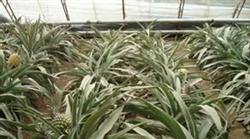
It generally takes about one year for a pineapple to go from planting to flowering and fruiting. Pineapples are also suitable for growing in flower pots, which not only makes full use of the space under trees, but also allows them to be sold as potted ornamental plants during the flowering and fruiting stages, offering high ornamental value and economic returns. In northern regions, cultivation should be carried out in solar greenhouses or multi-span greenhouses with heating facilities. Key points of cultivation techniques:
1. Planting. Pineapples are suited to slightly acidic soil conditions. The best planting period is from March to September. Plant them shallowly. Planting layouts include double-row and triple-row arrangements. For the double-row layout, the plant and row spacing is 20 x 50 cm, with a bed-to-furrow width of 1.5 m; for the triple-row layout, the plant and row spacing is 25 x 45 cm, with a bed-to-furrow width of 2 m.
2. Temperature management. Pineapples grow well in warm conditions, with an annual average temperature of 24-27°C being most suitable. They can grow within a range of 15-40°C, grow slowly below 15°C, and 5°C is the critical temperature for cold damage.
3. Light management. With sufficient light, they grow well, the fruit has a high sugar content and good quality. If the light is too intense and accompanied by high temperatures, the leaves and fruit are easily scorched. After removing the greenhouse film in summer, shade nets should be used for appropriate shading.
4. Water and fertilizer management. The amount and ratio of fertilizer applied to pineapples vary widely from place to place and should be determined according to actual conditions. The application ratio of nitrogen, phosphorus and potassium is roughly 3:1:2, with an annual amount per mu of 35-50 kg of nitrogen, 14-40 kg of phosphorus and 13-50 kg of potassium.
5. Flower and fruit management. The natural flower bud emergence rate of pineapples is not high, so ethephon is commonly used to force flowering. After more than one year of full growth, plants with about 35 fully grown leaves can produce fruit of normal size after flower forcing.
6. Pest and disease control. Few pests and diseases are seen in greenhouse cultivation introduced in northern regions.