Detailed Explanation of Practical Experience in Off-Season High-Yield Cultivation Techniques for Pineapple
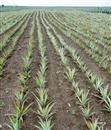
Pineapple planting methods include double-row, three-row and four-row. In the double-row system, the commonly used bed and furrow together are 150cm wide, with a single plant arranged in each of the two rows. Its advantages are: the bed furrow is relatively wide so the fibrous roots can spread outward, the plant and row spacing on the bed is relatively uniform, the stem bases press against each other, and the leaves spread out to form a hemispherical surface, which can fully utilize sunlight and easily form between-row...
I. Adapt to local conditions, select the site and build the plantation
According to the requirements of pineapple for external environmental conditions, select sloping land with relatively light winter cold damage, no frost or little frost, and soil pH 4.5-6.0 as the plantation site. After the site is selected, build horizontal terraces around the mountain according to contour lines, deep-plow 40-50 cm, thoroughly dig out perennial weeds such as thatch grass, and at the same time dig flood-control ditches and drainage ditches according to the size of the plot area.
II. Plant at the right time, with reasonable close planting
The planting time for pineapple is not very strict. Except for December to January of the following year, when it is too cold and dry and unsuitable for planting, it can be planted at all other times. Off-season cultivated pineapple should be marketed in March-April of the following year during the off-season for fruit, so it must be planted in March, and robust mature suckers or large shoot seedlings with thick stems and dense leaves should be selected for planting. When planting, the shoot seedlings are required to have more than 10 large leaves and a fresh weight of more than 200 grams. According to production practice, the local planting density is suitably 1000-1200 plants per mu.
III. Make heavy use of potassium fertilizer, apply sufficient basal fertilizer
Pineapple grows rapidly and has high yield and a large potassium requirement, so applying sufficient basal fertilizer and making heavy use of potassium fertilizer is an important measure for achieving high pineapple yields. The basal fertilizer is mainly plant ash and farmyard manure, combined with a small amount of superphosphate, applied at 0.25-0.5 kg per hole. Practice has proved that applying sufficient basal fertilizer helps improve soil aggregate structure, enhance soil permeability and water and fertilizer retention capacity, and create a good soil environment conducive to pineapple root growth; at the same time, after the seedlings survive, nutrients are available for absorption, accelerating root and leaf growth, promoting robust plant growth, and early fruiting and high yield. In addition, applying sufficient basal fertilizer such as plant ash can improve the cold resistance of the plants.
IV. Topdress at the right time, strengthen management
1. Topdressing at the right time. After the seedlings survive, topdress once every 1-2 months during the vegetative growth period, applying 25 grams of urea per plant; topdressing should preferably be done after rain. In July, apply a heavy flower-inducing fertilizer once, applying 50-100 grams of compound fertilizer per plant. In addition, during the fruit enlargement period, apply foliar topdressing 1-2 times (0.2%-0.4% urea aqueous solution). After February each year, when the weather warms up, fertilization management should be strengthened and foliar topdressing carried out in time to promote rapid plant growth.
2. Inter-row mulching. Pineapple roots are shallow-growing. In order to protect the root mass, keep the soil moist, suppress weed growth, lower summer and autumn soil temperatures and raise winter soil temperature, and favor robust root growth, full-year mulching between the small rows must be done conscientiously. Rice straw or mountain grass can be used as mulch, with a mulching thickness of 3-4 cm.
3. Intertillage and weeding. Pineapple roots have a strong demand for air, so the soil must be kept loose and breathable. Between the small rows and under the leaf crown, the root mass is dense and shallow-growing; where rice straw mulching has not been carried out, weeds must be hoed in time, and shallow hoeing should be noted during weeding to avoid damaging the roots. Generally around May, before weeds flower and when the ground becomes compacted after rain, intertillage and weeding should be carried out 1-2 times. After October, when the weather gradually becomes dry, intertillage and soil loosening should also be carried out to prevent drought, retain moisture, and thoroughly remove weeds.
V. Induce flowering and promote fruiting at the right time, adjust the harvest period
1. Flower induction. Pineapple planted in March, after 5-6 months of rapid-growth cultivation, by August, when the plants have grown to more than 35 cm in height and have 25-28 leaves longer than 35 cm, in order to strive for the fruit to be marketed in March and April of the following year and for a relatively concentrated harvest period, ethephon must be used for flower induction, at a concentration of 0.025%-0.05% (using 100 ml of 40% ethephon plus 80-160 liters of clean water); use a lower concentration when the temperature is high and a higher concentration when the temperature is low. Adding 1% urea to the diluted ethephon solution gives an even better effect. Pour 20-50 ml of the prepared diluted solution into each plant (into the heart), or use a knapsack sprayer with the nozzle cap removed and spray the solution into the plant from the heart. Ethephon flower induction should be carried out before 10:00 in the morning or after 5:00 in the afternoon on sunny days; generally, flower buds emerge 28-30 days after flower induction. The following issues should be noted when using ethephon heart-pouring for flower induction: (1) The plants to be induced must be robust plants with a certain foundation of vegetative growth, that is, they must have 25-28 green leaves longer than 35 cm. If the plants are too small or too weak, they will still flower and bear fruit after treatment, but the fruit will be small and the yield low, losing commercial value. (2) Ethephon is a plant growth regulator, not a fertilizer, so fertilization must be increased before and after flower induction to achieve the goal of increasing yield. (3) Grasp the appropriate concentration of the solution; if the concentration is too high, it not only wastes the chemical but also inhibits growth.
2. Promoting fruit enlargement. During the fruit enlargement period, use 0.2%-0.4% urea aqueous solution for foliar topdressing to promote fruit development, so as to achieve the goal of high yield and high quality.
VI. Topping and removal of buds
After flowering, topping should be done in time, removing the crown buds and excess suckers, concentrating nutrients to supply the growth of the small fruit; at the same time, 1-3 robust buds near the ground should also be retained as replacements for the mother plant after fruit harvest.
VII. Bagging to protect the fruit
Pineapple likes warmth and fears frost, so bagging to protect the fruit against cold should be done around "Minor Cold." Pineapple fruit bagging generally uses vest bags, which are convenient for securing firmly. When bagging, care should be taken not to tear the bag, and a layer of paper or cloth should be added inside the bag to help absorb moisture and retain moisture, while also preventing freezing. Practice has proved that fruit treated by bagging for protection is large and does not crack, and has high economic value; fruit not protected by bagging is small and cracks, has low economic value, and loses the significance of off-season cultivation.
VIII. Pest and disease control
In off-season pineapple cultivation, because the temperature is relatively low when the fruit ripens, there are fewer pests and diseases. Therefore, apart from controlling scarab larvae at planting time and preventing mouse damage during fruit ripening, chemical control can be omitted at other times, making the product meet pollution-free requirements.
IX. Harvest at the right time
In off-season pineapple planting, after one year of cultivation and management after planting, the harvest period can begin in March and April of the following year. When 2-3 rows of small fruit at the base of the fruit turn yellow, the fruit stalk has slight wrinkles, and the fruit tilts slightly to one side on the stalk, it can be harvested. Pineapple fruit harvesting should be carried out in stages and batches, harvesting the ripe ones first.
After fruit harvest, the management work of the second growth cycle begins. The high-yield period of pineapple is generally 2-4 years, and after the 5th year the yield drops sharply.