Identification and Control Methods for Pineapple Mealybugs
Pineapple mealybugs belong to the order Homoptera, family Pseudococcidae. Dysmicoccus brevipes is the most commonly seen species. The damage symptoms are caused by adults and nymphs feeding on the sap of pineapple rhizomes, leaves, fruits and seedlings. Affected leaves first show symptoms starting from the lower part, gradually fading upward to yellow and finally turning red-purple; in severe cases all leaves soften and droop...
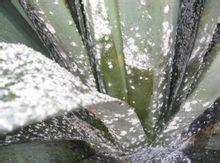
Pineapple mealybugs belong to the order Homoptera, family Pseudococcidae. Dysmicoccus brevipes is the most commonly seen species.
The damage symptoms are caused by adults and nymphs feeding on the sap of pineapple rhizomes, leaves, fruits and seedlings. Affected leaves first show symptoms starting from the lower part, gradually fading upward to yellow and finally turning red-purple; in severe cases all leaves soften, droop and wither, eventually leading to the death of the whole plant. Affected roots first turn dark brown, then gradually rot, causing the plant to become weak. After fruits are affected, the rind loses its luster, and the "honeydew" they secrete can lead to sooty mold, with severe cases showing shrinkage. After seedlings are affected, they develop poorly and may even wither.
Morphological characteristics
Adult: The female adult is about 2.5-3 mm long, flat and oval, covered with white wax powder, with waxy protrusions along the margin, 7-8 antennal segments, 17 pairs of cerarian pore clusters, and setae that secrete waxy filaments; the anal lobes each bear 2 medium-sized conical setae. Tubular ducts are distributed on abdominal segments 6-8, clustered along the margin; the hind tibia is about twice as long as the tarsus. Female body color is mostly pink. When sexually mature, a white waxy cotton-like ovisac is attached to the end of the abdomen. The male adult is very small, yellowish-brown, with transparent wings held flat on its back, and a pair of slender waxy structures at the end of the abdomen. It has one pair of transparent forewings.
Egg: Body length 0.35-0.38 mm, oval, initially yellow, later gradually turning yellowish-brown, in irregular cotton-like masses, attached to the host plant.
Nymph: There are 3 instars in total. It resembles the female adult but is smaller, with antennae and legs. Female nymphs become adults after 3 molts; male nymphs become pupae after 2 molts.
Pupa: Located in a cocoon sac formed by filamentous waxy material; the cocoon is irregular in shape, mostly elongated, and attached to the plant.
Occurrence pattern: One generation takes 45-59 days. Only after the female adult sucks the sap of the host plant can the ovaries mature and reproduce; it is parthenogenetic, mainly viviparous. In winter, especially in January-February, oviparity often occurs, or oviparity and viviparity alternate. Viviparous nymphs tend to cluster under the mother's body, and after finding a suitable site they begin feeding and causing damage; some remain motionless near the mother or crawl repeatedly over her. The nymph stage generally lasts 30 days in summer and up to 2 months in winter. Female adults lay eggs in cottony ovisacs. After emergence, male adults generally remain motionless in plant crevices, do not feed, and have a short lifespan of only a few days. The male nymph stage lasts about 14 days in summer, and the pupal stage generally 12-15 days. Heavy rain or continuous rainfall has a washing-off effect on mealybugs. Ants carry mealybug bodies, which helps mealybugs spread. Ants like to eat mealybug excrement, and when these excretions are consumed, it benefits mealybug growth and reproduction.
Control methods
(1) Strengthen orchard management to enhance tree vigor, apply fertilizer and irrigate reasonably, and improve tree resistance. Prune scientifically, cut off diseased and damaged branches, and regulate ventilation and light penetration. Combined with pruning, clean up the orchard to reduce insect sources.
(2) Use insect-free seedlings when planting; if necessary, treat the heads by soaking in a 500-800 times dilution of 40% dimethoate.
(3) Fumigation for insect control: Seedlings carrying insects can be fumigated. In an enclosed space, use a mixture of 10-16 g sodium cyanide, 15-24 mL sulfuric acid and 40 mL water to generate hydrocyanic acid gas and fumigate for 1-2 hours to kill the insects, after which they can be planted.
(3) Chemical control: In severe outbreaks, spray with resin mixture.
Commonly used agent: resin.