What are the key technical points of fertilization management in pineapple plantations?
Mineral nutrients in the soil are the material basis for the vegetative growth and reproductive growth of pineapple plants. Soil fertility, the amount of fertilizer applied, fertilizer quality, and fertilization techniques are among the important factors that directly affect the normal growth of pineapple plants and the achievement of high and stable yields. Pineapple is a perennial herbaceous fruit tree planted once and harvested for 2-3 crops...
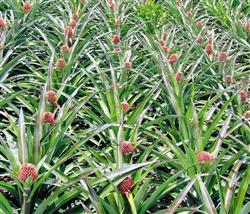
Mineral nutrients in the soil are the material basis for the vegetative growth and reproductive growth of pineapple plants. Soil fertility, the amount of fertilizer applied, fertilizer quality, and fertilization techniques are among the important factors that directly affect the normal growth of pineapple plants and the achievement of high and stable yields. Pineapple is a perennial herbaceous fruit tree planted once and harvested for 2-3 crops. It has the characteristics of large fruit, high yield per unit area, and rapid vegetative growth, so it requires relatively more fertilizer. If the soil lacks various mineral nutrients, it directly affects the vegetative growth of the plant, causing slow growth, weakness, and premature aging, and reproductive growth is therefore also affected, resulting in small flower buds, small fruit, and low yield. In order to make the vegetative growth vigorous, put the plants into production on schedule, obtain large fruit and high yield, and achieve continuous high and stable yields, fertilization should be carried out reasonably according to the biological characteristics and site conditions of pineapple.
1. Fertilization of non-producing plantations. From planting to fruiting is the vegetative growth stage. Fertilization should mainly be nitrogen fertilizer, supplemented by phosphorus and potassium fertilizers, with the aim of promoting pineapple leaf emergence, increasing leaf number and leaf area, and laying the foundation for reproductive growth. From flower bud emergence to fruit maturity is the reproductive growth stage, and fertilization should mainly be potassium fertilizer, supplemented by nitrogen and phosphorus fertilizers. In pineapple fertilization, the application ratio of nitrogen, phosphorus, and potassium is roughly 3:1:2, that is, 1 part phosphate fertilizer (phosphorus pentoxide), 2 parts potassium fertilizer (potassium oxide), and 3 parts nitrogen fertilizer (nitrogen). The application rates of the three elements nitrogen, phosphorus, and potassium per mu (calculated as pure nutrients) are: nitrogen 35-60 kg, phosphorus pentoxide 14-40 kg, and potassium oxide 13-50 kg, with a yield per mu of 1000-2800 kg.
Fertilizer application methods: one is as base fertilizer, and the other is as topdressing. Base fertilizer is applied before planting and before overwintering after each fruit harvest. The amount of base fertilizer before planting is generally 0.5 kg of farmyard manure per plant, and about 20-100 kg of cake fertilizer and compound fertilizer per mu. For newly reclaimed land and fertile soil, use less; for previously cultivated land and poor soil, use more. The amount of base fertilizer after fruit harvest and before overwintering is generally 0.5 kg of farmyard manure per plant, plus an additional 10 kg of cake fertilizer or compound fertilizer per mu. The specific amount depends on the size and growth vigor of the seedlings. Before overwintering, base fertilizer is commonly applied in holes combined with earthing up.
Topdressing is divided into two types: root-zone topdressing and foliar topdressing (that is, leaf surface topdressing). Root-zone topdressing should be done at least twice a year. The first time is from December to February of the following year (that is, before flower bud emergence), with the aim of promoting flower bud development; the second time is after fruit harvest in July, with the aim of promoting sucker growth. Each time, use 10 kg of urea and 10 kg of potassium sulfate per mu, mix them, and apply in holes around the root zone, or use 1000-1500 kg of decomposed dilute human and livestock manure and urine, and pour it into the leaf axils at the base of the plants. The purpose of foliar topdressing is to promote plant growth and fruit development. It is mainly carried out in the vigorous growth season of pineapple, roughly once each in April, June, July, and September, and twice each in May and August. Each time, use a 1% urea aqueous solution (with 0.5% potassium sulfate added), or dilute (1:10) decomposed human and livestock manure and urine, and spray or splash it on the pineapple leaves. For foliar topdressing in May and August, an additional 1 kg of potassium sulfate should be applied per 667 sq m each time.
2. Fertilization of producing plantations. Pineapple plantations that are about to enter production or have already entered production should continue to be fertilized; for half-producing plants and plants that have already emerged flower buds, fertilization should still mainly be potassium fertilizer, supplemented by nitrogen and phosphorus fertilizers, because at this time the suckers have begun to emerge and the slip buds are gradually growing. Therefore, this kind of fertilization not only satisfies the process of the fruit shifting from development to nutrient transformation, but also meets the needs of vegetative growth and development. To improve fruit quality, foliar topdressing is adopted when the fruit turns from green, spraying 0.1% monopotassium phosphate. After fruit harvest, if the daily average temperature is above 18°C, quick-acting chemical fertilizers or decomposed human and livestock manure and urine should be applied as topdressing. For chemical fertilizers, apply 15 kg of urea, 10 kg of potassium fertilizer, and 10 kg of compound fertilizer per mu in the root zone; or splash-apply 1000 kg of decomposed diluted human and livestock manure and urine. After fruit harvest, if the temperature has already dropped and root growth has slowed, cut off the old leaves extending into the furrows and press them into the rows, then apply organic fertilizer (such as compost, bran fertilizer, barnyard manure, etc.), and then earth up heavily. This fertilization is both a bud-promoting fertilizer and an overwintering fertilizer. Apply 2000 kg of compost and garbage fertilizer, 30 kg of phosphate fertilizer, and 40 kg of tung bran fertilizer per mu.
After weeding and leaf cutting, if it is from April to October, apply heavy quick-acting fertilizer, using 15 kg of urea per mu, 10 kg each of potassium fertilizer and compound fertilizer, mixed and applied between rows or between plants, or splash-apply 1000 kg of decomposed diluted human and livestock manure and urine. This fertilization mainly promotes sucker growth so as to bear fruit the following year. For the Cayenne variety, harvesting one crop as one growth cycle also requires fertilization to promote suckers, so that the suckers grow robustly. In addition to root-zone fertilization, because the temperature is high, foliar fertilizer can also be applied twice a month. After fruit harvest, if it is from November to February of the following year, it should be changed to heavy application of organic fertilizer. Apply 2000 kg of compost and barnyard manure, 30 kg of phosphate fertilizer, and 40 kg of tung bran per 667 sq m, and then earth up heavily, both to promote suckers and to prevent cold and overwinter.