What conditions are needed to establish a pineapple orchard?
During the growth and development of pineapple, irrigate once every 15 days with a 300-fold potassium dihydrogen phosphate aqueous solution, for 8 to 10 consecutive times, applying 1.5 to 2 kg per plant each time, pouring it into the funnel-shaped crown at the top of the pineapple plant, so that the potassium dihydrogen phosphate aqueous solution flows along the leaf axils to the soil around the roots. In this way, the pineapple plants grow robustly, with large leaves...
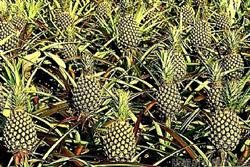 (1) Orchard site selection. The selection of a pineapple orchard site should fully take into account such influencing factors as climatic conditions, soil conditions and transportation conditions.
1. Climatic conditions. Suitable temperature, rainfall and sunshine are the basic conditions for normal pineapple growth. Pineapple has relatively strong adaptability to climatic conditions, but it is most suited to a warm and humid climate, and avoids frost, low-temperature overcast rain and excessive drought. Generally, it requires an annual average temperature of 24-27°C, no frost and no low-temperature overcast rain in winter; annual rainfall of 1000-2000 mm, with monthly rainfall distributed fairly evenly; and annual sunshine hours of more than 1700 h. Therefore, when establishing a pineapple orchard, especially for large-scale development and operation of a pineapple production base, areas with no moderate frost and no low-temperature overcast rain in winter and with relatively abundant water sources should be selected as far as possible.
2. Soil conditions. Pineapple has a relatively wide range of soil adaptability, but it is best suited to acidic red soil with deep soil layers, good drainage, loose and breathable texture, high organic matter content and good fertility. Particular attention should be paid to the fact that pineapple is relatively demanding about pH: only when the pH is 4-5, that is, acidic, does the plant grow normally; when the pH is above 6, plant growth is inhibited, and such soil is not suitable for growing pineapple.
3. Transportation conditions. Because the harvest period of pineapple fruit is relatively concentrated, with the harvest peak usually lasting only about half a month, developing pineapple, especially commercial production and development, requires relatively convenient transportation so that fresh fruit and large quantities of raw material fruit for processing can be transported and dispatched in a timely manner.
(2) Soil improvement. The root system of pineapple is characterized by shallow growth and a preference for air, with most of the root mass extending horizontally with the soil layer and distributed within the 20 cm cultivated layer. In the case of wasteland, compacted soil and a shallow cultivated layer, soil improvement must be carried out. Soil improvement should emphasize deep plowing, followed by the application of sufficient organic fertilizer, to create a soil environment favorable for pineapple root growth.
(3) Orchard planning. To plan a pineapple orchard, first use surveying instruments to draw a topographic sketch at a scale of 1:1000 or 1:10000, carry out map scanning and blueprint copying, and investigate and collect the local natural conditions; then, on this basis, carry out orchard planning.
1. Design of the planting area. When designing the planting area, scientific design should be carried out according to the size of the leased land and the degree of mechanization. Because pineapple can only be harvested 1-2 years after planting, and it is a fruit tree that can achieve high yield once or two or three times after one planting, and can achieve high yield and high efficiency under high-level cultivation and management conditions, the design of the planting area should be advanced and scientific. At the same time, without affecting operations, the planting area should be enlarged as much as possible to make full use of the land per unit area.
2. Establishment of windbreaks. The effects of windbreaks on pineapple are as follows: first, wind protection; second, reducing wind speed and decreasing evaporation; third, reducing frost and cold damage. For orchards with a large development area and gentle, open slopes, the area of shelterbelts generally accounts for 10% of the planting area; for orchards with high wind speed or affected by typhoons, shelterbelts may exceed 15%. For small-scale pineapple orchards, planting thorny shrubs around the orchard can both enclose the orchard to keep out cattle and people and also have a windbreak effect.
3. Design of the orchard road network. Orchard roads consist of main roads, branch roads and field paths. The road width varies with the scale of the orchard. For large and medium-sized orchards developed in contiguous tracts, the main road surface is 7 m wide, the branch road surface is 5 m wide, and the operation paths in the planting area are 3 m wide; for small orchards, it is sufficient to set up roads 5 m wide and operation paths 3 m wide; for specialized household orchards with modest planning, it is sufficient to set up operation paths 3 m wide connected to roads outside the orchard.
4. Design of water conservancy facilities in the orchard. Water use in pineapple orchards is seasonal, and pineapple-producing areas usually irrigate only when drought occurs in autumn. Therefore, the scale of water conservancy facilities should mainly be small, with storage and pumping for irrigation as the main approach. In hilly orchards without water sources and water conservancy facilities, water storage ponds can be built in small hills or on hilltops for irrigation and fertilization. Small water storage ponds can also be built at one per 667 sq m, capable of storing 20 sq m of water, and specialized households can set them up according to the area they develop. Large mechanized production farms can set up 1 pumping station per 100 hm2 of planting area, or a small water tower 5 m high for production water, to supply water for fertilization, pesticide spraying and irrigation machinery. While planning water conservancy facilities, drainage facilities should also be considered. Pineapple-producing areas in China are located in the southern subtropics, where rainfall is relatively concentrated, so drainage is particularly important; for terraces and contour beds built on hilly land or low mountains, a drainage ditch must be opened on the inner wall side.