Characteristics of Jackfruit and Detailed Explanation of Its Propagation Techniques
Jackfruit, also known as wood jackfruit or jackfruit, is a little-known tropical fruit, with only scattered distribution in the tropical and subtropical regions of our country. It originated in western India. In Guangdong, it is scattered in all cities and counties south of Guangzhou, with more in Dianbai and Gaozhou in western Guangdong, and also more in the cities and counties of the Leizhou Peninsula. However, with our country's reform, opening up and...
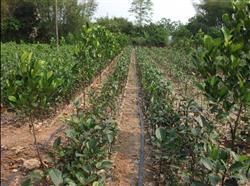
Jackfruit, also known as wood jackfruit or jackfruit, is a little-known tropical fruit, with only scattered distribution in the tropical and subtropical regions of our country. It originated in western India. In Guangdong, it is scattered in all cities and counties south of Guangzhou, with more in Dianbai and Gaozhou in western Guangdong, and also more in the cities and counties of the Leizhou Peninsula. However, with the development of our country's reform, opening up and market economy, and the rational use of natural resources such as land resources, meteorological resources, and germplasm resources, jackfruit, as a tree species excellent for fruit, grain, wood, and ornamental purposes, has great prospects for development; in ecologically suitable areas, planting large jackfruit forests and implementing good management will certainly achieve significant economic and ecological benefits.
I. Biological Characteristics The jackfruit tree is about 10-20 m tall, with a beautiful tree shape, excellent for both timber and ornamental purposes, and its fruit is rich in nutrition and widely used. The bark is grayish brown, the leaves are alternate, oblong or obovate, dark green and glossy on the surface, yellow-green on the underside, entire, thickly papery. The flowers are unisexual aggregate flowers, with male and female inflorescences borne simultaneously on the same plant; the flowers have a delicate fragrance and open once each in summer and winter. The fruit is multiple, ovate-elliptical, spindle-shaped, or even long cylindrical, and a large fruit can reach several tens of kilograms. The unripe fruit is pale green, gradually becoming yellow-green, while the ripe fruit is yellow or yellowish brown, with hexagonal turtle-shell-like protrusions on the surface; the flesh is soft, with a special odor, and the seeds are white and fleshy, edible, resembling the flavor of water caltrop.
II. Environmental Requirements Jackfruit is a tropical fruit tree, suitable for growing in tropical and warm southern subtropical areas. Temperature is the most important ecological factor determining whether jackfruit can be cultivated economically, as well as its yield and quality. According to the distribution and cultivation of jackfruit in our country, it can flower and fruit normally in areas with an annual average temperature of ≥22°C, an average temperature in the coldest month of ≥13°C, and an absolute minimum temperature >0°C. Seedlings are damaged by freezing at 5°C, young trees are sensitive to cold, and large trees are prone to cold damage below 7°C; the degree of damage worsens with the intensity of low temperature, with mild cases showing yellowing and falling leaves, and severe cases showing dead branches and shoot tips. Low temperature combined with cloudy days and dense fog has an even greater impact, causing flower and fruit drop. In areas with an annual average temperature of 21-21.5°C, although it can grow and fruit, the fruit is relatively small and the yield is low. In Hainan, where jackfruit is cultivated more in our country, the annual average temperature is 22.8°C and 23.0°C, and the coldest January temperatures are 15.1°C and 15.7°C. It can be seen that for economic cultivation, it should be developed in areas with high temperatures. Jackfruit requires a humid environment and sufficient moisture, and grows better with annual rainfall above 1200 mm; however, its root system is deep, and it is also quite drought-tolerant, so attention should be paid to drought prevention and moisture retention. Jackfruit requires abundant sunlight, but is also quite shade-tolerant, and seedlings especially avoid strong sunlight, so it can be interplanted with coconut, lychee, longan, wampee, banana, and plantain, with appropriately rational close planting and more vegetative branches retained. Jackfruit trees are tall with large leaves, and the branches and trunk are brittle, so it is not suitable to establish orchards in wind gaps or places with severe wind damage. Jackfruit is not strict about soil selection and can adapt to many types of soil.
III. Propagation Techniques Jackfruit propagation mainly uses seedling, grafting, and air-layering methods.
(1) Seedling Propagation The variation in jackfruit seedling progeny is not very great, and it can also bear fruit 4-5 years after planting; the method is simple and easy to master, so at present most production areas still use this method. Even if the grafting method is used, seedling rootstock plants must first be cultivated. Generally, through the "three selections," that is, selecting superior mother trees to take fruit, selecting well-developed, non-deformed fruit from the lower part of the trunk on the mother tree, and after the fruit is fully mature, harvesting it for after-ripening, cutting open the fruit, and at the part where the seed package is better developed (for the dry-package type, the top part of the fruit is better), selecting plump, round seeds for sowing. Jackfruit seeds are not tolerant of drying, so they should be washed and germinated immediately after collection. Because jackfruit has a straight main root, few fine lateral roots, poor root regeneration ability, and intolerance of transplanting, and moving seedlings damages the roots and affects survival, it is best to use plastic bags or other containers for seedling cultivation, using prepared nutrient soil for planting, so that the seedlings grow rapidly, which is also conducive to survival after field planting and shortens the recovery period. Before sowing, use moist sand to accelerate germination, and sow in containers or nursery beds only after germination. Place the seeds flat, cover with about 2 cm of soil, cover with grass, and water thoroughly. Afterward, pay attention to moisture regulation and appropriate fertilization; when the seedlings are 30 cm tall, they can leave the nursery. In plastic bag container seedling cultivation, because the soil volume is not large, it is easy to become too wet or too dry, affecting root and seedling growth, so the middle and lower parts of the container must have sufficient drainage holes. The containers should be placed as close together as possible, and the gaps and surroundings should be filled and packed tightly with soil. Provide appropriate shading and water frequently during drought.
(2) Grafting Propagation Grafting propagation is conducive to accelerating the propagation of superior strains and is the main method for propagation in the future. Use jackfruit or seedling plants of fruit jackfruit, breadfruit, etc. with a thickness of more than 1 cm as rootstocks, and graft by the patch budding (bud patch grafting) method. Grafting is more suitable during the sap flow period from April to October, when both rootstock and scion are easy to peel, the temperature is relatively high, and healing and survival after grafting are easy. From superior mother trees, select sun-facing, fully developed and mature branches of more than 1 year old as scions. Collect the scions in the morning and immediately remove the leaves, taking care not to damage the buds. It is best to graft immediately after collection, and the scions should be stored with moisture retention. During grafting, the latex flowing out at the grafting position should be wiped clean with a clean cloth, and the operation should be done gently and quickly; the bud patch should be pressed tightly against the rootstock, and the bud should be exposed and wrapped to retain moisture. About 20 days after grafting, check whether it has survived, either regraft or untie, and promptly cut back the rootstock to promote sprouting of the scion.