Key Technical Points for Early Spring Cultivation of Fresh-Eating Cherry Tomatoes
Cherry tomato, originally from Taiwan, China, is a type of cherry tomato grown mainly for fresh fruit consumption, commonly known as cherry tomato. For early spring cultivation, a 6 m span plastic greenhouse can be used, with seedlings raised in mid-November, transplanting in February of the following year, and fresh fruit harvest in early May, yielding 6000 kg of fresh fruit per mu. 1. Seed treatment....
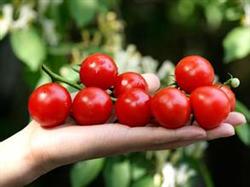
Cherry tomato, originally from Taiwan, China, is a type of cherry tomato grown mainly for fresh fruit consumption, commonly known as cherry tomato. For early spring cultivation, a 6 m span plastic greenhouse can be used, with seedlings raised in mid-November, transplanting in February of the following year, and fresh fruit harvest in early May, yielding 6000 kg of fresh fruit per mu.
1. Seed treatment. To prevent seed-borne pathogen transmission, seeds should be disinfected before sowing, either by hot water soaking or chemical soaking. Hot water soaking involves soaking the cherry tomato seeds in cold water for 10 minutes, then placing them in hot water at 50-55°C, stirring constantly and rapidly to ensure even heating, and adding hot water as needed to maintain a stable temperature. After 15-20 minutes, remove the seeds, place them in cold water to dissipate residual heat, then soak them in warm water at 25-30°C for 4-6 hours. Chemical soaking involves wrapping the seeds in gauze, placing them in a 10% trisodium phosphate aqueous solution for 20-30 minutes, then removing the seeds, wrapping them in a damp towel, and placing them at 25-28°C for germination. During germination, rinse the seeds with warm water at about 25°C 1-2 times daily. After 2-3 days of germination, when 50% of the seeds have sprouted, they are ready for sowing.
2. Sowing and seedling raising. First, water the prepared seedbed. After the water has seeped down for 2-3 hours, sow the seeds evenly, then cover with 0.5-1 cm of nutrient soil. The seeding rate is 3-5 g per sq m of seedbed, and 8-10 sq m of seedbed is needed per mu of transplanting area. After sowing, cover with plastic film to retain heat and moisture, and remove the film immediately after seedlings emerge. The management from sowing to cotyledon emergence mainly aims to create environmental conditions suitable for seed germination and seedling emergence, so as to achieve uniform, complete and vigorous seedlings as early as possible.
3. Timely transplanting of seedlings. When the cherry tomato seedlings have 1 true leaf and 1 heart leaf, transplant them into nutrient pots on a sunny midday. The nutrient soil should be mainly fully decomposed organic fertilizer, with an appropriate increase in phosphorus fertilizer and a suitable amount of nitrate nitrogen fertilizer. To ensure sufficient nutritional area, it is best to use 9 cm × 9 cm nutrient pots to protect the root system. The principle of seedbed management during the cherry tomato seedling stage is to provide appropriate temperature, humidity and sufficient sunlight. This is achieved through covering for insulation, removing the film for light, watering and fertilizing, and increasing the spacing between nutrient pots.
4. Transplanting. Transplant when the seedlings have grown 7-8 true leaves (transplanting with buds is also possible). Use double-row transplanting per bed, with a small row spacing of 60 cm and a plant spacing of 40 cm, planting 2000 plants per mu. The transplanting depth should be such that the cotyledon position is level with the bed surface, and thoroughly water after transplanting. Cover with plastic film after transplanting. Cut the film according to the bed length and the length to be buried in the soil at both ends, then place the cut film between the two rows of seedlings, pull the film horizontally toward the furrows on both sides, and finally pull tight and press firm. Field management such as watering, topdressing, temperature management, and uncovering and covering the greenhouse film is the same as for conventional early spring tomato cultivation. Pests and diseases are relatively mild and may not require control measures.
5. Pruning. Cherry tomatoes grow rapidly in the greenhouse, with tall plants and poor upright growth. When the plants reach 30-40 cm, insert stakes and tie the vines or use hanging strings for support to prevent lodging. The lateral branches have strong growth vigor. A multi-layer plus continuous 2-layer pinching pruning method can be used, that is, retain the flower clusters on the main stem, keep the lateral branches growing from the main stem, retain 2 flower clusters on each lateral branch, then pinch off the growing tip after leaving 2 leaves above the flower cluster. Timely remove side shoots and twist the lateral branches so they do not shade each other. Twisting is generally done on sunny days. Promptly remove yellowed old leaves and diseased leaves from the lower part to reduce nutrient consumption and improve light penetration.
6. Flower dipping for fruit retention. In early spring when temperatures are low, poor pollination can easily cause flower drop. Use 2,4-D to coat the calyx and flower stalk of freshly opened flowers (mark with red advertising color), or dip the entire uniformly opened flower cluster in a 2,4-D solution.
7. Harvesting. Because cherry tomatoes have high sugar content, only when fully ripe can they truly exhibit their inherent flavor and quality. Therefore, harvest at proper ripeness. When harvesting, retain the sepals and a section of the fruit stalk.