What are the control methods for grape bunch stem blight?
Common grape diseases include: grape bunch stem blight, gray mold, powdery mildew, anthracnose, black pox, white rot, sunburn, and many other diseases. Here is an introduction to how grape bunch stem blight is controlled: grape bunch stem blight mainly damages young flower buds, the rachis, or young fruit, causing them to shrivel and dry up, resulting...
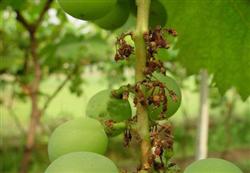
Common grape diseases include: grape bunch stem blight, gray mold, powdery mildew, anthracnose, black pox, white rot, sunburn, and many other diseases. Here is an introduction to how grape bunch stem blight is controlled:
Grape bunch stem blight mainly damages young flower buds, the rachis, or young fruit, causing them to shrivel and dry up, resulting in heavy flower and fruit drop. It generally reduces yield by 10%-30%, and by more than 40% in severe cases.
According to Wu Weimin, a fruit tree research expert at the Horticulture Research Institute of the Provincial Academy of Agricultural Sciences, high humidity is the main reason for the prevalence of grape bunch stem blight. Low-temperature and rainy weather from early May to early-to-mid June favors infection by the pathogen, and low-temperature and rainy weather during the flowering period favors the occurrence and spread of the disease. Vineyards in low-lying areas, with excessive watering, poor ventilation and light penetration, extensive field management, insufficient fertility, and weak vines suffer more severe disease. Kyoho is a susceptible variety, while New Rose, Longyan, and Rosario Bianco are relatively resistant varieties. Once the berries grow to the size of a soybean, the disease stops infecting.
The following measures can be taken to control grape bunch stem blight.
First, clean the vineyard in time. Remove diseased branches and diseased fruit, and destroy them in a centralized manner to reduce overwintering sources of inoculum.
Second, remove buds and train the shoots. Remove buds, pinch off growing tips, and prune fruit-bearing branches in time to improve ventilation and light penetration.
Third, fertilize reasonably. Apply more organic fertilizer and phosphorus and potassium fertilizer, control nitrogen fertilizer, and enhance the disease resistance of the plants.
Fourth, clear the ditch system. Open up a ditch system to reduce field humidity on rainy days.
Fifth, pesticide control. After grape buds swell, spray lime sulfur mixture mainly on the fruiting canes to eliminate overwintering sources of inoculum. After the grape leaves have fully unfolded, choose 25.5% iprodione for foliar spraying diluted 800-1000 times, or 40% pyrimethanil and chlorothalonil for foliar spraying diluted 800-1500 times, at 60-100 ml per mu, or 40% pyrimethanil and chlorothalonil for foliar spraying diluted 800-1500 times, at 60-100 ml per mu.