How to determine a more reasonable plant and row spacing for grapevines
For grape planting, a north-south row orientation is generally the better choice, as it allows better light reception and also makes the trellis surface basically perpendicular to the prevailing wind direction during the growing season, which can reduce wind damage. However, if limited by the plot, vines can also be planted in an east-west row orientation. The row spacing depends on the choice of trellising system: for a vertical trellis, the row spacing used is 2-2.8 m, and for a pergola...
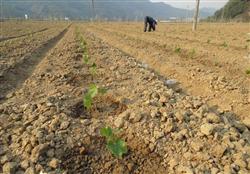
For grape planting, a north-south row orientation is generally the better choice, as it allows better light reception and also makes the trellis surface basically perpendicular to the prevailing wind direction during the growing season, which can reduce wind damage. However, if limited by the plot, vines can also be planted in an east-west row orientation.
The row spacing depends on the choice of trellising system: for a vertical trellis, the row spacing used is 2-2.8 m, and for a pergola, the row spacing is 4-6 m. For plant spacing, 0.5-0.6 m is often chosen, using a single-cordon pruning method. In addition, great importance must be attached to preparing the planting trench before planting. Generally, the planting trench is 0.8-1.0 m deep and 0.8-1.0 m wide; at minimum, a trench 0.6 m wide and 0.6 m deep should be dug. Fully decomposed organic fertilizer is applied at the bottom of the trench, and topsoil is backfilled to a position 0.4 m from the trench edge. Because grapes are plants that favor fertilizer and water, deep plowing, soil maturation and improvement before planting are needed to create suitable growing conditions for the root system, so that the plants can remain vigorous and achieve stable, high yields.