Detailed Explanation of Field Management Techniques for Pollution-Free Mango
I. It can flower and bear fruit in all four seasons of the year. The first crop flowers from late February to late March and the fruit ripens from late June to late July; the second crop flowers in late April and the fruit ripens in late July; the third crop flowers from late July to early August and the fruit ripens in late November; the fourth crop flowers in late September and the fruit ripens from March to April of the following year. II...
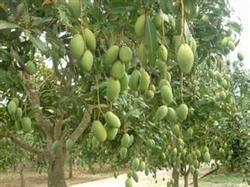 (1) Soil management:
Combined with the application of base fertilizer, dig a trench on each side of the tree canopy below the drip line. The conventional trench size is 100 cm x 50 cm x 40 cm, and green manure, decomposed organic fertilizer and phosphate fertilizer are pressed into it.
It is recommended to intercrop short-stemmed leguminous green manure, forage grass, other nectar source plants between the rows of the mango orchard, or grow grass between the rows, but the intercrops should be more than 1 m away from the base of the mango trees. The grass species selected should be short-stalked or creeping, have no shared pests or diseases with mango, and have a short growth period, such as Ageratum conyzoides. It is recommended to use year-round mulching in the mango root zone or planting belt.
(2) Weeding:
Weeds in the root zone should be controlled by manual, mechanical or microbial herbicides, and weeds between the rows are recommended to be controlled by mechanical, electrical, microbial herbicides or the chemical herbicides recommended in this standard.
(3) Water management:
During the autumn shoot sprouting period, flower bud morphological differentiation period, and early-to-mid fruit development period of mango, irrigation should be carried out promptly when the soil is dry. Irrigation once every 15-20 days is recommended.
(4) Fertilization:
The recommended fertilizer types are as follows. Nitrate nitrogen fertilizer should not be used.
The fertilizer types recommended for pollution-free mango production are as follows.
Commercial fertilizer categories:
Inorganic fertilizer (nitrogen fertilizer): urea, aluminum chloride.
Inorganic fertilizer (phosphate fertilizer): superphosphate, calcium magnesium phosphate, phosphate rock powder.
Inorganic fertilizer (potassium fertilizer): potassium chloride, potassium sulfate.
Inorganic fertilizer (calcium fertilizer): quicklime, limestone, dolomite powder.
Inorganic fertilizer (magnesium fertilizer): calcium magnesium phosphate.
Inorganic fertilizer (compound fertilizer): binary and ternary compound fertilizers.
Foliar fertilizer (growth aid category): Qingfeng Kede, Yuntaisu, Wandefu, Lufengbao, Aiduoshou, Damu Fengshou, Shierde, Yunda, 2116, Aopu'er, Gaomeishi, Huimanfeng, etc.
Foliar fertilizer (trace element category): fertilizers formulated with trace elements such as copper, iron, manganese, zinc, boron and molybdenum, as well as potassium dihydrogen phosphate, urea, potassium chloride, etc.
Other fertilizer categories:
Sea fertilizer: preservative-free fish residue, shrimp residue, shellfish residue, etc.
Animal miscellaneous fertilizer: preservative-free cattle and sheep wool waste, bone meal, livestock processing waste, etc.
Foliar fertilizer can be applied 2-3 times each during the autumn shoot greening period, flower bud period and young fruit development period, with an interval of 7-10 days. The types of foliar fertilizer are as described above.