What are the remedies for mango trees that fail to bear fruit?
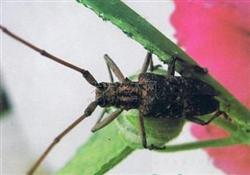
The mango stem borer belongs to the order Coleoptera, family Cerambycidae, and occurs in all mango-producing areas of southern China. Its larvae bore into and feed on the branches and trunk, weakening the affected plants and, in severe cases, causing them to die; infested branches break easily in the wind. This insect has 1 generation per year and overwinters mainly as larvae, while a small number of pupae or adults can also overwinter inside the tunnels. The following year...
 We often see this: when mango trees grow too vigorously, they show low yields or fail to set fruit. This is because vegetative growth dominates, while reproductive growth is at a disadvantage. To address this situation, effective measures must be taken to solve the problem of mango trees failing to set fruit or setting little fruit (that is, "empty bearing"). According to the experience of fruit growers across Maoming, the following three effective measures can be used:
1. Carry out girdling. During the growth process, make one to one full horizontal cut on the main branches or secondary main branches of mango trees that fail to set fruit, deep enough to reach the boundary between the phloem and the xylem, but the xylem should not be damaged. In this way, the nutrients produced by the leaves are no longer transported downward and all accumulate above the cut, giving the shoots sufficient starch, protein and fat and promoting flower bud differentiation. Combined with water and fertilizer control and deep digging of side ditches to lower the groundwater level, this is one of the good measures.
2. Carry out root pruning. The purpose of root pruning is to reduce the roots' absorption of water and nutrients and promote reproductive growth. The specific method is to dig a ring ditch about 60 cm deep and 30 cm wide along the vertical line of the tree canopy in winter while deep plowing and improving the soil, cutting off the thick roots in the lower soil layer, exposing them to the sun for five or six days, then applying decomposed organic fertilizer and covering it with topsoil. At the same time, in conjunction with winter orchard cleanup, carry out 20 cm deep inter-row plowing and turning of the soil to cut off the absorbing roots in the topsoil, weaken the transport of water and nutrients from the underground part to the aboveground part, increase the sap concentration of the tree, help the aboveground part accumulate nutrients, promote flower bud differentiation, and greatly benefit the fruit-setting rate.
3. Do a good job of pruning. It has been found that the reason most mango trees fail to bear fruit is excessive growth, which easily produces two or three flushes of shoots, late-autumn shoots and winter shoots, along with disordered canopy branches, poor internal ventilation, and a shift of the fruiting part outward. In response to this situation, pruning should be done well: remove thin and weak branches and dead branches, and also thin out part of the vigorous shoots and properly remove drooping branches, overlapping branches and shaded branches. This has a good effect on the rational distribution of the tree's branches, allowing sufficient sunlight, increasing the accumulation of nutrients in effective shoots, favoring flower bud differentiation and raising the fruit-setting rate.